










Kaya Limited Receives Share Acquisition Disclosure From Investors
Key highlights
- Kaya Limited received a Regulation 29(2) disclosure for share acquisitions by Axana Estates LLP and Plutus Investments and Holdings Private Limited.
- Kaya's Q1 FY27 revenue from operations rose 13.9% year-on-year to ₹60.14 crore.
- Kaya's standalone net loss widened to ₹15.18 crore in Q1 FY27 from ₹14.07 crore a year earlier.
- Kaya approved a preferential issue of 18.24 lakh equity shares and has a results board meeting scheduled for 6 November 2026.
powered by IRIS
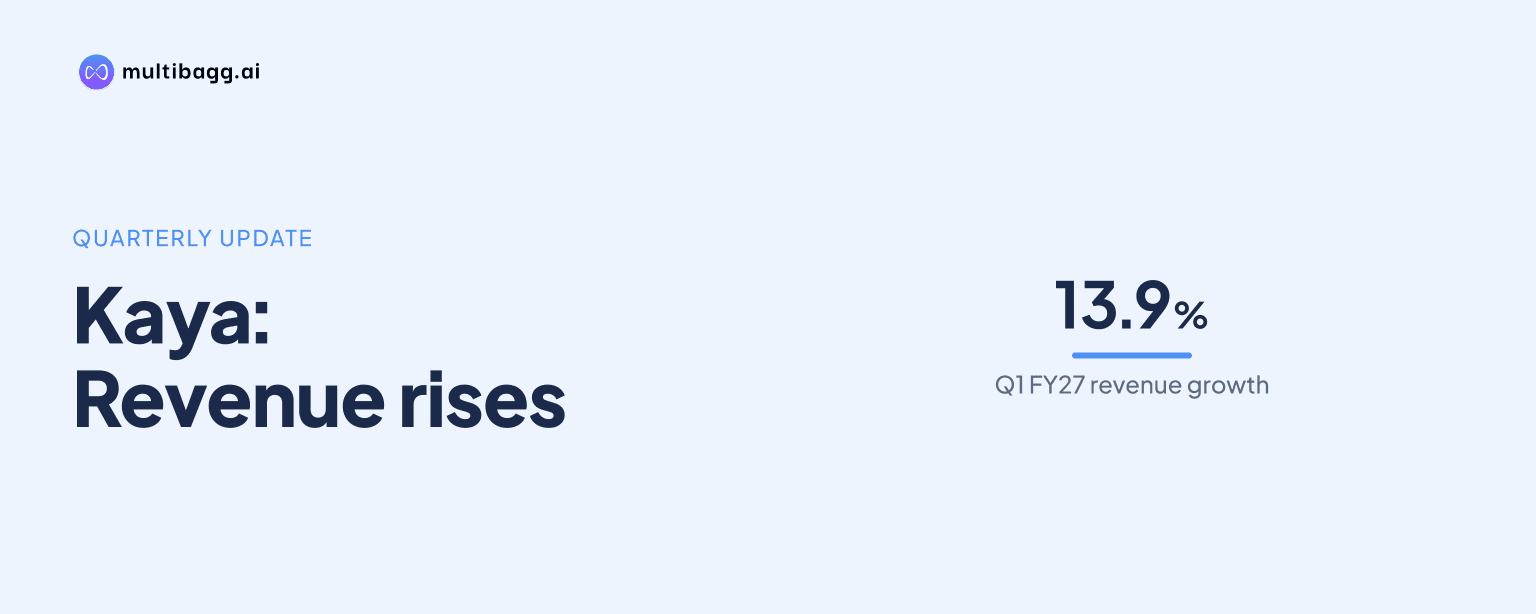
Kaya Limited received a Regulation 29(2) disclosure covering share acquisitions by Axana Estates LLP and Plutus Investments and Holdings Private Limited, while its Q1 FY27 revenue rose 13.9% year-on-year to ₹60.14 crore and standalone net loss widened to ₹15.18 crore.
Know Kaya inside out
Results, valuation, peers and who's buying, in one view.
What did Kaya Limited disclose about the share acquisition?
Kaya Limited said it had received a disclosure under Regulation 29(2) of the Securities and Exchange Board of India (Substantial Acquisition of Shares and Takeovers) Regulations, 2011. The disclosure relates to Axana Estates LLP and Plutus Investments and Holdings Private Limited acquiring shares in Kaya.
The information provided does not specify the number of shares acquired, the acquisition price, the transaction dates, or the post-acquisition holdings of the acquirers. It therefore establishes that a statutory shareholding disclosure was made, but does not provide enough detail to quantify the change in ownership or its financial value.
Regulation 29 covers disclosures linked to substantial acquisitions of shares or voting rights in listed companies. Such disclosures are relevant to investors because they report changes in holdings that may cross thresholds prescribed under takeover regulations. The filing itself does not state that Kaya's board, management structure, operations, or strategy will change as a result of the acquisition.
The disclosure comes during a period in which Kaya has also undertaken corporate actions, including approval of a preferential issue of 18.24 lakh equity shares. The company has separately stated that a planned fundraising through equity or debt was deferred until further notice. These matters should be assessed independently because the available information does not link the Regulation 29 filing to the preferential issue or the deferred fundraising plan.
How did Kaya perform in the June 2026 quarter?
Kaya reported revenue from operations of ₹60.14 crore in the quarter ended 30 June 2026, compared with ₹52.79 crore in the corresponding quarter a year earlier, representing 13.9% growth. The company described the quarter as Q1 FY27.
The clinic business recorded 16% revenue growth, while the skin business grew 19%, hair services grew 17%, and products grew 16%, according to the company. These operating metrics indicate that both clinic-led services and products contributed to the reported revenue increase.
Despite higher revenue, Kaya's standalone net loss widened to ₹15.18 crore from ₹14.07 crore in the year-earlier quarter. The company attributed the increase in loss to the impact of GST 2.0 changes on input tax credit availability. This means revenue growth did not translate into improved profitability during the period.
The reported earnings per share improved to a loss of ₹9.99 from a loss of ₹10.74 a year earlier. Operating margin was 6.0%, compared with 7.0% in the comparable quarter. The figures show that the business generated more revenue, but margins remained under pressure and the company continued to report a net loss.
Got a follow-up? Ask IRIS
Why is the disclosure relevant for Kaya investors?
The filing is relevant because it records a share acquisition by named entities under the takeover-disclosure framework. Shareholding disclosures allow investors to track material ownership changes using formal exchange filings rather than market speculation.
However, the information available does not identify whether the acquired shares were bought through market transactions, transferred privately, or issued by the company. It also does not provide the acquirers' combined holding before and after the transaction. Investors would need the detailed Regulation 29 disclosure to establish those facts.
For Kaya shareholders, the financial backdrop remains significant. The company recorded a full-year loss of ₹96.0 crore in FY26, followed by a ₹15.18 crore standalone loss in the first quarter of FY27. Revenue growth in the June quarter was supported by expansion across clinics, skin, hair, and products, but the GST-related input tax credit effect weighed on the bottom line.
The preferential issue approved by Kaya may also be relevant to capital structure analysis because it involves 18.24 lakh equity shares. Yet the supplied information does not state the issue price, the proposed allottees, or the potential dilution impact. The acquisition disclosure and the preferential issue should not be treated as the same transaction without supporting filing details.
What are the next reported milestones for Kaya?
Kaya has announced a board meeting on 6 November 2026 to consider unaudited standalone financial results for the quarter and half-year ended 30 September 2026. The board committees were also reconstituted with effect from 1 November 2026.
The next quarterly-results deadline cited for the July to September 2026 period is 14 November 2026. Listed companies are generally required to publish quarterly results within 45 days of the quarter-end, except for the January to March quarter, when the permitted period is 60 days.
Kaya's quarterly revenue history shows sales of ₹60 crore in both the March 2026 and June 2026 quarters in the data provided. Operating profit was ₹4 crore in the June 2026 quarter after a loss of ₹13 crore in March 2026. These figures provide operating context, although they are not a substitute for the company’s next audited or unaudited financial release.
The upcoming September-quarter results will provide the next official update on revenue growth, clinic and product performance, margins, and the continuing effect of GST-related input tax credit changes. The available information does not provide earnings guidance or a profitability target for the period.
Conclusion
Kaya's Regulation 29(2) disclosure confirms that Axana Estates LLP and Plutus Investments and Holdings Private Limited acquired shares in the company, although the available summary does not quantify their purchases or resulting ownership. At the same time, Kaya reported double-digit June-quarter revenue growth but remained loss-making, with standalone net loss widening to ₹15.18 crore.
The next item to watch is Kaya's board consideration of September-quarter and half-year results on 6 November 2026, with the stated reporting deadline of 14 November 2026. Investors will also need the complete share-acquisition disclosure and any subsequent filing to assess the extent and significance of the reported ownership change.