










Birla Corp expects Rs 100-a-tonne Q3 fuel-cost increase
Key highlights
- Birla Corp expects Q3 FY27 fuel costs to rise by about Rs 100 a tonne from Q2 FY27 levels.
- Birla Corp reported Q2 FY27 EBITDA of Rs 482 a tonne and capacity utilisation of 85%.
- Captive coal is expected to meet about 15% of Birla Corp's FY27 fuel requirement.
- Renewable power exceeded 32% in Q2 FY27, with management targeting 45% over the next year.
powered by IRIS
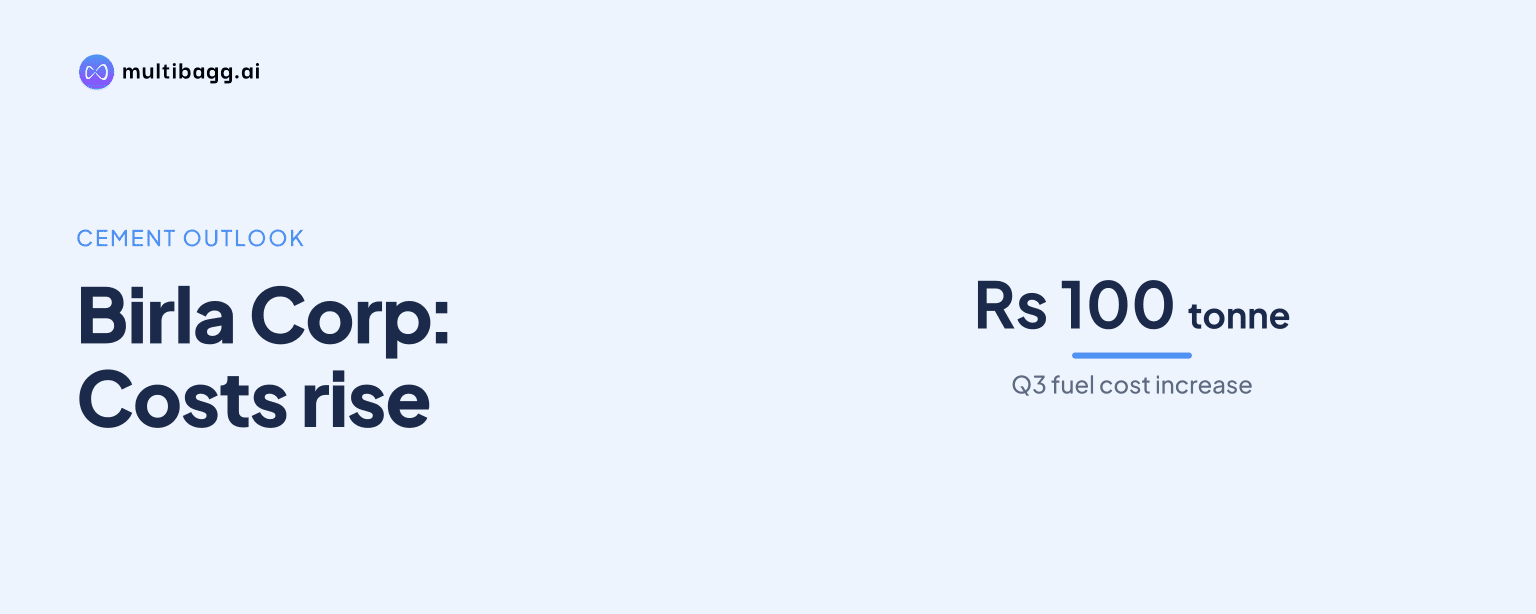
Birla Corporation Limited expects fuel costs to rise by about Rs 100 a tonne sequentially in Q3 FY27, after reporting EBITDA of Rs 482 a tonne in Q2 FY27, while management said its trade-heavy central-region sales mix restricts reliable price recovery. The company discussed the outlook on its November 2, 2026 earnings call.
Know Birla Corporation inside out
Results, valuation, peers and who's buying, in one view.
How much will Birla Corp's fuel cost rise in Q3 FY27?
Birla Corp expects fuel costs to increase by about Rs 100 a tonne in Q3 FY27 from Q2 FY27 levels. Group Chief Financial Officer Aditya Saraogi attributed the expected increase to higher international fuel prices and continued domestic coal-cost pressure, following sharp rises in pet coke and domestic coal during Q2.
Birla Corp reported Q2 FY27 EBITDA of Rs 482 a tonne, but management did not provide a Q3 EBITDA-per-tonne forecast. Managing Director and Chief Executive Officer Sandip Ghose said a high-season cement-price increase may recover the additional fuel cost, but the extent of recovery for profitability lost earlier cannot be predicted.
Management said a price movement of roughly Rs 5 to Rs 10 per bag may be possible in the high season, but such recovery depends on demand and competitors' actions. Ghose said the potential recovery of the Rs 100-a-tonne fuel increase differs from recovering margin pressure accumulated before Q3 FY27.
Why is Birla Corp's price recovery uncertain?
Birla Corp said price recovery is uncertain because its cement sales are heavily skewed towards trade channels and blended cement in central India. Management said trade prices in its core markets have remained depressed despite industry consolidation, as producers continue to seek or retain market share.
Non-trade prices in central India corrected towards the end of Q2 FY27 after falling sharply, but management said this offered Birla Corp limited benefit because of its lower non-trade exposure. October exit pricing had improved by around Rs 5 to Rs 7 per bag, although management said the October average increase was below that exit level.
Ghose also said the October price uptick was neither substantial nor necessarily durable if market conditions change. In the premium A-category segment, some market leaders that previously charged a premium had reduced their price positioning, adding to pressure on trade-market pricing.
What caused Birla Corp's Q2 FY27 cost increase?
Birla Corp said pet coke, domestic coal and packaging material were the main contributors to higher Q2 FY27 costs. Management linked pet coke inflation to geopolitical factors and said monsoon flooding at Coal India mines reduced domestic coal availability while high power-sector demand directed supply towards electricity producers.
The Q2 FY27 fuel mix left Birla Corp exposed to both imported and domestic fuel prices. Imported fuel, mainly pet coke and imported coal, accounted for about one-third of consumption, domestic purchased coal for about half, captive coal for around 13%, and alternative fuel and raw material, or AFR, for 4%.
Birla Corp also bought clinker from third parties in Q2 FY27 after a delayed planned shutdown carried into the quarter. Management said the clinker purchase affected per-tonne margins, whereas the difference between standalone and consolidated profitability also reflected differing fuel mixes at its operating units.
Got a follow-up? Ask IRIS
How is Birla Corp seeking to contain fuel costs?
Birla Corp is increasing production from its captive Bikram coal block to substitute higher-cost fuels. Management said coal extracted from Bikram in Q1 and Q2 FY27 was lower grade and suitable only for power plants, but the company is seeking better-grade coal that can also be used in kilns.
Captive coal is expected to meet about 15% of Birla Corp's fuel requirement in FY27, compared with the around 13% share in the Q2 FY27 fuel mix. Saraogi said captive coal was 20% to 25% cheaper than market-priced fuel as of the November 2 call, while also providing more consistent quality.
Birla Corp also plans to raise renewable power's share from more than 32% in Q2 FY27 to 45% over the next year. Management said it is separately increasing AFR usage across plants and may extend captive-mine coal use from Madhya Pradesh plants to Rajasthan plants, depending on fuel prices and overall optimisation.
What demand and pricing risks does Birla Corp see in H2 FY27?
Birla Corp sees weather conditions, the Uttar Pradesh election and large producers' market-share strategies as the main risks to H2 FY27 demand and pricing. Management cited drought conditions in parts of Maharashtra and Rajasthan, as well as earlier flooding in north Bihar and eastern Uttar Pradesh.
Ghose said an election can initially support activity, but demand can soften after the model code of conduct takes effect, particularly in non-trade sales. Management said Gujarat had renewed infrastructure activity and Rajasthan demand was holding up, but neither market was driving very large volume growth.
Birla Corp expects domestic coal prices to decline in Q4 FY27 if winter reduces power demand and Coal India subsidiary supply improves. Management did not expect comparable relief in pet coke, saying prices could remain at current levels or rise further in Q4 FY27.
Conclusion
Birla Corp enters Q3 FY27 with an expected Rs 100-a-tonne fuel-cost increase, an 85% Q2 FY27 capacity-utilisation level and constrained pricing flexibility in its trade-heavy central markets. Captive coal, renewable power and AFR use provide cost-management mechanisms, but their effect will need to contend with imported fuel and purchased domestic coal exposure.
The next indicators are whether high-season cement pricing recovers the expected Q3 fuel-cost increase, whether Bikram supplies kiln-suitable coal, and whether domestic coal prices ease in Q4 FY27 as management expects. Management's disclosed plan to lift renewable power above the Q2 FY27 level of 32% to 45% over the next year is another operational milestone to watch.