










Birla Corporation profit drops 59% as fuel costs climb sharply
Key highlights
- Birla Corporation’s Q2/FY27 net profit fell 58.9% year on year to Rs 37 crore, while revenue rose 9.3% to Rs 2,441 crore.
- Pet coke prices rose 64%, contributing to a 15% increase in power and fuel costs during the quarter.
- Cement sales volume increased 6.9% to 4.54 million tonnes, but Cement Division EBITDA per tonne fell 32.3% to Rs 482.
- Birla Corporation’s Jute Division revenue rose 17% to Rs 155 crore, while cash profit increased to Rs 13.01 crore.
powered by IRIS
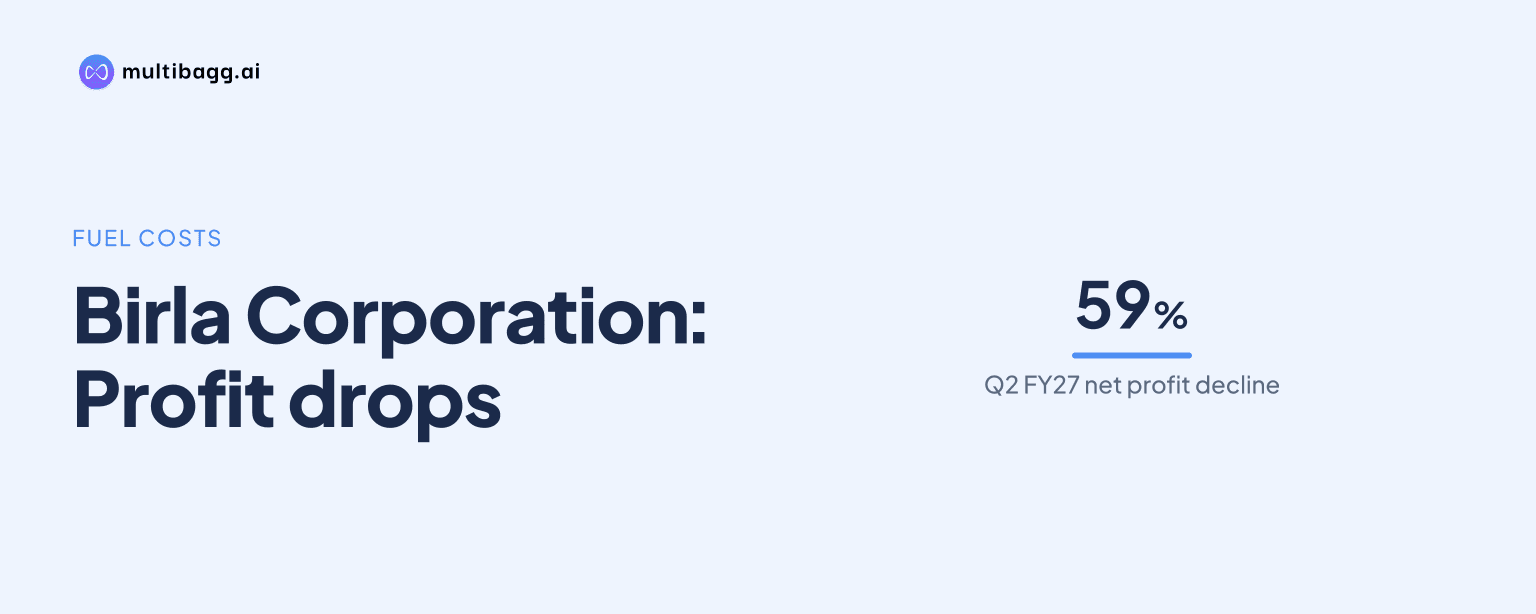
Birla Corporation Limited reported consolidated net profit of Rs 37 crore for Q2/FY 26-27, down 58.9% from Rs 90 crore a year earlier, as a 64% rise in pet coke prices lifted power and fuel cost 15%. Revenue grew 9.3% to Rs 2,441 crore, but Cement Division EBITDA per tonne fell 32.3% to Rs 482.
Know Birla Corporation inside out
Results, valuation, peers and who's buying, in one view.
How did Birla Corporation’s September-quarter earnings change?
Birla Corporation’s consolidated profit fell even as revenue increased in the second quarter of financial year 2026-27 (Q2/FY 26-27). Earnings before interest, tax, depreciation and amortisation (EBITDA) declined 23.6% year on year to Rs 254 crore from Rs 332 crore, while cash profit decreased 28.3% to Rs 190 crore from Rs 265 crore. Net profit dropped to Rs 37 crore from Rs 90 crore.
Revenue rose 9.3% to Rs 2,441 crore in Q2/FY 26-27 from Rs 2,233 crore in Q2/FY 25-26. In the first half of FY27 (H1FY27), revenue increased 8.3% to Rs 5,111 crore from Rs 4,720 crore, while EBITDA fell 12.8% to Rs 619 crore and net profit declined 27.1% to Rs 153 crore. The two periods show revenue growth alongside lower reported profitability.
The Cement Division’s EBITDA margin was 9.8% in Q2/FY 26-27, down 490 basis points from a year earlier. Cement capacity utilisation remained at 85%, unchanged from Q2/FY 25-26, meaning the decline in earnings occurred while plant utilisation was steady. H1FY27 capacity utilisation was 91%, compared with 92% in H1FY26.
Why did Birla Corporation’s cement profitability decline?
Birla Corporation’s cement profitability declined because cost increases exceeded the gain in cement realisation. Clinker cost rose 13% year on year and power and fuel cost rose 15% during the September quarter, after pet coke prices increased 64%. Cement Division EBITDA per tonne consequently fell to Rs 482 from Rs 712, a decline of 32.3%.
Cement sales volume grew 6.9% to 4.54 million tonnes in Q2/FY 26-27 from 4.25 million tonnes a year earlier. Realisation increased 1.7% to Rs 4,925 per tonne from Rs 4,845, but it was marginally lower sequentially as cement prices weakened in July and August in core markets. The company also cited excessive rainfall that disrupted construction activity in those markets.
Industry realisation declined 3% in eastern India during the full quarter and was flat in central India, while the west and north recorded modest improvement. For H1FY27, Birla Corporation’s cement volume rose 6.1% to 9.59 million tonnes from 9.04 million tonnes, and realisation rose 1.7% to Rs 4,934 per tonne. Yet EBITDA per tonne declined 18.3% to Rs 583 from Rs 714.
Birla Corporation increased green-power consumption to 32% in the September quarter from 30% a year earlier to mitigate cost pressure. It also began extracting coal from its Bikram coal mine in Madhya Pradesh during the quarter. Production is being ramped up, with the mine expected to supply 180,000 tonnes in the second half of the current financial year.
Got a follow-up? Ask IRIS
What products and channels drove Birla Corporation’s cement sales?
Birla Corporation increased premium-product and trade-channel sales during Q2/FY 26-27, while blended cement remained its largest product category. Blended cement accounted for 86% of total cement sales, compared with 89% in Q2/FY 25-26, and its volume rose 4% year on year. The company reported significant gains in Maharashtra, Uttar Pradesh, Bihar and Rajasthan.
Sales from the newly commissioned Kundanganj and Mukutban facilities rose 20% and 8%, respectively, in the September quarter. Premium-product volume increased 17% to 2.38 million tonnes from 2.02 million tonnes. Perfect Plus, Birla Corporation’s flagship brand, recorded 21% year-on-year sales growth.
Premium cement accounted for 64% of Birla Corporation’s trade-channel sales, up from 61% a year earlier. The trade channel itself represented 82% of total sales, compared with 79% in Q2/FY 25-26. In H1FY27, the trade-channel share was 82% against 78%, while premium cement accounted for 63% of trade-channel sales against 59% in H1FY26.
These product and channel shifts coincided with a 1.7% increase in quarterly cement realisation, but did not offset higher inputs. Cement EBITDA per tonne declined by Rs 230, from Rs 712 to Rs 482, as clinker cost increased 13% and power and fuel cost increased 15%. The company said subdued prices prevented full recovery of the input-cost increase.
How did Birla Corporation’s jute business perform?
Birla Corporation’s Jute Division raised revenue and profit despite lower production caused by raw-jute shortages. Production volume declined 26% year on year after Birla Jute reduced working days in response to supply constraints. Revenue nevertheless rose 17% to Rs 155 crore from Rs 132 crore because of better price realisation.
Jute Division cash profit increased to Rs 13.01 crore in the September quarter from Rs 4.64 crore a year earlier, while operating profit rose to Rs 6.16 crore from Rs 4.02 crore. Export sales grew 143% and shopping-bag sales increased 64%. This contrasted with the Cement Division, where sales volume rose 6.9% but EBITDA per tonne fell 32.3%.
Conclusion
Birla Corporation’s Q2/FY 26-27 results show that higher cement volume, premium-product sales and consolidated revenue did not compensate for input inflation. Revenue rose 9.3% to Rs 2,441 crore and cement sales reached 4.54 million tonnes, but the rise in pet coke prices contributed to a 15% increase in power and fuel cost and a 58.9% fall in net profit.
What to watch next is whether improving cement realisation and coal output from Bikram reduce the cost burden. Birla Corporation said cement realisation started improving from October as construction activity regained momentum, although it expects cost pressure to persist. Management expects the mine to deliver 180,000 tonnes of coal in the second half of the current financial year and significantly reduce fuel cost.