










Bondada Has 1.27 GWh of BESS Orders Across Five Projects
Key highlights
- Bondada has 1.27 GWh of BESS orders under execution across five projects.
- LFP projects represent 1.05 GWh of Bondada's disclosed storage capacity.
- APTRANSCO's 225 MW, 450 MWh project is the largest individual BESS system disclosed.
- TNGECL and APTRANSCO together account for 425 MW and 850 MWh of BESS capacity.
powered by IRIS
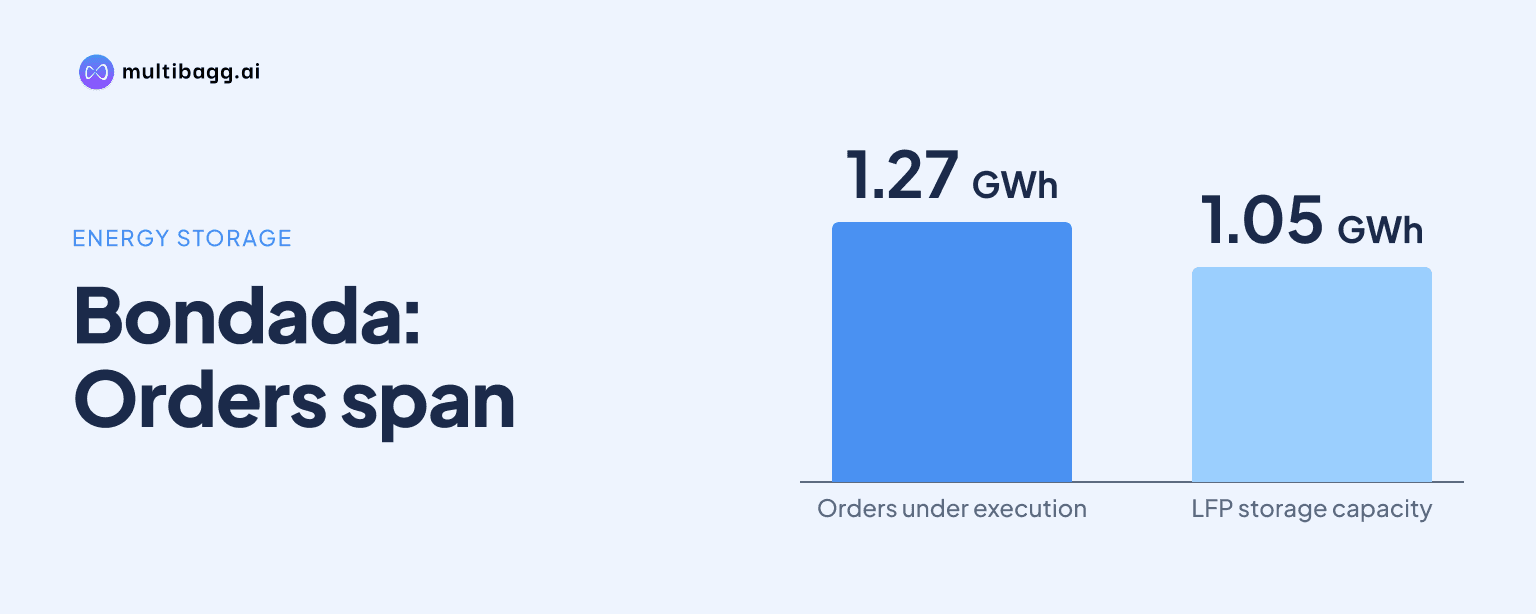
Bondada Group has 1.27 GWh of battery energy storage system orders under execution across five projects, led by 1.05 GWh of LFP capacity and 220 MWh of vanadium redox flow battery capacity. The portfolio is listed against TNGECL, APTRANSCO, NTPC and GIPCL, with individual projects ranging from 100 MWh to 450 MWh.
Know Bondada Engineering inside out
Results, valuation, peers and who's buying, in one view.
What BESS orders does Bondada have under execution?
Bondada has disclosed 1.27 GWh, or 1,270 MWh, of battery energy storage system (BESS) orders in hand that are under execution. The five projects total 511.6 MW of power capacity and comprise three LFP projects totalling 475 MW and two vanadium redox flow battery (VRFB) projects totalling 36.6 MW. The presentation identifies BESS as a strategic move to support renewable-energy integration and manage peak demand.
The largest individual project listed is a 225 MW, 450 MWh LFP system for APTRANSCO, followed by a 200 MW, 400 MWh LFP system for TNGECL. The other LFP project is a 50 MW, 200 MWh system for NTPC. The two VRFB projects add 220 MWh, comprising a 16.6 MW, 100 MWh NTPC project and a 20 MW, 120 MWh GIPCL project.
How do Bondada's LFP and VRFB projects compare?
Bondada's LFP portfolio totals 1,050 MWh across three projects, compared with 220 MWh across two VRFB projects. The 450 MWh APTRANSCO project is the largest LFP system, while the 120 MWh GIPCL project is the larger of the two VRFB systems. The presentation describes the NTPC and GIPCL VRFB opportunities as India's largest tenders for that technology.
The two technologies also differ in their power ratings. LFP accounts for 475 MW of the disclosed 511.6 MW total, including all three projects rated at 50 MW or more. VRFB accounts for 36.6 MW, although its 220 MWh capacity means that the 16.6 MW NTPC and 20 MW GIPCL projects still form a defined part of Bondada's 1.27 GWh orders-under-execution total.
NTPC is the only utility listed in both technology segments. Its 50 MW, 200 MWh LFP project and 16.6 MW, 100 MWh VRFB project together amount to 300 MWh. By comparison, TNGECL and APTRANSCO together account for 850 MWh, consisting of the 200 MW, 400 MWh and 225 MW, 450 MWh LFP projects respectively.
Which utilities are linked to Bondada's BESS projects?
Bondada lists TNGECL, APTRANSCO, NTPC and GIPCL across the five BESS projects. TNGECL and APTRANSCO are also identified as offtakers for a 425 MW, 850 MWh utility-scale BESS project shown in the presentation, where the stated roles are grid balancing, peak-load support and renewable-energy integration.
The disclosed capacities are unevenly distributed among the four utilities. APTRANSCO's 450 MWh project is 50 MWh larger than TNGECL's 400 MWh project, while NTPC's two projects total 300 MWh and GIPCL's project is 120 MWh. The presentation does not disclose contract values, BESS tariff figures, project-specific execution dates or completion milestones for the five projects.
The 850 MWh TNGECL and APTRANSCO block represents the largest grouping in the portfolio and is mapped to LFP technology in the project list. NTPC's 300 MWh allocation spans both LFP and VRFB, whereas GIPCL is listed only with a 20 MW, 120 MWh VRFB system. This creates a technology mix across utilities rather than a single battery format for the full 1.27 GWh pipeline.
Got a follow-up? Ask IRIS
What roles does Bondada intend to perform in BESS?
Bondada presents three BESS roles: build, own and operate (BOO), engineering, procurement and construction (EPC), and operations and maintenance (O&M). The presentation does not assign a specific BOO, EPC or O&M role to each of the five projects, but lists the three models alongside the 1.27 GWh orders-under-execution disclosure.
The storage plan sits within Bondada's stated transition from EPC contracting towards ownership of long-term annuity assets. The presentation says BESS tariffs, solar power-purchase agreements and fibre contracts can add recurring cash flows, but it does not provide a BESS tariff, ownership percentage, operating period or maintenance term for the 1.27 GWh portfolio.
Bondada's wider asset-ownership disclosures include the 27 July 2026 acquisition of a 60% controlling interest in Onix IPP Pvt Ltd, which holds a 225 MW alternating-current solar portfolio in Maharashtra. That portfolio has a 25-year power-purchase agreement with MSEDCL. The solar transaction demonstrates the ownership model referred to in the presentation, but no equivalent ownership terms are disclosed for the BESS projects.
How does BESS fit into Bondada's wider expansion plan?
Bondada positions BESS alongside renewable energy, telecom, data-centre services, railways, defence and product manufacturing. Its renewable-energy offering includes solar independent power producer and EPC work, while its BESS offering is described as eco-friendly storage solutions on an independent power producer model with technology partners for batteries. The 1.27 GWh project total provides an identified order base for that storage offering.
The presentation links storage with grid-scale renewable deployment, policy-driven tenders and peak-demand management. The 425 MW, 850 MWh TNGECL and APTRANSCO project is specifically associated with grid balancing and renewable-energy integration, while the full five-project list adds the 50 MW, 200 MWh LFP system and two VRFB systems for NTPC and GIPCL.
Bondada also disclosed PhotonicGrid Networks Pvt Ltd as a new fibre build, own and operate subsidiary on 3 September 2026. PhotonicGrid is described as pre-operative and due to start after telecom licences, whereas the BESS portfolio is expressly labelled as orders in hand under execution. The presentation gives a defined 1.27 GWh capacity figure for storage but no operating or revenue date for either the fibre venture or individual BESS projects.
Conclusion
Bondada's disclosed storage programme consists of five projects totalling 1.27 GWh, split between 1.05 GWh of LFP capacity and 220 MWh of VRFB capacity. The 850 MWh TNGECL and APTRANSCO grouping is the largest disclosed block, while NTPC appears in both technologies with 300 MWh. The company links the projects to grid balancing, peak demand and renewable-energy integration.
The next issue to watch is whether Bondada maps BOO, EPC and O&M responsibilities to individual projects, because it presents all three models without project-level assignments. Execution updates, tariffs, commissioning schedules and ownership terms would also clarify how the 1.27 GWh orders support the company's stated plan to build long-term annuity assets.