










Borosil Renewables Q2 Profit Rises as Margins Face Pressure
Key highlights
- Borosil Renewables reported Q2 FY27 standalone revenue of ₹396.2 crore, up 4.7% year on year.
- Reported Q2 FY27 EBITDA was ₹116.3 crore, while EBITDA margin fell 440 basis points to 28.6%.
- Solar-glass volumes declined 4.5% during Q2 FY27, with maintenance causing an estimated ₹15 crore revenue loss.
- The company expects to commission its 600-tonnes-per-day expansion by the end of Q4 FY27, taking capacity to 1,600 tonnes per day.
powered by IRIS
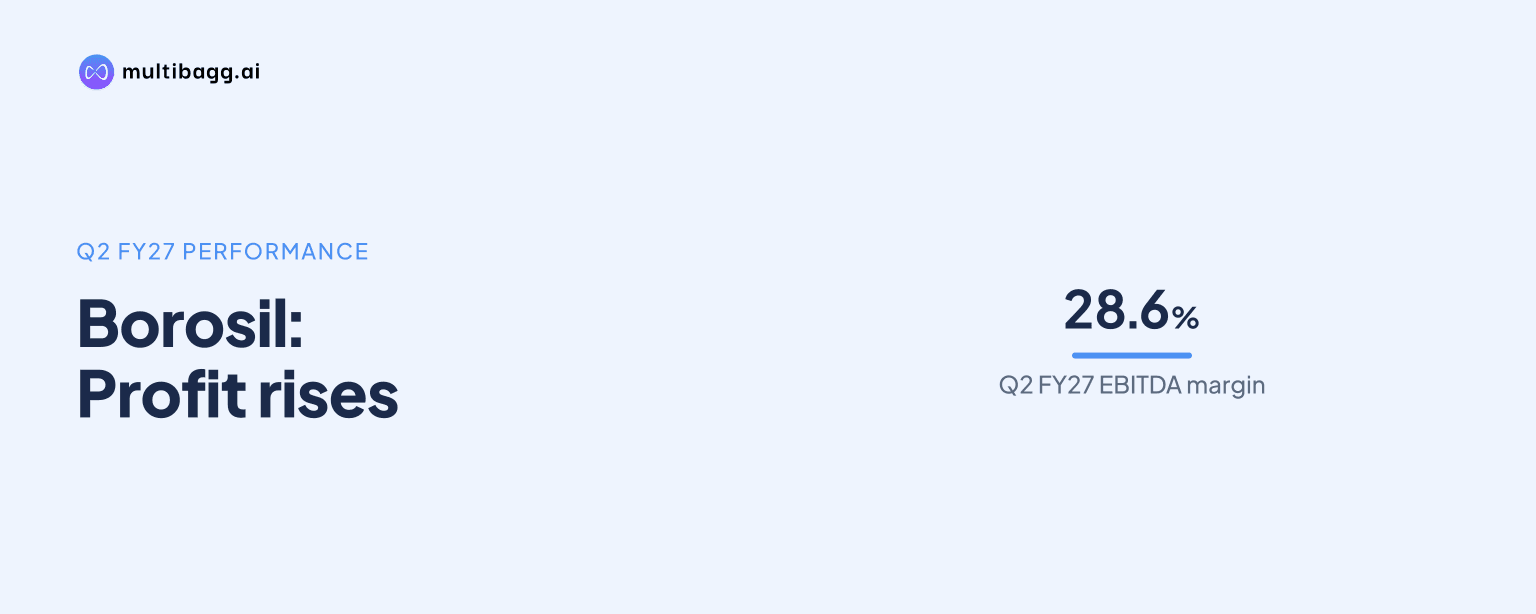
Borosil Renewables Limited reported Q2 FY27 revenue of ₹396.2 crore, up 4.7% year on year, while PAT rose 53.1% to ₹70.1 crore, even as furnace maintenance, a lower fuel surcharge and higher input costs reduced operating margins.
Know Borosil Renewables inside out
Results, valuation, peers and who's buying, in one view.
What did Borosil Renewables report in Q2 FY27?
Borosil Renewables reported standalone revenue from operations of ₹396.2 crore for the quarter ended September 2026, compared with a year earlier, according to its Q2 FY27 investor presentation. The reported revenue included ₹14.1 crore from solar kits. Consolidated net revenue was ₹396.7 crore, reflecting the company’s reported standalone business and overseas operations.
EBITDA in the investor presentation was ₹116.3 crore, down 7.3% year on year, with an EBITDA margin of 28.6%. PAT rose to ₹70.1 crore, up 53.1% year on year. Separately, the supplied results summary cited consolidated net profit of ₹68.8 crore, up 11.7% year on year. The difference reflects the use of separate reported standalone and consolidated figures across the provided materials.
For the first half of FY27, standalone sales were ₹801.8 crore, including ₹15.4 crore from solar kits, up 12.8% from ₹710.7 crore in H1 FY26. H1 EBITDA increased 18.5% to ₹258.3 crore from ₹218 crore. The half-year figures indicate that the first-quarter performance helped offset the operational disruption seen in the September quarter.
Why did Borosil Renewables' margins decline during the quarter?
Margins declined because furnace maintenance reduced production, while pricing and costs moved unfavourably during the quarter. Management said solar-glass volumes fell 4.5% in Q2 FY27 because of furnace maintenance, leading to an estimated revenue loss of about ₹15 crore. The company also reported a 2.8% decline in average solar-glass realisation.
Chief Executive Officer Melvin Moses said average realisation was ₹155.9 per square metre in Q2 FY27, compared with ₹160.3 per square metre in Q1 FY27. This decline followed a partial rollback of the fuel surcharge in July when gas prices temporarily eased. Gas prices later rose again, increasing operating costs.
The company said solar-glass EBITDA margin was 30.4% in Q2 FY27, compared with 33.0% in Q2 FY26 and 33.8% in Q1 FY27. Soda ash prices increased 10%, while freight costs for imported dolomite and limestone also rose. Management said these cost increases did not have a pass-through mechanism during the quarter.
Overseas subsidiaries remained a drag on consolidated performance. They did not generate net revenue in Q2 FY27 and reported negative EBITDA of ₹0.11 crore, according to the supplied call highlights. This limited the contribution from operations outside the domestic solar-glass business.
How is production recovering after furnace maintenance?
Production recovered gradually from mid-September and reached levels above the company’s previous records in October, according to management. The improvement followed completion of the maintenance-related disruption that had constrained Q2 volumes. The company indicated that October production was exceptionally strong and expected the higher operating level to continue.
Management also said the fuel surcharge had been restored after gas prices resurged. Based on improved production and the surcharge restoration, it expects solar-glass margins to recover to more than 31% by the end of the current quarter. This is management guidance, rather than a reported financial result.
The recovery is relevant because Q2 sales of ₹396.2 crore were lower than the ₹405.7 crore quarterly sales figure cited for Q1 FY27 in the earnings-call material. The company’s operating performance in the next quarter will depend on sustained furnace output, input costs and the effectiveness of the restored surcharge in covering higher energy expenses.
Got a follow-up? Ask IRIS
What is Borosil Renewables' solar-glass expansion plan?
Borosil Renewables is adding 600 tonnes per day of production capacity at its existing location, a 60% expansion that would raise total solar-glass capacity to 1,600 tonnes per day. The company expects commissioning towards the end of Q4 FY27, which corresponds with its stated March 2027 timeline.
Management said full funding for the expansion is in place and that it does not expect further dilution for the project. The company has stated a post-expansion turnover target of ₹2,500 crore, although no timeframe beyond the completion of the expansion was specified in the supplied material.
The investment is being pursued against a domestic supply-demand gap in solar glass. Management said domestic module capacity stood at 233 GW, while annual installations were 62 GW. The company described domestic demand as robust and said the gap supported the need for additional domestic solar-glass production.
What does the quarter mean for investors and the solar-glass market?
The quarter shows that Borosil Renewables remained profitable and expanded revenue despite a temporary operational disruption, but its margins were sensitive to production availability, gas prices and imported raw-material costs. Revenue growth of 4.7% and a 53.1% increase in the reported PAT were accompanied by a 440-basis-point decline in reported EBITDA margin.
For investors, the key operating indicators are furnace utilisation, average realisation, fuel-surcharge recovery and progress on the 600-tonnes-per-day expansion. The domestic solar market backdrop remains supportive based on the module-capacity and installation figures cited by management. However, the supplied information also shows that input costs and overseas subsidiary losses can affect consolidated earnings.
The company made the audio recording of its October 30, 2026 investor call, which covered results for the quarter ended September 2026, available on its investor website and informed BSE. Management participants on the call included Executive Chairman P. K. Kheruka, Director Ashok Jain, Chief Executive Officer Melvin Moses and Chief Financial Officer Sunil Roongta.
Conclusion
Borosil Renewables delivered higher Q2 FY27 revenue and reported PAT despite lower solar-glass volumes during furnace maintenance and pressure from pricing and costs. The results underline the importance of stable production and energy-cost recovery to margins, while the H1 figures show growth in sales and EBITDA over the prior-year period.
The next disclosed milestone is commissioning of the 600-tonnes-per-day capacity addition towards the end of Q4 FY27, with the company targeting total capacity of 1,600 tonnes per day by March 2027. Investors will also watch whether the October production recovery and restored fuel surcharge support management’s expectation of solar-glass margins above 31% by the end of the current quarter.