










BPL says due preference shares remain unredeemed for lack of profits
Key highlights
- BPL said due preference shares remain unredeemed because profits were insufficient under Section 55.
- BPL reported a Rs 8.7327 crore consolidated loss for the six months ended September 30, 2026.
- Revenue from operations rose to Rs 45.8154 crore from Rs 39.316 crore a year earlier.
- BPL recorded Rs 8.6637 crore of non-cash effective-interest expense on intercompany borrowing.
powered by IRIS
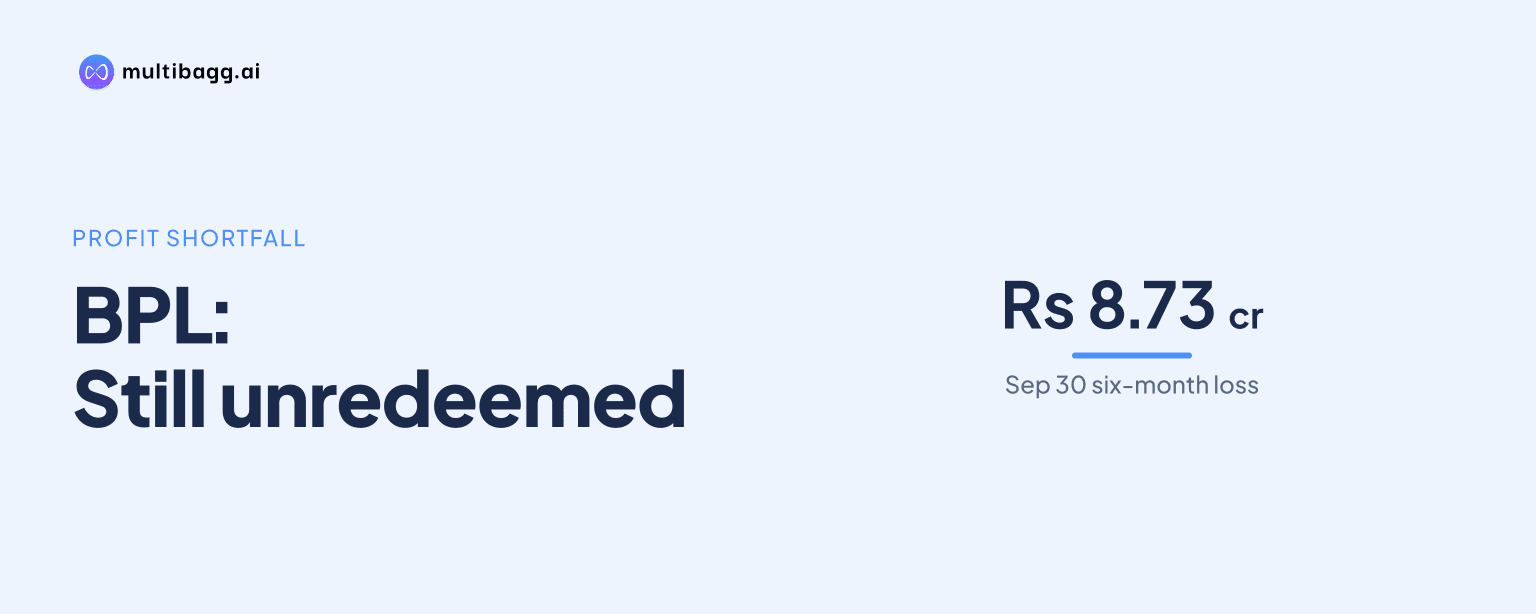
BPL Limited said preference shares that had become due remained unredeemed at September 30, 2026 because profits were insufficient, while the group reported a consolidated loss of Rs 8.7327 crore for the six months ended that date. The company cited Section 55 of the Companies Act, 2013 as the basis for the non-redemption.
Know BPL inside out
Results, valuation, peers and who's buying, in one view.
Why has BPL not redeemed its due preference shares?
BPL said its preference shares had become due but had not been redeemed owing to insufficient profits, as provided under Section 55 of the Companies Act, 2013. The statement appears in Note 8 to the consolidated unaudited financial results for the six months ended September 30, 2026, which the board took on record on November 2, 2026.
The filing does not state the number of preference shares outstanding, their redemption value, their issue terms or the date on which they fell due. It also does not set a redemption timetable or quantify the profits required for redemption. The disclosure therefore establishes the stated reason for non-redemption at September 30, rather than a plan for resolving it.
BPL prepared the results under Indian Accounting Standards, or Ind AS, and stated that the reporting format had been modified to align with applicable Securities and Exchange Board of India, or SEBI, requirements and Schedule III of the Companies Act. The auditor's limited review report specifically referred to the disclosures in Notes 8 and 10 as at September 30, 2026.
What financial results accompanied BPL's preference-share disclosure?
BPL reported a consolidated loss of Rs 8.7327 crore for the six months ended September 30, 2026, compared with a profit of Rs 2.5448 crore in the corresponding six months of 2025-26. Revenue from operations rose to Rs 45.8154 crore from Rs 39.316 crore, but the increase in revenue did not prevent the reported loss.
The group recorded a Rs 8.6637 crore non-cash effective-interest expense on intercompany borrowing during the six-month period. Before that charge, BPL reported a loss before exceptional items and tax of Rs 6.90 lakh, compared with a profit of Rs 2.5448 crore a year earlier. The filing identifies the effective-interest charge as a non-operating, non-cash finance cost.
The September 2026 quarter produced a loss of Rs 5.1902 crore after a loss of Rs 3.5425 crore in the June 2026 quarter. Quarterly revenue from operations increased to Rs 24.4223 crore in the September quarter from Rs 21.3932 crore in June and Rs 19.839 crore in the September 2025 quarter. The results show higher revenue alongside losses in both quarters of the first half.
Which BPL segments changed during the first half?
BPL's consumer segment revenue rose to Rs 39.9505 crore in the first half of 2026-27 from Rs 30.133 crore in the corresponding prior-year period, while brand licensing revenue declined to Rs 5.8649 crore from Rs 9.183 crore. Consumer operations accounted for most of the increase in group revenue during the period.
Consumer segment result increased to Rs 1.922 crore from Rs 1.88 crore a year earlier. Brand licensing, however, recorded a segment loss of Rs 4.09 crore, compared with segment profit of Rs 81 lakh in the prior-year six months. Other unallocated income was Rs 2.02 lakh, down from Rs 53.50 lakh.
The contrast between the two operating segments is visible in the revenue and result figures. Consumer revenue increased by Rs 9.8175 crore, whereas brand licensing revenue declined by Rs 3.3181 crore. The filing does not explain the operational causes of either movement, but it records a shift from a profit to a loss in brand licensing.
Got a follow-up? Ask IRIS
How does intercompany interest affect BPL's cash flows?
BPL recorded Rs 8.66 crore of interest on intercompany borrowing as a non-cash expense under the effective-interest method required by Ind AS 109. The company said the interest is payable only at maturity and is added back under operating activities and adjusted under financing activities in the cash-flow statement, in line with Ind AS 7.
The cash-flow statement reported cash generated from operations of Rs 8.4296 crore for the six months ended September 30, 2026, compared with cash used in operating activities of Rs 85.787 crore for the full year ended March 31, 2026. BPL reported net cash used in financing activities of Rs 9.4041 crore in the half year, including the non-cash effective-interest adjustment and finance cost paid of Rs 74.46 lakh.
Cash and cash equivalents rose to Rs 2.1991 crore at September 30, 2026 from Rs 1.0802 crore at the beginning of the year, an increase of Rs 1.119 crore. The source distinguishes the cash-flow treatment of the intercompany interest from its profit-and-loss treatment, but does not disclose the borrowing's principal amount or maturity date.
What liabilities and proceedings has BPL disclosed?
BPL reported contingent liabilities of Rs 88.84 crore as at September 30, 2026. The company also disclosed that an unsecured creditor had obtained an arbitral award of Rs 27.98 crore together with interest, and that BPL paid Rs 72 crore to the creditor in November 2024 and a further Rs 96 crore before the proceedings described in the note.
BPL said it disputes the creditor's computation of interest before an appropriate jurisdiction, meaning the claim cannot presently be quantified. The filing also says the same unsecured creditor filed an arbitration petition against BPL and others concerning a loan availed by BPL to make the Rs 96 crore payment; those proceedings remained in progress on November 2, 2026.
ARCIL has lodged a claim before the Debt Recovery Tribunal, or DRT, based on a corporate guarantee issued on behalf of BPL Display Devices Limited, which is in liquidation. The matter remained pending before courts, and BPL did not state an amount for the ARCIL claim. Separately, the company said Ramagundam Power Generation Private Limited had not commenced commercial operations, although management considered that subsidiary a going concern because underlying assets were available.
Conclusion
BPL's disclosure combines a capital-structure constraint with a loss-making first half. Due preference shares remained unredeemed because the company said profits were insufficient, while the group moved from a Rs 2.5448 crore profit in the comparable prior-year half to a Rs 8.7327 crore loss. Revenue increased, led by consumer operations, but brand licensing moved into a loss and the accounts included Rs 8.6637 crore of non-cash effective-interest expense.
The next stated financial milestone is the end of 2026-27, when BPL says it will make provisions for deferred tax, current tax and employee benefits under Ind AS 12 and Ind AS 19. Investors can also watch for company disclosures on any preference-share redemption action and developments in the creditor interest dispute, related arbitration and ARCIL proceeding.