










BSE Limited Q2 Profit Rises 44.9% as Revenue Gains 34.1%
Key highlights
- BSE reported Q2 FY27 consolidated net profit of ₹809.15 crore, up 44.9% year-on-year.
- Revenue from operations rose 34.1% year-on-year to ₹1,432.66 crore in Q2 FY27.
- Transaction charges increased 42% to ₹1,127.8 crore during the September 2026 quarter.
- BSE's EBITDA margin expanded to 68.7% from 64.66% a year earlier.
powered by IRIS
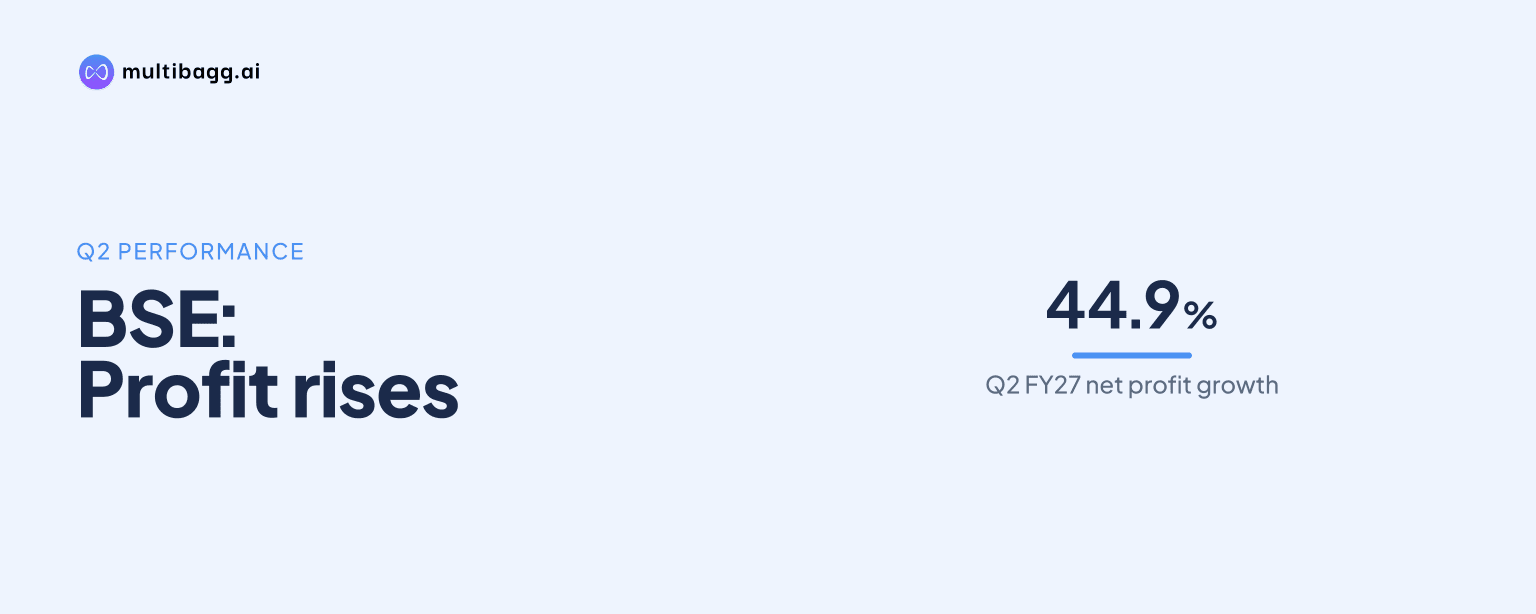
BSE Limited reported consolidated net profit of ₹809.15 crore for Q2 FY27, up 44.9% year-on-year, as revenue from operations increased 34.1% to ₹1,432.66 crore in the July-September 2026 quarter. The result reflects higher transaction charges and activity in equity derivatives, although earnings were lower than the preceding June quarter.
Know BSE inside out
Results, valuation, peers and who's buying, in one view.
What did BSE report for Q2 FY27?
BSE reported year-on-year growth in revenue, operating profit and net profit for the quarter ended September 30, 2026. Consolidated revenue from operations rose to ₹1,432.66 crore from ₹1,068.39 crore in Q2 FY26. Consolidated net profit increased to ₹809.15 crore from ₹558.43 crore in the year-ago quarter.
The exchange also reported net profit from continuing operations of ₹807.52 crore, compared with ₹557.02 crore a year earlier. Total income increased 36% year-on-year to ₹1,550.5 crore. The differences in reported profit figures reflect the separate metrics disclosed in the results material, while both indicate a roughly 45% increase over the corresponding quarter last year.
On a standalone basis, BSE's profit after tax rose 50.3% to ₹773.4 crore from ₹514.5 crore. Standalone revenue from operations increased 38.3% to ₹1,349.3 crore, compared with ₹975.5 crore in Q2 FY26.
Which business drivers supported BSE's revenue growth?
Higher transaction charges were the principal disclosed contributor to BSE's quarterly revenue growth. Transaction charges rose 42% year-on-year to ₹1,127.8 crore in Q2 FY27 from ₹794 crore in Q2 FY26, supported by increased activity in equity derivatives and related trading and settlement activity.
Operating revenue growth was accompanied by an increase in costs, though expenses grew more slowly than revenue. Total operating expenses rose 21% year-on-year to ₹494.7 crore from ₹410.1 crore. BSE said its first-half operating expenses included regulatory fees and clearing and settlement expenses, which are directly linked to transaction volumes.
Treasury income on clearing and settlement funds moved in the other direction. It declined 14% year-on-year to ₹36.5 crore from ₹42.8 crore. The fall did not prevent overall revenue and profit from increasing because transaction-led income grew substantially during the quarter.
How did BSE's profitability change during the quarter?
BSE's EBITDA increased 42.4% year-on-year to ₹984 crore from ₹690.9 crore, and the EBITDA margin expanded to 68.7% from 64.66%. The margin expansion shows that revenue growth outpaced the increase in operating expenses in the September quarter.
The company separately reported operating EBITDA, including its contribution to the core settlement guarantee fund, of ₹973.1 crore, up about 43% year-on-year from ₹680.26 crore. The corresponding margin was reported at 68%, compared with 64% a year earlier. These disclosures point to improved operating profitability despite the higher regulatory and clearing-related cost base.
BSE's performance was softer on a sequential basis after the record June quarter. Revenue declined 8.5% from ₹1,566.02 crore in Q1 FY27, net profit fell 7.4% from ₹874.02 crore, and EBITDA decreased 8.2% from ₹1,071.9 crore. However, EBITDA margin edged up from 68.45% in Q1 FY27 to 68.7% in Q2 FY27.
Got a follow-up? Ask IRIS
What do BSE's first-half figures show?
BSE's first-half FY27 results show continued growth across its transaction-led businesses. Consolidated revenue for April to September 2026 stood at ₹3,257 crore, compared with ₹2,184 crore in the corresponding period a year earlier, a reported increase of 49%.
Operational revenue rose 48% to ₹2,999 crore from ₹2,026 crore in the first half. Transaction charges across equity cash, equity derivatives, mutual funds and clearinghouse activities increased 60% to ₹2,456 crore from ₹1,531 crore. Other operating income, which includes data distribution, colocation, order throttle charges and index services, increased 23% to ₹200 crore.
For the half year, operating expenses rose 36% to ₹980 crore from ₹721 crore. Operating EBITDA, including the core settlement guarantee fund contribution, increased 55% to ₹2,019 crore, while the margin expanded to 67% from 64%. Net profit attributable to shareholders rose 53% to ₹1,680 crore from ₹1,095 crore.
What does the result mean for investors and market participants?
For investors, the quarter highlights BSE's reliance on transaction-linked income, particularly charges generated across trading and clearing activity. The 42% growth in transaction charges exceeded the 34.1% rise in total revenue, while operating expenses increased 21%, supporting the reported improvement in EBITDA margin.
For market participants, higher activity in equity derivatives and other transaction segments supported exchange revenues during the quarter. At the same time, the quarter-on-quarter moderation in revenue, profit and EBITDA indicates that the September-quarter figures were below the June-quarter levels, even as year-on-year growth remained strong.
The board also approved the appointment of Ashutosh Singh as Executive Director. No further details on the appointment's terms or responsibilities were provided in the supplied results information.
Conclusion
BSE delivered a strong year-on-year Q2 FY27 performance, with consolidated revenue from operations rising 34.1% to ₹1,432.66 crore and consolidated net profit increasing 44.9% to ₹809.15 crore. Growth in transaction charges, alongside operating expense growth that was slower than revenue growth, supported higher operating margins.
The next disclosed reference point is the company's subsequent quarterly performance, particularly whether transaction-led revenue, equity derivatives activity and operating margins remain at levels that support the first-half FY27 growth trend. Investors will also track the effect of transaction-volume-linked regulatory and clearing costs on profitability.