










CAMS sees non-mutual-fund margin above 25% in three years
Key highlights
- CAMS said non-mutual-fund margin can exceed 25% within three years, compared with roughly 18% to 19% cited on the call.
- CAMS said its payments business has sustained a 20% margin despite a card-business mix.
- CAMS described AIF margins as stable at about 20% and called KRA a very profitable franchise.
- FUNDSNet 2.0 gross costs are expected to rise from Rs 5 crore in Q2 to Rs 8 crore in Q3 and Rs 9.5 crore in Q4.
powered by IRIS
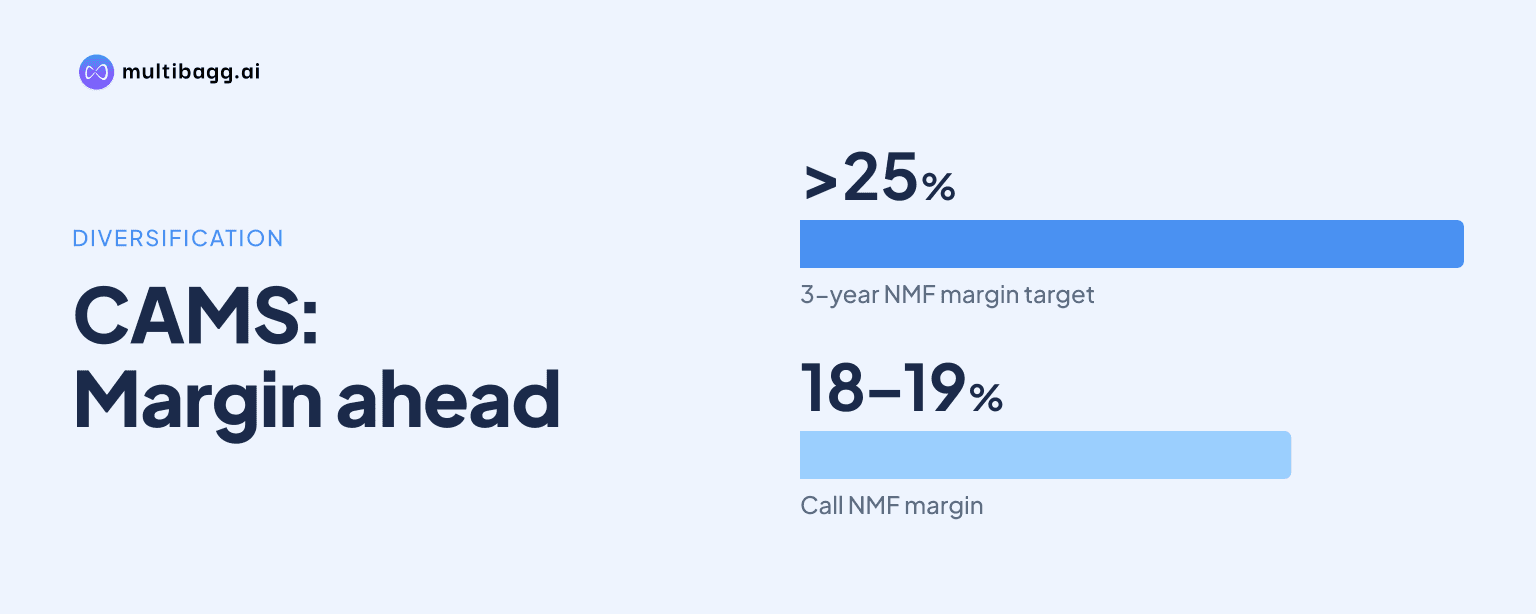
Computer Age Management Services Limited (CAMS) said on its earnings call that its non-mutual-fund margin can exceed 25% within three years, versus the roughly 18% to 19% level cited by an analyst on the call. Management linked the outlook to sustained payments profitability, growth in its KRA business and a broadly unchanged mix of payments, KRA and AIF operations.
Know Computer Age Management Services inside out
Results, valuation, peers and who's buying, in one view.
Can CAMS non-mutual-fund margin exceed 25%?
Yes, CAMS said a steady-state non-mutual-fund margin of 25% or more is achievable over the three-year period discussed on the call. Management said that outcome assumes payments, Know Your Customer Registration Agency (KRA) and alternative investment fund (AIF) businesses remain in broadly the same proportion of the mix as they are now.
The roughly 18% to 19% starting margin was cited by an analyst, not reported by CAMS as a segment result during the call. Management’s 25%-plus view would therefore imply an increase of at least 6 percentage points from that level, although CAMS did not provide a year-by-year margin target or separate revenue and profit figures for the three businesses.
Management also said its aim is to get closer to 30%, while identifying 25% as the more specific three-year outcome that was “very much on the cards.” That is a management outlook rather than a current result, and it relies on the stated mix assumption rather than a disclosed forecast of a major shift toward any single business.
Which CAMS businesses support the higher margin outlook?
CAMS identified payments and KRA as the principal contributors to the projected 25%-plus non-mutual-fund margin, while describing AIF as stable at about a 20% margin. Management said payments has grown at a profitability level that exceeded its expectations and has retained a 20% margin despite carrying a card-business mix.
Management said the payments margin was sustainable rather than a one-off outcome. It did not disclose a separate revenue base, transaction volume or future margin range for CAMSPay, so the call supports the conclusion that payments is profitable at present but does not quantify its individual contribution to the three-year segment-margin target.
KRA was described by CAMS as a “very profitable franchise,” and management said the 25%-plus outcome was predicated on KRA continuing to grow. CAMS did not disclose a numerical KRA margin or revenue contribution, making the relevant disclosed comparison the combined non-mutual-fund margin of roughly 18% to 19% and management’s 25%-plus steady-state outlook.
AIF has a more service-led operating model than CAMS’s platform businesses. Management said AIF is stable at about a 20% margin but has lower operating leverage in at least part of its activities because of that service character, unlike payments, KRA, repository services and mutual-fund registrar and transfer agency operations.
How will FUNDSNet 2.0 spending affect CAMS margins?
CAMS expects gross costs associated with FUNDSNet 2.0 to increase as more modules go live, but management expects the net quarterly operating-expense effect to be Rs 1.5 crore to Rs 2 crore. The company said it recorded about Rs 5 crore of project-related cost in Q2, including roughly Rs 2.5 crore of incremental profit-and-loss cost and Rs 1.5 crore of depreciation.
CAMS said it had cumulatively charged about Rs 27 crore of the project to operating expenses over time. Management expects productivity improvements and other savings from FUNDSNet 2.0 to broadly offset the higher steady-state cost, which is why it distinguished the Rs 8 crore and Rs 9.5 crore gross-cost expectations from the lower estimated net effect.
The company said the platform does not fundamentally change the fixed-cost nature of the model because the old platform was also largely fixed cost. Management’s mechanism is that additional revenue on a platform produces operating leverage, while some FUNDSNet 2.0 work replaces existing activity and creates productivity savings rather than only incremental expense.
Got a follow-up? Ask IRIS
What operating leverage does CAMS expect?
CAMS said that in normal years it expects margins to expand by 100 to 200 basis points, with 100 basis points equal to 1 percentage point. Management said this trajectory should continue because payments, KRA, repository services and mutual-fund registrar and transfer agency operations are largely platform businesses whose costs do not flex substantially with revenue.
The operating-leverage outlook is not uniform across all businesses. CAMS said AIF, at about a 20% margin, retains a service component that limits leverage relative to the four largely platform-led businesses, which is why management’s three-year non-mutual-fund target depends on the current proportional mix being maintained.
CAMS also disclosed a reduction in its workforce during the year. Headcount was about 8,450 at the start of the year and about 8,200 at the quarter-end, a reduction of roughly 250 employees, while reductions in outsourced headcount took the overall reduction to around 250 to 300; management did not assign a financial effect to those changes.
What could affect CAMS margins and yields next?
CAMS maintained its guidance for a year-on-year decline of around 3% in mutual-fund asset-based yield, after reporting a sub-1% quarter-on-quarter decline in the quarter discussed. Management said the yield movement reflected customer mix, asset mix and scale-based pricing, rather than an incremental customer discount.
For the second half, CAMS said it had sufficient visibility to retain that yield outlook. Renewals with a couple of large customers are due next year, but management did not predict the result; it said there was no reason, in its view, for disproportionate discounts or reductions in basis points in those discussions.
Direct mutual-fund plans do not affect CAMS pricing, according to management, because pricing is constant regardless of the transaction source, plan type or unit-holding method. CAMS also said potential merchant discount rate benefits from Unified Payments Interface transactions would be limited for CAMSPay, estimating Rs 1 crore to Rs 2 crore on a Rs 100 crore book if implemented.
Conclusion
CAMS’ three-year non-mutual-fund margin outlook combines payments that management says are sustaining a 20% margin, a KRA business it calls highly profitable, and an AIF operation at about a 20% margin. The company’s 25%-plus target is conditional on those businesses retaining broadly their present mix, with platform operating leverage providing an additional mechanism for expansion.
The next disclosed milestones are expected FUNDSNet 2.0 gross costs of about Rs 8 crore in Q3 and Rs 9.5 crore in Q4, against management’s estimate of a Rs 1.5 crore to Rs 2 crore net quarterly effect. Large mutual-fund customer renewals next year are also unresolved, while management has retained its around 3% year-on-year asset-based yield decline guidance for now.