










CAMS PAT rises 14.5% as mutual-fund AUM growth slows in Q2 FY27
Key highlights
- CAMS reported Q2 FY27 operating revenue of Rs 415 crore, up 10% year-on-year.
- CAMS PAT rose 14.5% year-on-year as EBITDA margin expanded 140 basis points to 46%.
- CAMS equity mutual-fund AUM grew 15.5%, compared with 15.2% for the industry.
- Non-mutual-fund revenue grew nearly 22% year-on-year and represented just under 16% of revenue.
powered by IRIS
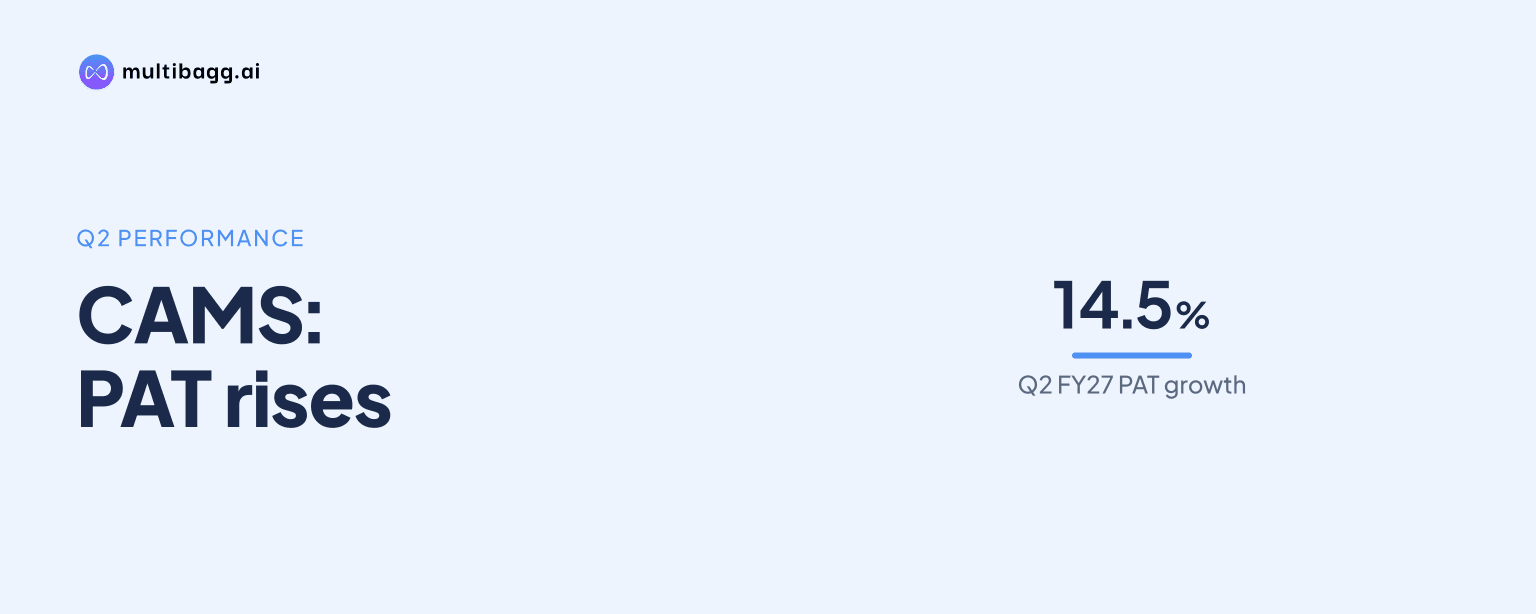
Computer Age Management Services Limited increased profit after tax (PAT) by 14.5% year-on-year in the second quarter of fiscal year 2027 (Q2 FY27), despite mutual-fund assets under management (AUM) growing about 12%, as operating revenue rose 10% to Rs 415 crore and earnings before interest, tax, depreciation and amortisation (EBITDA) margin reached 46%.
Know Computer Age Management Services inside out
Results, valuation, peers and who's buying, in one view.
How did CAMS grow PAT faster than AUM?
CAMS grew PAT faster than AUM because Q2 FY27 operating revenue increased 10% year-on-year to Rs 415 crore, EBITDA rose 13.5% to nearly Rs 191 crore, and EBITDA margin expanded 140 basis points to 46%. Management contrasted the result with earlier quarters in which asset growth had reached 18%, 19% or 20% or more.
The margin expansion occurred after CAMS absorbed a deferred employee increment in Q2 FY27 and about Rs 4 crore of new-platform cost. Management also said the quarter-on-quarter decline in yield was below 1%, compared with its indication that yields can decline by 3% to 3.5% in some quarters.
What drove CAMS mutual-fund growth above the industry?
CAMS outpaced the industry in equity AUM, which grew 15.5% year-on-year versus 15.2% for the industry. Total CAMS mutual-fund AUM rose about 12.5% to Rs 58.5 lakh crore, and management put its market share at 67%, showing that equity growth exceeded the expansion of the overall asset base.
Management attributed the equity trend partly to its share of industry equity net sales, which was above 70% over the preceding year. Gross systematic investment plan (SIP) collections rose 16.5% year-on-year, compared with 12.4% for the industry, while live SIPs and the investor base also grew ahead of the industry.
CAMS added InCred AMC as a mutual-fund registrar and transfer agency (RTA) client, taking its roster to 32 of India’s 64 licensed asset management companies (AMCs). ASK Investments and Carnelian launched maiden funds during Q2 FY27, while management expected Oaklane and Neo to go live in Q3 FY27.
How much did non-mutual-fund business contribute to CAMS growth?
CAMS’ non-mutual-fund business grew nearly 22% year-on-year and contributed just under 16% of Q2 FY27 revenue, up 150 basis points from a year earlier. Management said the business had delivered annual growth above 20% in most of the preceding 12 quarters.
CAMSPay crossed 6% of revenue, compared with about 3% two to two-and-a-half years earlier. Management said payment-services revenue increased more than 50% year-on-year and 13% quarter-on-quarter, supported by recurring payments through the National Automated Clearing House, eNACH, Unified Payments Interface AutoPay and cards.
Alternative-investment revenue increased 22% year-on-year as AUM crossed Rs 3.3 lakh crore, with more than 50 new mandates and 15 new marquee relationships. CAMS also said five of India’s top 10 broking houses were active users of its KYC Registration Agency business, which had been almost entirely mutual-fund based three years earlier.
Got a follow-up? Ask IRIS
Which newer products could add to CAMS’ revenue mix?
CAMS’ insurance repository crossed 1.5 crore dematerialised policies, while Bima Central added a broker module for policy dematerialisation and customer transactions through white-label applications and websites. Management said insurance digitisation may deepen over the next two or three quarters, but did not quantify a revenue effect.
The account-aggregator business grew 19% from a small base, including a personal financial management module deployed for one of India’s largest banks. ConsenPro, CAMS’ data-privacy product, was under implementation with 20 clients after the company began building the business seriously in April and May.
Twelve CAMS AMC clients had launched specialised investment funds with combined AUM of Rs 20,000 crore and nearly 1 lakh investors. GIFT City retail funds had AUM above Rs 1,500 crore after five launches, and management expected two to three further launches in the current quarter.
What technology changes does CAMS expect to affect operations?
CAMS expects its technology modernisation to improve productivity after FUNDSNet went live as the transaction-facing RTA utility. Management plans to sunset the legacy utility in March or April and said FUNDSNet handles millions of transactions each day for brokers, aggregators, platforms, AMCs and operations teams.
The company estimated that modernisation was about 30% complete across its various forms. Automated form and data reading has been in production for seven or eight months since March or April, and management said this had contributed to falling headcount after April and lower complaints, although it did not quantify savings.
CAMS Lens was adopted by the National Institute of Securities Markets as an artificial-intelligence-powered compliance training partner. Management said the financial impact of the modernisation programme should become more visible over the next three to four quarters.
Conclusion
CAMS’ Q2 FY27 performance indicates that revenue mix, equity-market share gains and operating leverage supported earnings growth above the increase in mutual-fund assets. PAT rose 14.5% as revenue grew 10%, EBITDA margin widened 140 basis points and non-mutual-fund revenue increased nearly 22%, while equity AUM growth of 15.5% exceeded the industry’s 15.2% rate.
The next disclosed milestones are the expected Q3 FY27 launches of Oaklane and Neo, two to three additional GIFT City fund launches in the current quarter, and the March or April retirement of the legacy transaction utility. Management’s planned technology rollout and the progression of CAMSPay, which exceeded 6% of revenue, will be further measures of diversification and productivity gains.