










Capacite Infraprojects Revenue Rises 19% as Margin Narrows
Key highlights
- Capacite reported Q2 FY27 revenue of Rs 770.9 crore, up 19.3% year on year.
- Q2 FY27 EBITDA rose 9.9% to Rs 119.1 crore, while margin declined to 15.4% from 16.8%.
- Q2 FY27 consolidated net profit fell 2.9% to Rs 47.7 crore.
- Capacite reported a forward order book of about Rs 13,535 crore and FY26 revenue of Rs 2,623 crore.
powered by IRIS
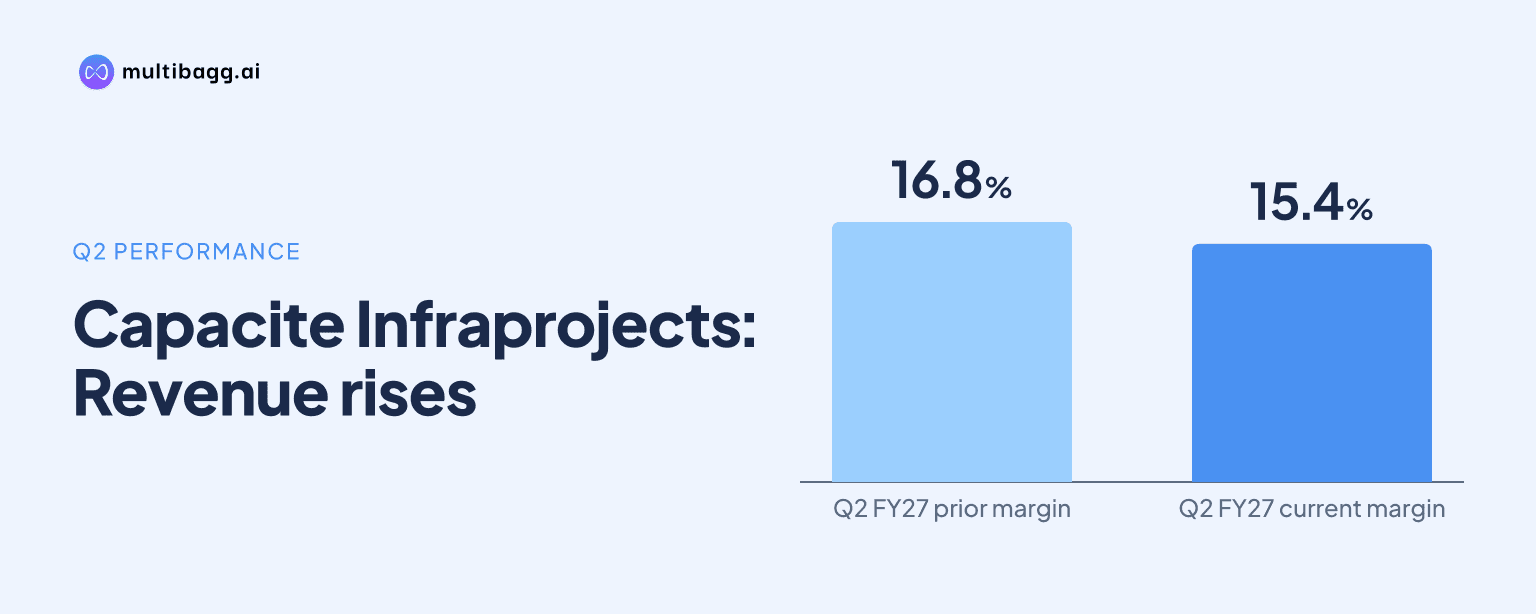
Capacite Infraprojects Ltd reported Q2 FY27 consolidated revenue of Rs 770.9 crore, up 19.3% year on year, but net profit fell 2.9% to Rs 47.7 crore as EBITDA margin narrowed to 15.4% from 16.8%.
Know Capacite Infraprojects inside out
Results, valuation, peers and who's buying, in one view.
What did Capacite report in Q2 FY27?
Capacite reported higher revenue and EBITDA for the quarter ended September 30, 2026, while profitability ratios weakened from the corresponding quarter a year earlier. Consolidated revenue rose to Rs 770.9 crore from Rs 646.2 crore. EBITDA increased 9.9% to Rs 119.1 crore from Rs 108.4 crore, but grew more slowly than revenue.
The difference in revenue and EBITDA growth resulted in a 140-basis-point contraction in EBITDA margin to 15.4%. Consolidated net profit was Rs 47.7 crore, compared with Rs 49.1 crore in Q2 FY26. The results therefore show continued expansion in the company’s reported business volume, alongside pressure on the conversion of revenue into operating and net profit.
How did the Q2 performance follow the June quarter?
The Q2 figures followed a June quarter in which Capacite reported consolidated revenue from operations of Rs 629 crore and net profit of Rs 39.44 crore. The June-quarter update said revenue rose 7% year on year, while profit after tax fell 15%. It also identified labour shortages and Mumbai water restrictions as factors affecting execution during that period.
The Q2 revenue of Rs 770.9 crore is higher than the Rs 629 crore reported for the June quarter. EBITDA margin, however, remained below the level reported in the earlier comparable period. The June quarter’s EBITDA margin was stated at 15.7%, compared with the 15.4% margin reported for Q2 FY27.
Historical quarterly data also shows that revenue has moved upward over recent periods. Revenue was Rs 646 crore in September 2025, Rs 675 crore in December 2025, Rs 712 crore in March 2026 and Rs 629 crore in June 2026. The reported Q2 FY27 number of Rs 770.9 crore marks a further increase from those figures.
What do the balance-sheet and ownership figures show?
Capacite’s disclosed leverage indicators suggest moderate debt levels, although its interest coverage ratio points to a tighter capacity to service finance costs from operating profit. The company reported a debt-equity ratio of 0.25 times as of the half-year and a debt-to-EBITDA ratio of 1.13 times.
Operating profit to interest coverage stood at 3.58 times. This measure indicates the relationship between operating profit and interest obligations, and is relevant when assessing how much of the company’s earnings are available to meet borrowing costs. The company also reported return on capital employed of 14.7% and enterprise value to capital employed of 0.7 times.
Institutional investors reduced their holding by 3.58 percentage points during the latest quarter, taking their stake to 18.31%. The data does not state the reasons for the change in institutional ownership. For shareholders, the movement is a disclosed change in the company’s investor base rather than an explanation of the Q2 financial performance.
Got a follow-up? Ask IRIS
What is Capacite’s operating base and market position?
Capacite is a building and factories contractor that reported FY26 revenue from operations of Rs 2,623 crore. Its latest operating update placed the forward order book at about Rs 13,535 crore. The order book is an important operating measure because it represents work available for execution, while reported revenue depends on project progress and execution during each period.
The Q2 revenue outcome must also be viewed against the execution conditions disclosed for the June quarter. Labour availability and water restrictions in Mumbai were cited as factors affecting operations then. The supplied information does not provide a separate explanation from the company for the Q2 margin movement, so the reported decline in margin should be assessed as a financial outcome rather than attributed to a specific cause.
Capacite’s shares closed at Rs 145.70 on the BSE on October 30, 2026, down Rs 7.45 or 4.86% for the session. The reported share-price move occurred before the scheduled discussion of Q2 and H1 FY27 performance and outlook.
What should investors monitor after the Q2 results?
Investors will monitor whether Capacite can sustain revenue execution while improving its EBITDA margin and protecting net profitability. Revenue grew by 19.3%, whereas EBITDA rose by 9.9% and net profit declined by 2.9%. These figures place margin performance and costs alongside revenue conversion at the centre of the next update.
Management has scheduled an earnings call for November 5, 2026, at 11:00 am IST to discuss Q2 and H1 FY27 operational and financial results. The call gives investors and analysts an opportunity to hear management’s stated outlook. The supplied announcement does not disclose guidance, revised targets or any specific operational plan ahead of that call.
Conclusion
Capacite delivered a 19.3% increase in Q2 FY27 revenue to Rs 770.9 crore, supported by a sizeable forward order book, but the quarter also recorded lower net profit and a 140-basis-point decline in EBITDA margin. Its debt-equity ratio of 0.25 times and debt-to-EBITDA ratio of 1.13 times indicate manageable reported leverage, while the 3.58-times interest coverage ratio remains relevant to profitability assessment.
The next disclosed event is the November 5, 2026 earnings call, when management will discuss Q2 and H1 FY27 performance and outlook. Investors will watch for management’s comments on execution conditions, the order book, margin trends and the factors affecting the company’s ability to translate revenue growth into profit.