










Care premium rises 35% as SAHI market share reaches 21.3%
Key highlights
- Care's H1 FY27 gross written premium rose 35.1% to Rs 6,897 crore on the n basis.
- Care's SAHI retail market share increased to 21.3% in H1 FY27 from 19.3% in H1 FY26.
- Care's retail health premium grew 43.5% to Rs 4,358 crore on the n basis.
- Care's investment AUM reached Rs 12,897 crore and Ind AS profit before tax rose to Rs 392 crore.
powered by IRIS
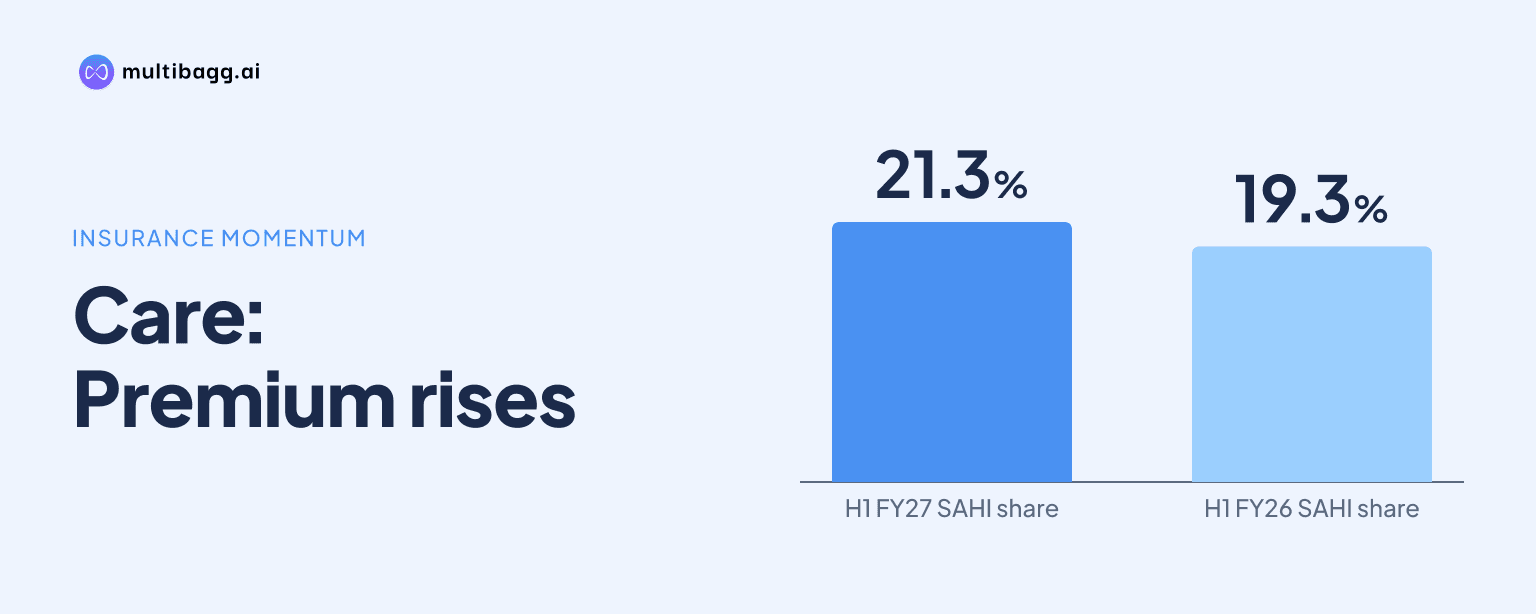
Care Health Insurance Limited reported H1 FY27 gross written premium of Rs 6,897 crore, up 35% year on year, and lifted its share of the standalone health insurer market to 21.3% from 19.3% in H1 FY26. Retail health premium growth, which outpaced overall premium growth, was the principal disclosed driver.
Know Religare Enterprises inside out
Results, valuation, peers and who's buying, in one view.
How fast did Care grow premiums in H1 FY27?
Care increased premium to Rs 6,897 crore in H1 FY27 from Rs 5,104 crore in H1 FY26, a 35% year-on-year increase on the n basis disclosed by the company. The half-year figure was also equal to about 60% of FY26 premium of Rs 11,417 crore, following growth from Rs 7,022 crore in FY24 and Rs 9,223 crore in FY25.
Retail was the larger product category, accounting for 65% of Care's product mix, compared with 31% for group business, 2% for personal accident and 1% for travel. Retail gross written premium on the n basis rose 43.5% to Rs 4,358 crore from Rs 3,036 crore, exceeding the 35.1% increase in total gross written premium.
The presentation reports two accounting views of premium: n basis and 1/n basis. On the 1/n basis, total gross written premium rose 40.6% to Rs 6,400 crore and retail health gross written premium rose 50.7% to Rs 4,049 crore, again showing faster retail expansion than the overall book.
How did Care's market share change?
Care's retail share among standalone health insurers, or SAHIs, rose to 21.3% in H1 FY27 from 19.3% in H1 FY26, an increase of 2 percentage points. Its share among the wider industry increased to 12.8% from 11.2% over the same period, according to the GIC segment data presented.
The H1 FY27 result extended a multi-year progression in the disclosed retail-share series. Care's SAHI share moved from 16.8% in FY24 to 18.8% in FY25 and 19.7% in FY26, while its industry share rose from 9.4% to 10.8% and then 11.6% across those financial years.
Care's distribution was led by agents at 40% and brokers at 33%, together representing 73% of the mix. Corporate agents other than bancassurance contributed 10%, bancassurance 8%, direct business 7% and other channels 2%; the company also reported 287 branches, more than 1,450 network locations and more than 21,850 healthcare-network locations.
Got a follow-up? Ask IRIS
What do Care's claims and renewal measures show?
Care paid Rs 3,500 crore of claims in H1 FY27, compared with Rs 2,727 crore in H1 FY26, while the number of paid claims increased to 9.2 lakh from 7.9 lakh. Its claim settlement ratio improved to 97% from 96%, and the company said it had settled more than 94.1 lakh claims since inception.
Retail health indemnity renewal rose to 97% in H1 FY27 from 91% a year earlier. Customer grievances per 10,000 policies fell to 0.42 from 0.81, while grievances per 10,000 claims edged down to 46 from 47, providing two separately reported service measures alongside the higher claims volume.
Care also disclosed that 99.5% of new policies were applied for digitally and 96% of policy renewals were automated. Direct-to-consumer new-business growth exceeded 60%, while 80% of cashless claims were processed in under 30 minutes and the cashless-claims net promoter score was 74.
How did Care's investment book and profitability move?
Care's investment assets under management, or AUM, reached Rs 12,897 crore in H1 FY27, up from Rs 9,498 crore in H1 FY26 and Rs 10,944 crore at FY26. The annualised gross debt yield was 7.3%, compared with 7.2% in FY24 and FY25, and the company reported a leverage ratio of 3.7 times.
Bonds accounted for 56% of the investment portfolio and government-security bonds for 36%, making bonds and government securities 92% of the book. Within debt securities, 56% was rated AAA, 39% was in government securities and 5% was rated AA+, meaning 95% of the debt portfolio was AAA or government securities.
Profit before tax under Indian Accounting Standards, or Ind AS, increased to Rs 392 crore in H1 FY27 from Rs 276 crore in H1 FY26. The claims ratio declined to 66.1% from 67.0%, while the expense ratio rose to 34.4% from 34.2%; the combined insurance service ratio fell to 100.5% from 101.2%, and return on average equity based on profit before tax rose to 12.1% from 10.2% on a non-annualised basis.
Conclusion
Care's H1 FY27 disclosures show that premium growth was led by retail health, where n-basis premium rose 43.5%, above the 35.1% increase in overall premium. The resulting increase in SAHI market share to 21.3% coincided with a 97% retail renewal rate, a 97% claim settlement ratio, Rs 12,897 crore of investment AUM and higher profit before tax of Rs 392 crore.
What to watch next is whether Care can sustain the retail-led growth and share progression while claims and expenses evolve. The company reported Rs 450 crore of Tier II capital raised, including Rs 300 crore in the quarter ended September 2026, taking outstanding debt to Rs 550 crore as of 31 October 2026; its next disclosures can show how this capital, the 3.7-times leverage ratio and the 7.3% gross debt yield develop.