










Centennial Surgical Suture Seeks Probe Into Unusual Trades
Key highlights
- Centennial Surgical Suture asked BSE and SEBI to examine unusual trading reported on October 26, 2026.
- The company cited trades of 2, 18, 120, and 2 shares at prices of ₹66.60 and ₹71.25.
- A separate one-share trade at ₹71.25 on October 21, 2026, was also highlighted.
- No regulatory finding, penalty, or trading restriction has been confirmed.
powered by IRIS
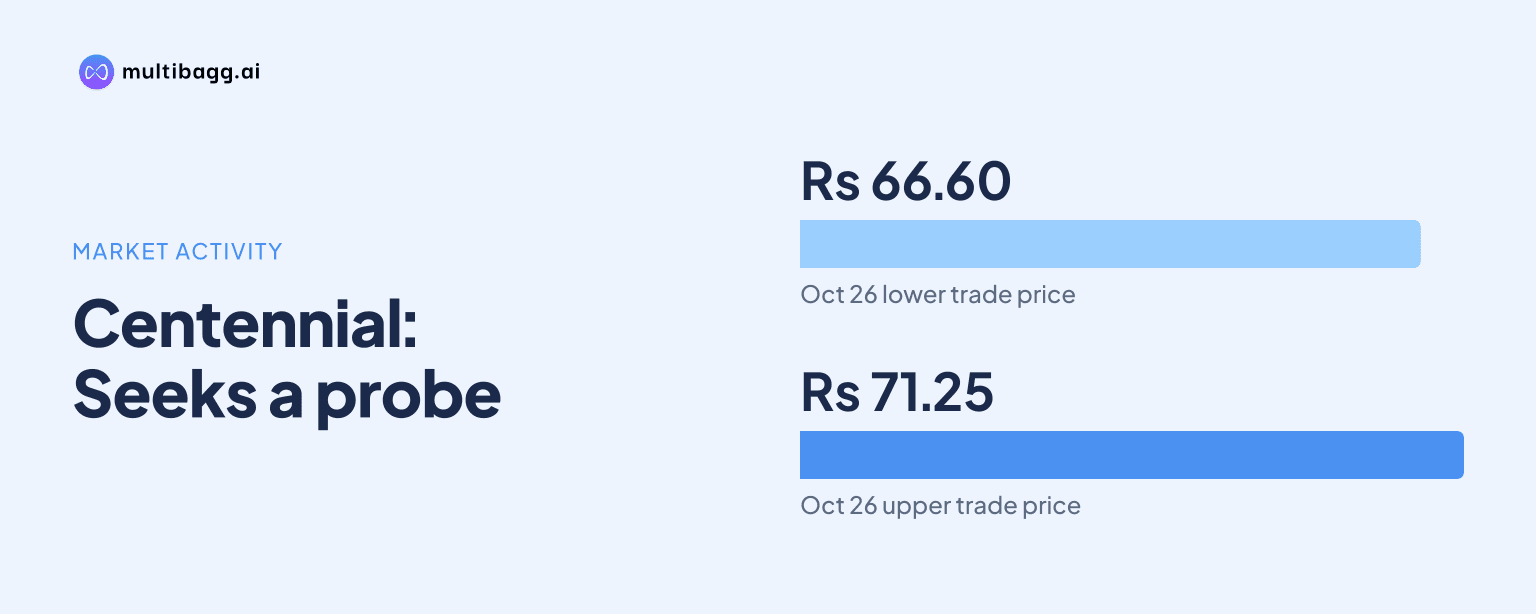
Centennial Surgical Suture Ltd. has asked BSE Limited and the Securities and Exchange Board of India to investigate unusual trading in its shares after transactions ranging from 2 to 120 shares occurred at ₹66.60 and ₹71.25 on October 26, 2026. The company said no material corporate announcement or business change explained the movement.
Know Centenial Surgical Suture inside out
Results, valuation, peers and who's buying, in one view.
Why did Centennial Surgical Suture request a trading investigation?
Centennial Surgical Suture requested urgent scrutiny because it considers the reported price movement and trade pattern to be abnormal. The company said the movement in its scrip was unsupported by any announcement, operational development, or other material business event disclosed by it.
The company asked BSE's Investigation or Surveillance Department and SEBI to examine the transactions for possible manipulation, misuse, or unethical trading. Its communication referred to both abnormal price rise and fall in different descriptions of the trading activity, while its central contention was that the moves did not reflect any known corporate development.
Centennial Surgical Suture also denied the involvement of its promoters, directors, key managerial personnel, and their immediate relatives in the trades it flagged. It said it was prepared to assist the authorities in reviewing the transactions.
Which trades did Centennial Surgical Suture identify?
Centennial Surgical Suture identified a series of small transactions in the morning session on October 26, 2026, including trades at ₹66.60 and ₹71.25. The company highlighted the limited quantities involved as part of the pattern requiring regulatory examination.
According to the details cited in the communication, 2 shares traded at ₹66.60 at 9:08 am, followed by 18 shares at the same price at 9:15 am. At 9:21 am, 120 shares traded at ₹71.25, and a further 2 shares traded at ₹71.25 at 9:34 am.
The company also referred to a one-share transaction at ₹71.25 on October 21. It said small-lot purchases involving quantities such as 1, 2, 3, 5, 10, and 20 shares appeared across brokers in different parts of India. These were allegations made by the company in seeking the probe, not findings by BSE or SEBI.
What did the company allege about the trading pattern?
Centennial Surgical Suture alleged that the small-volume activity could indicate coordinated or synchronised trading intended to influence its share price. It described the apparent pattern as planned and said the transactions may have been structured to avoid exchange or regulatory surveillance.
The company asked the authorities to verify the validity of the transactions and examine the brokers and clients involved, where appropriate. It also referred to the possible use of upper or lower circuit mechanisms in the alleged activity. No regulator has confirmed that such conduct occurred.
The distinction is important for investors. A company complaint can trigger scrutiny or provide information to an exchange and the market regulator, but it does not establish wrongdoing. The available information contains no confirmed manipulation finding, penalty, trading restriction, or enforcement action against any party.
Got a follow-up? Ask IRIS
Why do small-lot trades matter in a thinly traded share?
Small trades can matter more in securities with limited trading liquidity because even a low number of shares may coincide with visible changes in the quoted price. In such situations, transaction size, frequency, counterparties, order placement, and links between market participants can be relevant to a surveillance review.
Centennial Surgical Suture's complaint focuses on this context. The reported transactions ranged from 1 share to 120 shares, yet occurred at two distinct price points during the cited morning session. The company said it had not released any material information that would justify significant movement in the share price.
For market participants, the filing provides a company-level clarification that it did not identify a business event behind the reported movement. It does not provide financial results, revenue data, profit figures, or an operating update that could independently explain the price action.
How does the complaint affect shareholders and market oversight?
Centennial Surgical Suture's request puts the reported trades before BSE and SEBI for potential review, while the absence of a regulatory finding means the matter remains an allegation. Investors therefore have no confirmed evidence from the disclosed information that any person or entity manipulated the shares.
The complaint may nevertheless be relevant to shareholders because it records the company's position that the price movement was not linked to its disclosed business operations. The company said it would provide transaction details and cooperate with the investigation process.
The case also underlines the role of exchange surveillance and SEBI oversight in reviewing unusual market activity. Any conclusion on the trades, including whether they were legitimate market transactions or involved a regulatory breach, would depend on an examination by the relevant authorities rather than on the company's assertions alone.
Conclusion
Centennial Surgical Suture has formally sought a BSE and SEBI examination of unusual share transactions after identifying trades from 1 to 120 shares at ₹66.60 and ₹71.25. Its key position is that no material corporate announcement or business change supported the reported price movement, and that its promoters, directors, key managerial personnel, and their immediate relatives had no involvement.
The next point to watch is whether BSE or SEBI discloses any surveillance outcome, investigation step, or enforcement action. Centennial Surgical Suture has indicated that it is ready to provide transaction information, but the available disclosure does not specify a timetable for a regulatory decision.