










ECOS (India) Mobility Q2 FY27 PAT rises 21.4% to ₹17.7 crore
Key highlights
- ECO Mobility reported Q2 FY27 revenue from operations of ₹234.51 crore, up 9.48% year on year.
- Q2 FY27 profit after tax rose 21.4% year on year to ₹17.73 crore.
- ECO Mobility’s Q2 FY27 EBITDA margin improved 45 basis points year on year to 11.92%.
- H1 FY27 revenue from operations reached ₹445.88 crore, a 12.79% year-on-year increase.
powered by IRIS
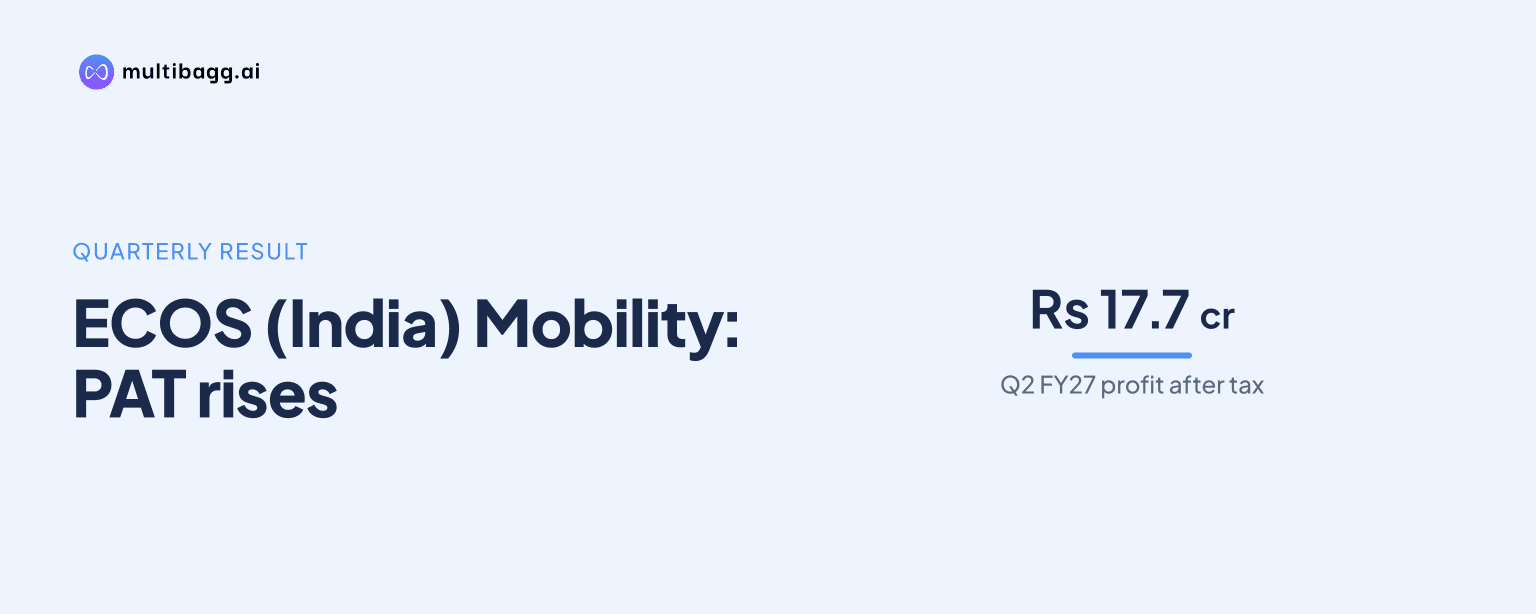
ECOS (India) Mobility & Hospitality Limited reported Q2 FY27 profit after tax of ₹17.73 crore, up 21.4% year on year. The company’s revenue from operations rose 9.48% to ₹234.51 crore for the quarter ended September 30, 2026, while EBITDA margin improved to 11.92% from 11.47% a year earlier.
Know Ecos (India) Mobility & Hospitality inside out
Results, valuation, peers and who's buying, in one view.
How did ECO Mobility perform in Q2 FY27?
ECO Mobility reported total revenue of ₹238.45 crore in Q2 FY27, compared with ₹216.14 crore in Q2 FY26, a year-on-year increase of 10.32%. Revenue from operations, which excludes other income, was ₹234.51 crore, up from ₹214.21 crore in the corresponding quarter of the previous year.
Profitability increased at a faster pace than operating revenue. EBITDA, excluding other income, rose 13.78% year on year to ₹27.95 crore from ₹24.57 crore. Profit after tax increased to ₹17.73 crore from ₹14.61 crore. Quarterly earnings per share rose to ₹2.96 from ₹2.43.
The company also indicated on its November 16 earnings call that quarterly revenue grew about 10.94% sequentially. EBITDA was ₹21.8 crore in Q1 FY27, making the Q2 figure a sequential improvement as well. The EBITDA margin increased to 11.92% in Q2 from 10.3% in the preceding quarter, according to the call commentary.
What drove ECO Mobility’s margin improvement?
ECO Mobility’s EBITDA margin expanded by 45 basis points year on year to 11.92%, while PAT margin rose by 68 basis points to 7.44%. The figures show that earnings grew faster than revenue during the quarter, with EBITDA rising 13.78% and PAT rising 21.40%.
Management described the quarter as one of healthy business growth and improved profitability during the earnings call. The call presentation showed Q2 EBITDA of ₹27.95 crore, compared with ₹24.57 crore in Q2 FY26 and ₹21.8 crore in Q1 FY27. This sequential change was reflected in the higher margin versus the preceding quarter.
The result also needs to be viewed alongside the company’s revenue mix and operating model. ECO Mobility operates an asset-light fleet model, according to the earnings-call materials. Its reported operating footprint covered 160 Indian cities, with 1,538 active enterprise organisations and 72 new clients added during Q2.
How was ECO Mobility’s first-half FY27 performance?
ECO Mobility’s revenue from operations for the first half of FY27 increased 12.79% year on year to ₹445.88 crore. Total revenue for the six-month period was ₹453.57 crore, compared with ₹400.14 crore in H1 FY26.
First-half EBITDA, excluding other income, was ₹49.80 crore, up from ₹46.42 crore a year earlier. However, the H1 EBITDA margin was 11.17%, below 11.74% in H1 FY26. The second-quarter margin recovery therefore followed a relatively lower first-quarter margin.
PAT for H1 FY27 was ₹32.28 crore, compared with ₹27.90 crore in H1 FY26, representing growth of 15.72%. The half-year PAT margin improved to 7.12% from 6.97%, and EPS increased to ₹5.38 from ₹4.65.
Got a follow-up? Ask IRIS
What guidance has ECO Mobility provided for FY27?
ECO Mobility has retained its FY27 revenue-growth guidance of 13% to 15%, according to the earnings-call summary. Management also indicated an H2 EBITDA margin range of 10% to 11%.
The Q2 EBITDA margin of 11.92% was above that stated H2 range, but the guidance remains the company’s disclosed expectation for the second half rather than a revised target. Investors assessing the full-year result will therefore track whether revenue growth remains within the stated band and how margins develop through H2.
The company has also stated an aspiration to reach ₹1,000 crore in revenue by FY28. This is an aspiration rather than a reported financial result. Its execution will depend on the pace of business growth across its enterprise client base, city network, technology initiatives and event-based business efforts mentioned in the call summaries.
Why do the Q2 numbers matter for investors?
The Q2 result matters because both operating revenue and profitability increased, with PAT growth outpacing revenue growth. Revenue from operations grew 9.48%, while PAT rose 21.40%, and the operating margin improved year on year as well as sequentially.
For investors, the central points are the sustainability of margin improvement and the pace of revenue growth against the 13% to 15% FY27 guidance. The supplied earnings-call summaries also noted higher receivables and unbilled revenue, without providing amounts. That makes future disclosures on working capital and cash conversion relevant alongside reported profit.
For customers and enterprise clients, the company’s 160-city presence and addition of 72 clients in Q2 indicate continued expansion of its operating network. But the results do not provide separate service-line revenue, customer-retention data, or a regional breakdown, limiting detailed assessment of demand by segment.
Conclusion
ECO Mobility delivered higher Q2 FY27 revenue, EBITDA and profit, with revenue from operations reaching ₹234.51 crore and PAT rising 21.4% to ₹17.73 crore. The margin expansion to 11.92% was a notable feature of the quarter, although the first-half EBITDA margin remained below the level reported in H1 FY26.
The next updates should show whether the company can meet its FY27 revenue-growth guidance of 13% to 15% while maintaining margins within its stated H2 range of 10% to 11%. Investors will also watch subsequent disclosures for any additional detail on receivables, unbilled revenue and progress toward the FY28 revenue aspiration of ₹1,000 crore.