










ECO Mobility Q2 profit rises 21.4% as margin reaches 11.9%
Key highlights
- ECO Mobility’s Q2 FY27 profit after tax rose 21.40% to Rs 17.732 crore.
- ECO Mobility’s Q2 FY27 revenue from operations increased 9.48% to Rs 234.506 crore.
- ECO Mobility’s Q2 FY27 EBITDA margin excluding other income increased to 11.92% from 11.47%.
- ECO Mobility reported more than 3 million trips in H1 FY27 and 1,538 active clients.
powered by IRIS
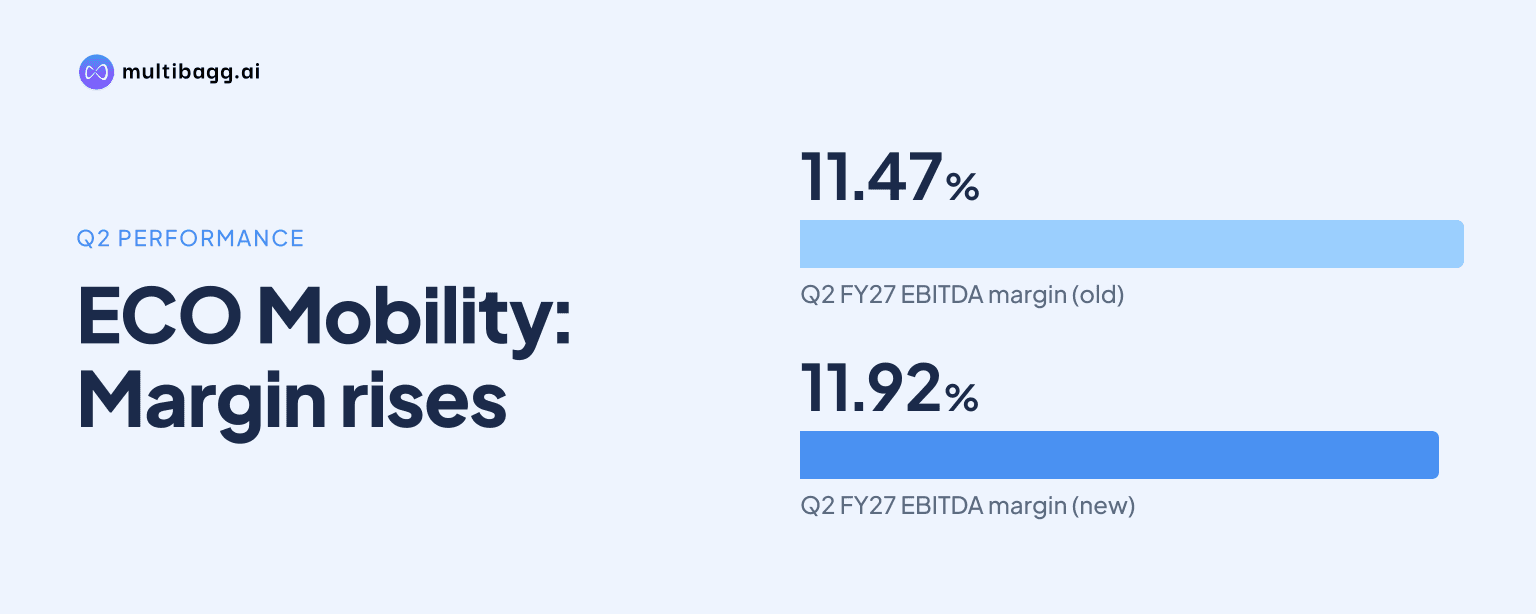
ECOS (India) Mobility and Hospitality Limited, referred to in its presentation as ECO Mobility, reported Q2 FY27 profit after tax of Rs 17.732 crore, up 21.4% year on year, as EBITDA margin excluding other income rose to 11.92% from 11.47%. Revenue from operations increased 9.48% to Rs 234.506 crore.
Know Ecos (India) Mobility & Hospitality inside out
Results, valuation, peers and who's buying, in one view.
How did ECO Mobility perform in Q2 FY27?
ECO Mobility increased total income by 10.32% year on year to Rs 238.445 crore in Q2 FY27 from Rs 216.144 crore in Q2 FY26. Revenue from operations was Rs 234.506 crore, compared with Rs 214.208 crore, while other income rose to Rs 3.939 crore from Rs 1.936 crore. Chairman and Managing Director Rajesh Loomba described the quarter as ECO Mobility’s highest-ever quarterly revenue.
ECO Mobility’s profit after tax rose 21.40% to Rs 17.732 crore from Rs 14.606 crore, exceeding the growth rate in operating revenue. Profit before tax increased 22.36% to Rs 23.759 crore, while depreciation and amortisation expense rose to Rs 7.822 crore from Rs 6.9 crore. Finance cost was Rs 30.8 lakh, compared with Rs 18.3 lakh a year earlier.
ECO Mobility’s EBITDA, or earnings before interest, tax, depreciation and amortisation, excluding other income rose 13.78% to Rs 27.95 crore. Its EBITDA margin increased by 45.08 basis points to 11.92%, while profit-after-tax margin rose by 67.30 basis points to 7.44% from 6.76%. Management also said EBITDA margin expanded 158 basis points sequentially to 11.9%.
What changed in ECO Mobility’s Q2 cost base?
ECO Mobility’s Q2 FY27 margin expansion coincided with other expense falling to Rs 9.069 crore from Rs 12.778 crore in Q2 FY26, despite higher business activity. Total cost of service rose to Rs 173.732 crore from Rs 154.245 crore, and employee benefit expense increased to Rs 23.409 crore from Rs 21.714 crore. Management attributed the profitability improvement to cost efficiencies and operating leverage.
Purchase of stock declined to Rs 35.4 lakh in Q2 FY27 from Rs 1.245 crore a year earlier, while change in stock-in-trade was negative Rs 80,000 compared with negative Rs 33.9 lakh. These movements occurred alongside the 9.48% increase in operating revenue, but the presentation does not break down the individual causes of the changes in each cost line.
ECO Mobility’s quarterly margin was above its FY26 EBITDA margin of 11.6%, according to its historical financials. That annual measure had declined from 14.1% in FY25 and 16.2% in FY24. The presentation does not provide an FY27 EBITDA-margin target, so the disclosed evidence is limited to the Q2 recovery and management’s stated focus on efficiency.
Got a follow-up? Ask IRIS
What does ECO Mobility’s H1 FY27 result show?
ECO Mobility reported H1 FY27 revenue from operations of Rs 445.878 crore, up 12.79% from Rs 395.327 crore in H1 FY26. Total income rose 13.35% to Rs 453.565 crore, including other income of Rs 7.687 crore, compared with total income of Rs 400.139 crore and other income of Rs 4.812 crore in the previous first half.
ECO Mobility’s H1 EBITDA excluding other income increased 7.27% to Rs 49.798 crore from Rs 46.421 crore, slower than revenue growth. As a result, H1 EBITDA margin declined by 57.39 basis points to 11.17% from 11.74%. This differs from Q2’s 45.08-basis-point year-on-year margin increase, meaning the second-quarter improvement had not fully offset the first-half comparison.
ECO Mobility’s H1 profit after tax rose 15.72% to Rs 32.282 crore from Rs 27.897 crore, and its profit-after-tax margin increased to 7.12% from 6.97%. Profit before tax grew 12.69% to Rs 42.923 crore, while tax expense increased to Rs 10.641 crore from Rs 10.192 crore. The half-year margin pattern shows profit growth ahead of revenue growth even as EBITDA margin remained below the prior-year level.
How did ECO Mobility’s operating activity and balance sheet change?
ECO Mobility reported 1.58 million trips in Q2 FY27, up 15% year on year, taking H1 FY27 trips beyond 3 million. It onboarded 72 clients in the quarter, compared with 67 in the corresponding period a year earlier, and ended the period with 1,538 active clients. Its presence extended to 160 cities, supported by a network of more than 20,500 vehicles.
ECO Mobility’s total assets were Rs 469.511 crore as of 30 September 2026, compared with Rs 413.493 crore on 31 March 2026. Current assets increased to Rs 379.113 crore from Rs 342.424 crore, while trade receivables rose to Rs 111.456 crore from Rs 107.021 crore. Cash and cash equivalents declined to Rs 6.672 crore from Rs 24.188 crore, while other financial assets increased to Rs 125.814 crore from Rs 75.209 crore.
ECO Mobility reported nil non-current borrowings at both 30 September 2026 and 31 March 2026, while current borrowings were nil at September-end versus Rs 10.7 lakh at March-end. Total equity increased to Rs 282.496 crore from Rs 264.936 crore. Total lease liabilities rose to Rs 12.435 crore from Rs 7.672 crore, comprising Rs 10.405 crore of non-current and Rs 2.03 crore of current lease liabilities at 30 September 2026.
Conclusion
ECO Mobility’s Q2 FY27 results showed profit after tax rising 21.40%, faster than the 9.48% increase in revenue from operations, with EBITDA margin increasing to 11.92%. The H1 result was more mixed: revenue rose 12.79% and profit after tax rose 15.72%, but EBITDA margin was 11.17%, below 11.74% in H1 FY26.
The next point to watch is whether management’s stated focus on cost efficiencies and operating leverage sustains the Q2 sequential margin improvement of 158 basis points. ECO Mobility’s disclosed operating markers, including more than 3 million H1 trips, 1,538 active clients and 160 cities, provide measures for tracking the business activity supporting that objective.