










ECOS Mobility runs 94% vendor fleet across 160 Indian cities
Key highlights
- ECOS Mobility operated 94% of its Q2 FY27 fleet through vendors and owned 6%.
- ECOS Mobility reported more than 20,500 vehicles and operations in 160 Indian cities in Q2 FY27.
- ECOS Mobility completed 1.58 million trips in Q2 FY27.
- Customers associated with ECOS Mobility for more than five years contributed 50% of H1 FY27 revenue.
powered by IRIS
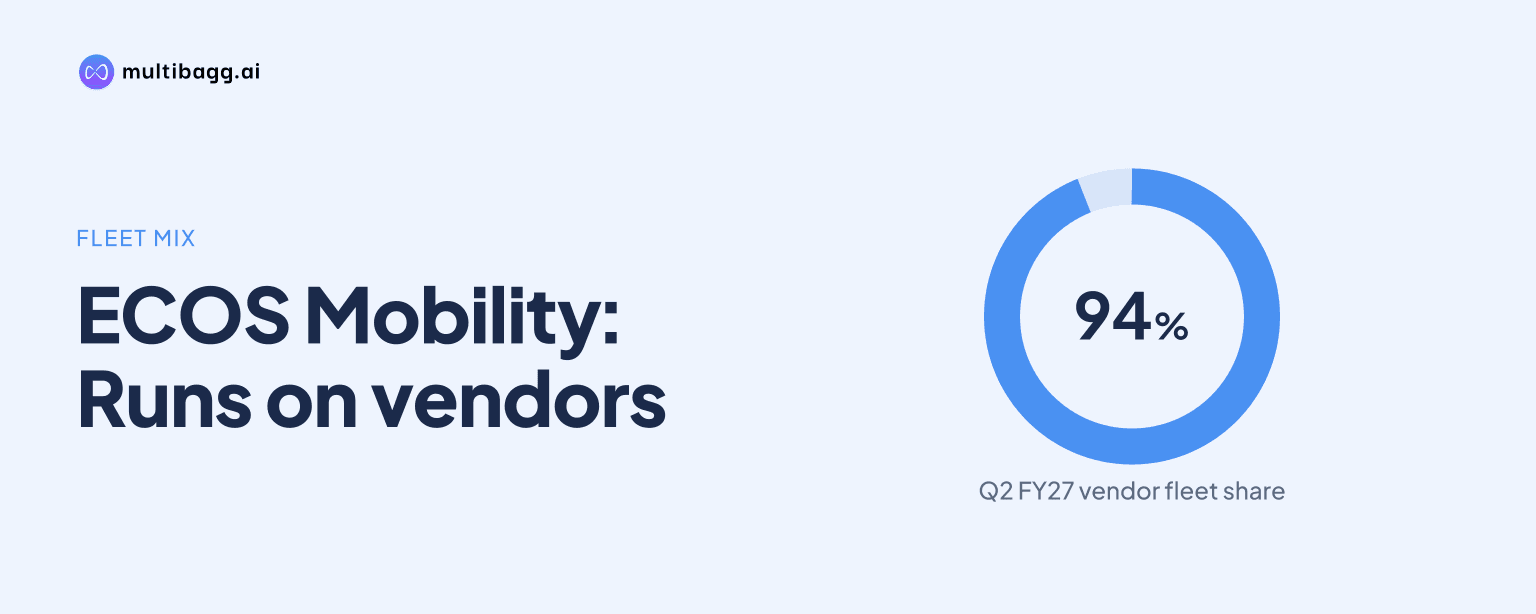
ECOS (India) Mobility & Hospitality Limited operated 94% of its vehicle fleet through vendors in Q2 FY27 while delivering corporate mobility services across 160 Indian cities. ECOS Mobility reported more than 20,500 vehicles and 1.58 million trips in Q2 FY27, combining an asset-light fleet structure with chauffeured rentals and employee transportation services.
Know Ecos (India) Mobility & Hospitality inside out
Results, valuation, peers and who's buying, in one view.
How does ECOS Mobility use vendor vehicles?
ECOS Mobility operated 94% of its Q2 FY27 fleet through vendors and owned the remaining 6%. The presentation describes this as an asset-light model and separately says that more than 90% of the fleet is vendor owned. The disclosed mix means vendors provide most vehicles used in the company’s corporate transport network.
The Q2 FY27 fleet covers economy, premium, luxury, buses and vans, and hybrid or electric vehicles. Listed vehicles range from Maruti Suzuki Dzire and Ciaz economy cars to Toyota Innova Hycross and Fortuner premium models, Mercedes-Benz E-Class and BMW 5 Series luxury cars, and BYD E6 and Tata Tigor electric options. This range allows ECOS Mobility to address corporate requirements across vehicle categories without disclosing ownership of each category.
ECOS Mobility divides its operating services into chauffeured car rentals and employee transportation services. Chauffeured rentals serve corporate and institutional customers, events and business-to-business-to-consumer travel, while employee transportation covers daily home-office-home travel under 24x7, multi-shift operations. The company recorded 1.58 million trips in Q2 FY27 across this wider operating model.
The network was built over several disclosed milestones. ECOS Mobility developed business-operations software in 2008, established a vendor network across India in 2012, and launched an online booking tool with application programming interfaces, or APIs, in 2017. The company also reported revenue milestones of Rs 650 crore in 2025 and Rs 800 crore in 2026, without splitting those figures between owned and vendor-operated vehicles.
How does ECOS Mobility cover 160 Indian cities?
ECOS Mobility says it operates in 160 cities in India, including 14 cities with own offices and 146 cities served through vendor vehicles. This breakdown shows that vendor coverage accounts for most of the company’s geographic footprint. The company also says its fleet exceeded 20,500 vehicles in Q2 FY27.
A separate business-driver page says ECOS Mobility has direct presence in 30 cities alongside operations in 160 cities. The presentation does not define direct presence or reconcile the 30-city count with its 14 own-office locations. The two disclosures therefore distinguish the total network from different measures of the company’s more direct operating presence.
Revenue was concentrated in several large locations in Q2 FY27. Bangalore contributed 22.9% of revenue, Delhi 16.0%, Gurgaon 12.4%, Mumbai 11.0% and Hyderabad 10.5%. Together, those five locations represented 72.8% of the listed city revenue mix, compared with 7.2% for Chennai, 7.0% for Pune and 6.7% for Noida.
ECOS Mobility also reports operations in more than 100 countries worldwide, but provides no country-level revenue or fleet figures. Its corporate customer base included more than 70 Fortune 500 companies, more than 75 BSE 500 companies and more than 1,500 organisations as of Q1 FY27. Those disclosed customer categories align with its focus on corporate and institutional mobility rather than consumer-only travel.
Got a follow-up? Ask IRIS
What controls support ECOS Mobility’s vendor network?
ECOS Mobility says technology links customer-facing applications with internal operating controls across its 160-city network. Its systems include a customer app, CabDrive Pro, an online booking tool, a driver app, a 24x7 contact centre, software-as-a-service tools and APIs. RentNet and central transport management systems are identified as internal control tools.
The company says these systems integrate front-end applications, back-end systems and corporate travel tools used by clients. For employee transportation, this mechanism supports multi-shift daily commutes, while chauffeured rentals cover corporate travel, events and business-to-business-to-consumer requirements. ECOS Mobility does not disclose technology spending, system uptime or a quantified operational-efficiency measure.
ECOS Mobility lists panic buttons and global positioning system, or GPS, tracking among its safety and service-control measures. It also cites safety and hygiene standards, customer specifications, chauffeur verification, induction, learning and development, skill development and behavioural training. These controls are material to the disclosed Q2 FY27 fleet mix because vendor-operated vehicles accounted for 94% of the fleet.
The company reported an average customer rating of 4.8 in FY26. It lists National Tourism Awards for FY14 through FY17 and a Service Provider of the Year award at the ET Travel & Tourism Annual Awards in 2023. ECOS Mobility does not disclose the sample size or methodology for the FY26 rating.
How important are long-standing customers and market demand?
Customers associated with ECOS Mobility for more than five years contributed 50% of revenue in H1 FY27, compared with 55% in FY26 and 61% in FY25. Their contribution had increased from 34% in FY21 to the FY25 high before declining over the next two disclosed periods. Since H1 FY27 is a partial year, the percentage mix is the clearest reported comparison with the full-year figures.
ECOS Mobility positions itself as a business-to-business corporate mobility provider, citing dedicated fleets, experienced drivers, fleet management systems and tailored service. In its comparison with app-based aggregators, the company describes aggregators as primarily business-to-consumer focused and as having limited dedicated fleets. These are ECOS Mobility’s stated competitive distinctions, not independently measured market-share results.
The presentation estimates the organised chauffeured car rental market at Rs 9,810 crore in 2023 and forecasts Rs 22,687 crore by 2030, implying a 12.7% compound annual growth rate. It estimates the organised employee transportation services market at Rs 7,804 crore in 2023 and forecasts Rs 19,757 crore in 2030, with a 14.2% rate. ECOS Mobility identifies global capability centres, information technology and information technology-enabled services, manufacturing, corporate travel and events as relevant demand settings.
Conclusion
ECOS Mobility’s disclosed model combines a 94% vendor-operated Q2 FY27 fleet with technology, chauffeur controls and corporate service offerings across 160 Indian cities. More than 20,500 vehicles, 1.58 million Q2 FY27 trips and a 50% H1 FY27 revenue contribution from customers of more than five years indicate the scale, operating coordination and recurring-account component of the model.
Management’s stated plan is to increase wallet share from existing customers, add customers through a larger skilled sales team, and expand in Tier-II and Tier-III cities and new geographies. It also plans to strengthen technology and talent, build the brand and expand services in existing networks. The next disclosures may show how this plan affects the difference between 14 own-office cities and 30 direct-presence cities, as well as service delivery across the vendor-operated fleet.