










ECO Mobility reaches 160 cities as Q2 trips rise 15% year on year
Key highlights
- ECO Mobility added 9 cities in Q2 FY27, taking its pan-India presence to 160 cities.
- ECO Mobility completed approximately 1.58 million Q2 FY27 trips, about 15% more than a year earlier.
- ECO Mobility’s fleet reached approximately 20,500 vehicles on September 30, 2026, with around 95% vendor-operated.
- ECO Mobility added 72 clients in Q2 FY27, lifting its active client base to 1,538.
powered by IRIS
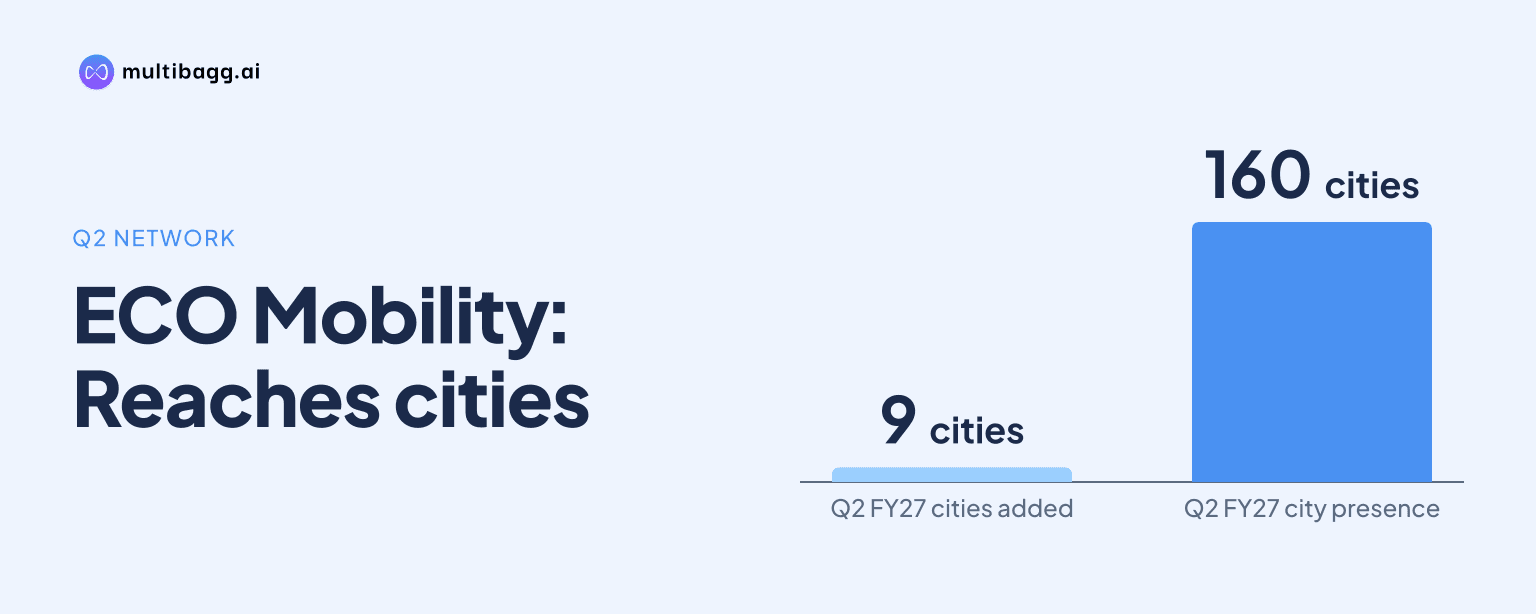
ECOS (India) Mobility & Hospitality Limited reached 160 cities in Q2 FY27 after adding nine locations, while approximately 1.58 million trips completed in the September 2026 quarter rose about 15% year on year. ECO Mobility also reported an owned and vendor-operated fleet of about 20,500 vehicles as of September 30, 2026.
Know Ecos (India) Mobility & Hospitality inside out
Results, valuation, peers and who's buying, in one view.
How did ECO Mobility expand to 160 cities in Q2 FY27?
ECO Mobility expanded its pan-India presence to 160 cities in Q2 FY27 by adding nine cities during the quarter ended September 2026. The company said the footprint was supported by owned vehicles and vendors, with its network covering economy and luxury cars, mini vans, luxury coaches and specialty vehicles.
The larger network coincided with approximately 1.58 million trips in Q2 FY27, representing growth of about 15% from Q2 FY26 and about 7% from Q1 FY27. For H1 FY27, ECO Mobility said trips crossed 3 million, about 21% above the corresponding first half of FY26.
Revenue from operations was Rs 234.506 crore in Q2 FY27, up 9.48% year on year and 10.94% quarter on quarter. In H1 FY27, revenue from operations increased 12.79% year on year to Rs 445.878 crore, compared with Rs 395.327 crore in H1 FY26.
The quarterly operating update shows trip growth of about 15% year on year alongside revenue-from-operations growth of 9.48% in Q2 FY27. ECO Mobility did not disclose revenue per trip, city-level revenue, or the contribution of the nine newly added cities to the Rs 234.506 crore quarterly revenue figure.
How large was ECO Mobility’s fleet at September 2026?
ECO Mobility had an owned and vendor-operated fleet of approximately 20,500 vehicles as of September 30, 2026, about 12% larger than a year earlier. Around 95% of the fleet was vendor-operated under the company’s asset-light model, leaving a minority of the reported fleet as owned vehicles.
Its electric-vehicle fleet reached 475 vehicles at the end of Q2 FY27, compared with 460 at the end of Q1 FY27 and 338 a year earlier. That was an addition of 15 electric vehicles sequentially and 137 vehicles year on year, while the total fleet stood at approximately 20,500 vehicles.
ECO Mobility reported two operating revenue categories for the quarter: employee transportation services, or ETS, and chauffeured car rentals, or CCR. ETS accounted for 58% of Q2 FY27 revenue and CCR accounted for 42%, a 16-percentage-point difference in the disclosed mix.
The company did not provide rupee revenue, trip totals or fleet numbers separately for ETS and CCR in its September-quarter announcement. It also did not state what portion of the 475 electric vehicles was vendor-operated, although approximately 95% of the overall 20,500-vehicle fleet used vendors.
Did ECO Mobility add clients and new distribution channels?
ECO Mobility onboarded 72 new clients in Q2 FY27, taking its active client base to 1,538. The quarterly addition was above 67 clients in Q2 FY26 and 61 clients in Q1 FY27, showing increases on both comparisons.
Around 50% of quarterly revenue continued to come from customers associated with ECO Mobility for more than five years. The company did not disclose the number of these customers, their individual revenue contribution, or a split of this measure between the 58% ETS and 42% CCR revenue streams.
During Q2 FY27, ECO Mobility launched a business-to-consumer, or B2C, app for premium chauffeur-driven car rentals on Android and Apple platforms. The company also said it continued to build distribution for its SIXT partnership under an exclusive India general sales agent, or GSA, arrangement.
The release gave no booking data, revenue contribution or target for the B2C app or the SIXT arrangement as of September 30, 2026. These initiatives were disclosed alongside the 72 new clients added in Q2 FY27 and the active client base of 1,538, rather than as quantified drivers of quarterly revenue.
Got a follow-up? Ask IRIS
What did ECO Mobility report for Q2 FY27 profit and margins?
ECO Mobility reported profit after tax, or PAT, of Rs 17.732 crore in Q2 FY27, up 21.40% year on year and 21.87% quarter on quarter. PAT margin was 7.44%, compared with 6.76% in Q2 FY26 and 6.80% in Q1 FY27.
Earnings before interest, tax, depreciation and amortisation, or EBITDA, excluding other income, rose 13.78% year on year to Rs 27.949 crore in Q2 FY27. The EBITDA margin was 11.92%, compared with 11.47% in Q2 FY26 and 10.34% in Q1 FY27; management attributed the improvement in profitability to cost efficiencies and operating leverage.
For H1 FY27, EBITDA was Rs 49.798 crore, up 7.27% from Rs 46.422 crore in H1 FY26, while the EBITDA margin was 11.17% against 11.74% a year earlier. H1 FY27 PAT increased 15.72% to Rs 32.282 crore, and PAT margin rose to 7.12% from 6.97%; thus, the Q2 EBITDA margin increased year on year while the H1 EBITDA margin was lower than the prior-year first-half level.
What was ECO Mobility’s financial position at September 2026?
ECO Mobility reported a debt-free balance sheet as of September 30, 2026, with cash and investments of Rs 125.611 crore and net worth of Rs 282.669 crore. Cash and investments included Rs 24.337 crore of mutual funds for which redemption requests had been initiated, with the company stating that proceeds were subsequently received through the settlement process.
Earnings per share were Rs 2.96 in Q2 FY27, compared with Rs 2.43 in Q2 FY26, while H1 FY27 earnings per share were Rs 5.38 against Rs 4.65 a year earlier. Shareholders approved a final FY26 dividend of Rs 2.38 per equity share at the 30th annual general meeting held on September 21, 2026.
The September-quarter release paired the debt-free position with Rs 17.732 crore of quarterly PAT and Rs 27.949 crore of EBITDA excluding other income. It did not disclose a capital-expenditure target, a fleet-expansion target, or a projection for the 160-city network beyond the September 30, 2026 reporting date.
Conclusion
ECO Mobility’s Q2 FY27 update combines a nine-city expansion with approximately 1.58 million trips, a 20,500-vehicle fleet and 72 new clients. Revenue from operations rose 9.48% year on year to Rs 234.506 crore, while PAT increased 21.40% to Rs 17.732 crore; ETS remained the larger disclosed revenue stream at 58%, compared with 42% for CCR.
The next disclosed operating areas to watch are distribution for the exclusive India SIXT GSA arrangement and activity from the B2C premium rental app launched in Q2 FY27. ECO Mobility provided no bookings, revenue target or timetable for either channel, so later company disclosures will be needed to assess their contribution alongside the more than 3 million trips reported for H1 FY27.