










ECOS Says Low Vendor Returns Could Tighten Vehicle Supply
Key highlights
- ECOS said unsustainable vendor economics could reduce investment in cars and lower corporate transport supply.
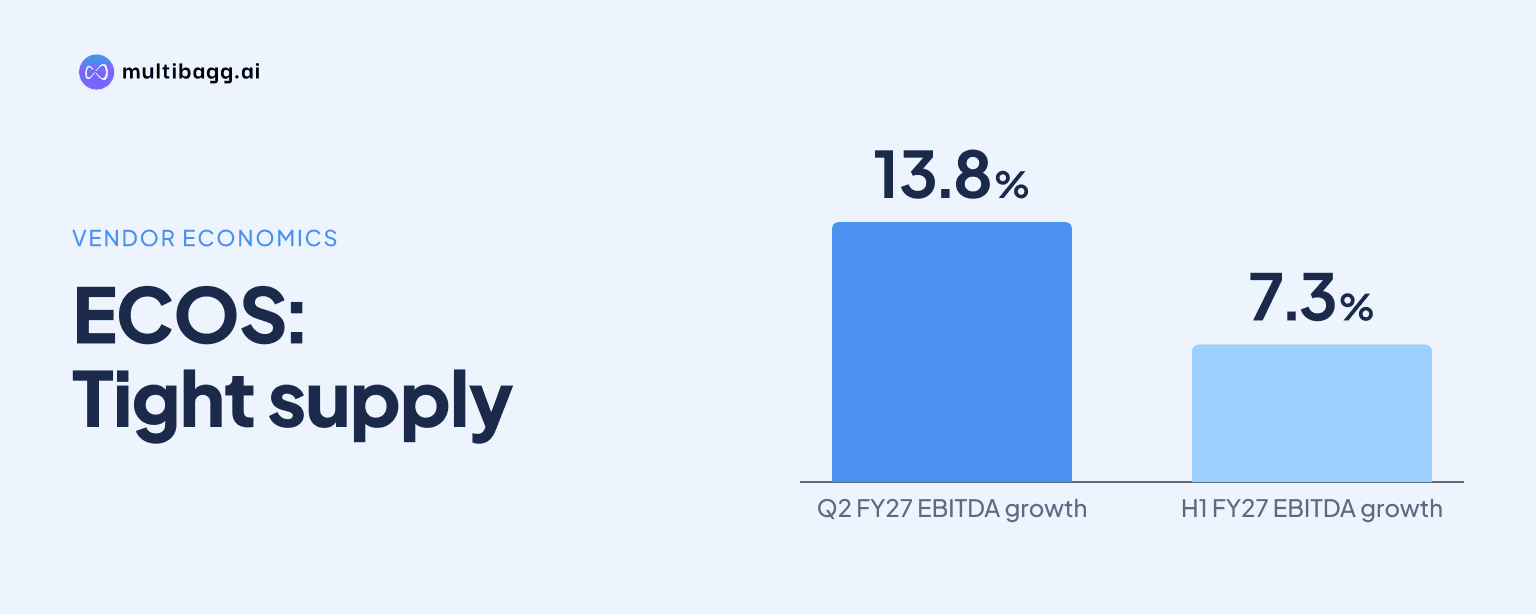
- ECOS reported Q2 FY27 EBITDA growth of 13.8% year on year, compared with 7.3% in H1 FY27.
- ECOS expects H2 FY27 EBITDA margin of 10% to 11%, after about 11.1% to 11.2% in H1 FY27.
- ECOS plans Rs 35 crore to Rs 45 crore of vehicle capital expenditure over the next two years.
powered by IRIS
ECOS (INDIA) Mobility and Hospitality Limited said on November 16, 2026 that contract rates below sustainable vendor economics could reduce investment in cars, constrain corporate transport supply and eventually require clients to pay the true economic cost of service. ECOS said it has maintained price thresholds despite losing some requests for proposal, or RFPs.
Know Ecos (India) Mobility & Hospitality inside out
Results, valuation, peers and who's buying, in one view.
Why does ECOS think vehicle supply could tighten?
ECOS said intense competition can create an unsustainable business model at the last-mile, or vehicle-provider, level. Management described a sequence in which inadequate unit economics reduce supply-chain investment in cars, leading to lower available supply and, eventually, clients paying the economic cost required to provide corporate transport services.
The company framed this as an industry-cycle outlook rather than a forecast of a specific price increase. Management said a supplier cannot sustain a three-to-five-year contract at unsustainable or loss-making cost levels. ECOS did not provide a timetable for tighter supply, a contract-rate target or a measure of expected vehicle-owner returns.
An analyst said fleet owners and driver-owners had faced flat or lower pricing for three to four years, while software costs had risen in locations including Bengaluru and Hyderabad. Management agreed with the broader concern, saying reduced investment in additional cars could follow when last-mile economics no longer support vehicle purchases.
How has ECOS responded to low-priced contracts?
ECOS said it has set price thresholds below which it will not provide services, even during high competitive intensity. Management said this decision may have caused the company to miss certain RFPs, but presented the approach as necessary because long-duration contracts cannot be fulfilled sustainably at a loss-making cost.
The company linked that stance to its FY27 profitability commentary. ECOS reported year-on-year earnings before interest, tax, depreciation and amortisation, or EBITDA, growth of 13.8% in Q2 FY27, compared with 7.3% growth in H1 FY27. Management cited cost efficiencies, pricing discipline and operating leverage as contributors.
The period comparison shows Q2 FY27 EBITDA growth exceeded the growth reported for the full first half. However, ECOS did not say that the anticipated supply-led pricing correction had started. Management said it expected H2 FY27 EBITDA margin of 10% to 11%, following margin of roughly 11.1% to 11.2% in H1 FY27.
How dependent is ECOS on external vehicle providers?
ECOS intends to keep company-owned vehicles at 5% to 10% of its total fleet under its asset-light model. That means vehicle availability largely depends on external providers, including fleet owners with five or 10 cars and driver-owners, making their willingness to add vehicles central to ECOS's supply outlook.
Management did not disclose the number of vendors, vendor-owned vehicles, supplier churn or vendor payment rates. An analyst referred to an operating platform managing more than 12,000 cars, but ECOS did not confirm how many of those vehicles were externally owned as of the November 16, 2026 call.
ECOS also distinguished its employee expenses from chauffeur and vendor costs. Management said chauffeur costs were only very marginal within employee cost, while about 75% of employee cost related to operational manpower on the ground, which works to ensure client service-level agreements, or SLAs, are met on every trip.
Got a follow-up? Ask IRIS
What operational trends affect ECOS's capacity needs?
ECOS said workforce additions followed transaction growth in the prior year. Management cited trip growth of about 27% in CCR and about 23% to 24% in ETS, while saying ticket size had shrunk somewhat. Revenue therefore increased less than transaction volumes, despite the additional operational manpower needed to support more trips.
An analyst said ECOS had around 1,270 employees in FY26 and added roughly 300 people, or 33%, in the following year. Management said most additions were at the lowest operating level, where employee requirements correlate directly with transactions, and said employee count had not increased much over the previous six months.
This contrast matters because higher trip volumes require last-mile service capacity, while smaller ticket sizes can limit revenue growth per transaction. ECOS did not disclose average revenue per trip, city-level contract rates or the respective returns earned by fleet owners and driver-owners in Bengaluru, Hyderabad or other markets.
What plans could change ECOS's cost and supply mix?
ECOS plans vehicle capital expenditure of Rs 35 crore to Rs 45 crore over the next two years. Management said the spending would cover economy, luxury and electric vehicles, depending on client requirements and replacement needs, while owned vehicles would remain within the 5% to 10% fleet range.
Technology investments are also part of ECOS's operating plan. The company said it deployed Microsoft Dynamics enterprise resource planning software in the month before the November 16, 2026 call and had around eight to 10 artificial intelligence, or AI, projects automating repetitive work and other processes.
Management said benefits from AI had begun to emerge during the prior one to two months and would feed into next year's manpower and headcount planning. ECOS expects higher productivity in shared services, while retaining last-mile personnel needed to maintain service quality and relationships with suppliers and customers.
ECOS also said it had launched a business-to-consumer, or B2C, application in beta testing on Android and Apple platforms. Management identified automated customer communications, payment follow-ups and invoice dispatch as potential efficiency measures, but gave no numerical target for cost savings, revenue, market share or working-capital improvement.
Conclusion
ECOS's stated view is that low contract prices can weaken vendor economics before a pricing change becomes visible in corporate transport contracts. Its response is to avoid work below internal price thresholds, even if that results in lost RFPs, while relying on an asset-light model in which only 5% to 10% of fleet vehicles are owned directly.
The next disclosed measures to watch are whether ECOS maintains its 10% to 11% H2 FY27 EBITDA-margin expectation and keeps vehicle capital expenditure within Rs 35 crore to Rs 45 crore over two years. The unresolved issue is when, or whether, lower vendor investment will reduce supply enough to change customer pricing, as ECOS gave no date or numerical target for that cycle.