










ECOS targets 10%-11% EBITDA margin amid pricing pressure
Key highlights
- ECOS reported a Q2 FY27 EBITDA margin of 11.9% but expects a 10%-11% range over the next two quarters.
- Q2 FY27 revenue from operations was Rs 234.5 crore, up 10.9% sequentially and 9.5% year on year.
- ETS contributed 58% of Q2 FY27 revenue and CCR contributed 42%; management describes ETS as lower margin.
- ECOS completed about 15.8 lakh trips in Q2 FY27, up 15% year on year, and added 72 clients.
powered by IRIS
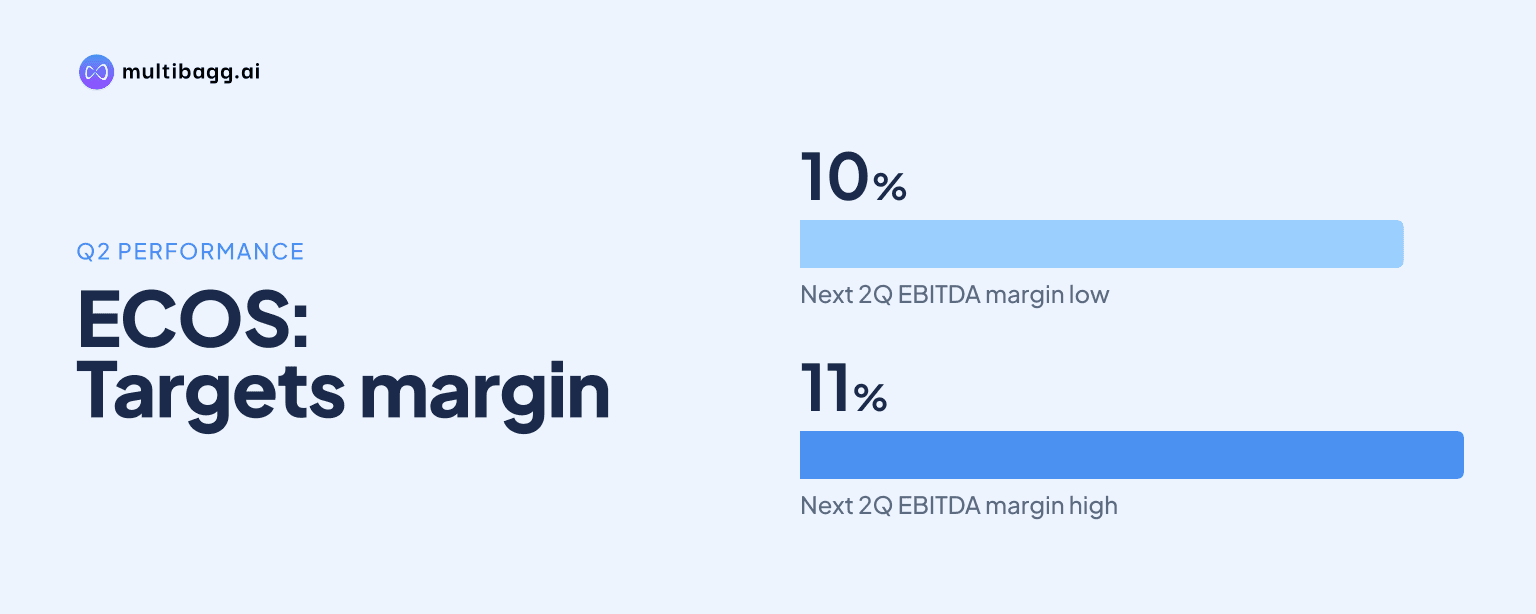
ECOS (INDIA) Mobility and Hospitality Limited expects a 10%-11% EBITDA margin over the next two quarters despite reporting 11.9% in Q2 FY27, because a 58% employee transportation services mix and competitor-led low-price bidding continue to affect margins. ECOS said it has declined prospective contracts below its pricing threshold.
Know Ecos (India) Mobility & Hospitality inside out
Results, valuation, peers and who's buying, in one view.
Why has ECOS set a 10%-11% EBITDA margin range?
ECOS has set an expected EBITDA, or earnings before interest, tax, depreciation and amortisation, margin range of 10%-11% for the next two quarters, with management saying it is confident of about 10%. Chairman and Managing Director Rajesh Loomba clarified this range after the chief financial officer initially referred to 11%-13% during the November 16, 2026 earnings call.
The range is below a prior level of more than 15% raised by an analyst on the call. Loomba said the business mix shifted over the past two to three years from majority chauffeur-driven car rentals, or CCR, to majority employee transportation services, or ETS. He also cited extremely high price pressure from competitors during the past one to one-and-a-half years, which management said reduced gross margins.
Q2 FY27 produced a margin above the stated range, but management did not treat that outcome as a new baseline. EBITDA was Rs 27.9 crore, up 27.9% from Rs 21.8 crore in Q1 FY27 and 13.8% from Rs 24.5 crore in Q2 FY26, while the margin reached 11.9% from 10.3% sequentially and 11.5% a year earlier.
Will ECOS reject employee transport contracts priced too low?
Yes, ECOS said it has strategically let go of certain prospective business offered below its selected pricing threshold. Management said it does not consider it prudent to increase revenue at the cost of margins, making pricing discipline part of its stated approach to sustainable and profitable growth.
The policy is particularly relevant to larger ETS contracts, where Loomba said competitive intensity remains high. He said that competitors may choose to bid at a loss to build revenue, but ECOS would retain its own pricing floor. Management also said some clients reject operators focused only on revenue when service quality or long-term commitment is inadequate, although it gave no figure for contracts won or lost on that basis.
ETS accounted for 58% of Q2 FY27 revenue, compared with 42% for CCR. Management described ETS as the lower-margin segment and CCR as a somewhat higher-margin business, but said it does not calculate EBITDA by segment. Loomba expects the current mix to remain broadly steady, with one or two percentage points of movement from quarter to quarter.
What drove ECOS's 11.9% Q2 FY27 EBITDA margin?
ECOS attributed the Q2 FY27 margin increase to cost optimisation, operating leverage and a marginally higher contribution from CCR. Revenue from operations rose 10.9% sequentially and 9.5% year on year to Rs 234.5 crore, providing the higher revenue base against which management said employee costs were controlled.
Cost of service fell to 74.2% of revenue in Q2 FY27 from 75.1% in Q1 FY27, an improvement of more than 100 basis points. Employee costs were about 10% of revenue, down from 11.2% in Q1 FY27, while employee benefit expense was Rs 23.4 crore, up 7.8% year on year but slightly lower than the preceding quarter.
Profit after tax was Rs 17.732 crore in Q2 FY27, up 21.4% from Rs 14.606 crore in Q2 FY26, and the profit-after-tax margin was 7.4%. For H1 FY27, EBITDA was Rs 49.798 crore at an 11.2% margin and profit after tax was Rs 32.282 crore, up 15.7% year on year. The Q2 outcome therefore combined better cost ratios with revenue growth, even as management retained its 10%-11% margin expectation.
Got a follow-up? Ask IRIS
How is ECOS pursuing growth while protecting pricing?
ECOS expects revenue to grow 13%-15% in FY27 while maintaining its pricing threshold for new work. Its priorities for the remainder of FY27 are to add high-quality enterprise relationships, increase share of wallet with existing customers, expand into geographies where there is a clear business case, and develop business-to-consumer and partnership channels.
Operating volumes increased during Q2 FY27. ECOS completed about 15.8 lakh trips, up 15% year on year and nearly 7% sequentially, while H1 FY27 trips exceeded 30 lakh, almost 21% above the comparable prior-year period. The company added 72 clients in Q2 FY27, versus 67 in Q2 FY26 and 61 in Q1 FY27, taking its active enterprise-client base to 1,538 organisations, nearly 10% higher sequentially.
ECOS ended September 30, 2026 with operations in 160 Indian cities after adding nine cities in the quarter. Its owned and vendor-operated network was about 20,500 vehicles, roughly 12% larger year on year, with vendor partners supplying around 95% of the fleet. Management said this supply model enables capacity to be aligned with customer demand rather than built ahead of demand.
Can technology help ECOS manage future margin pressure?
ECOS has started artificial intelligence, or AI, work across around eight to 10 projects, but management gave no quantified saving, headcount target or margin benefit. Loomba said the programme began three to four months before the November 16, 2026 call, led by an internal AI specialist reviewing departmental processes and feasible automation linked to the core enterprise resource planning system.
The company deployed a new Microsoft Dynamics enterprise resource planning system in the month before the call. Management identified repetitive tasks previously handled through computer-based spreadsheets, customer alerts for delayed vehicles, payment follow-ups and invoice dispatch as early areas for automation. It said resulting benefits would feed into next year's manpower and operating plans rather than be introduced abruptly.
Loomba said shared services offer the larger productivity opportunity because ECOS has a sizeable manpower pool in that area. He distinguished those functions from last-mile operations, where staffing remains necessary to maintain service quality and relationships with suppliers and customers. The technology plan is therefore an efficiency mechanism, but its financial contribution remains undisclosed.
Conclusion
ECOS delivered a Q2 FY27 EBITDA margin of 11.9% on Rs 234.5 crore of revenue, helped by a lower cost-of-service ratio, operating leverage and a marginally larger CCR contribution. Yet its stated 10%-11% margin range reflects structural mix change toward 58% ETS revenue and management's view that aggressive competitor pricing persists in major ETS contracts.
The next measures to watch are ECOS's ability to meet its 13%-15% FY27 revenue-growth expectation without moving below its pricing threshold, and whether the ETS-CCR mix stays near the reported 58%-42% split. Management also aspires to reach Rs 1,000 crore of revenue by FY28, while AI and enterprise-resource-planning initiatives are scheduled to inform next year's manpower planning without a disclosed financial target.