










Century Plyboards capex doubles as operating cash flow declines
Key highlights
- Century Plyboards spent Rs 368.2666 crore on property, plant and equipment and capital work in progress in the half year ended 30 September 2026.
- Net operating cash flow fell to Rs 176.3728 crore from Rs 287.8540 crore in the corresponding 2025 half year.
- Non-current borrowings increased to Rs 690.6096 crore at 30 September 2026 from Rs 426.6675 crore at 31 March 2026.
- Capital work in progress rose to Rs 283.8888 crore at 30 September 2026 from Rs 170.5826 crore at 31 March 2026.
powered by IRIS
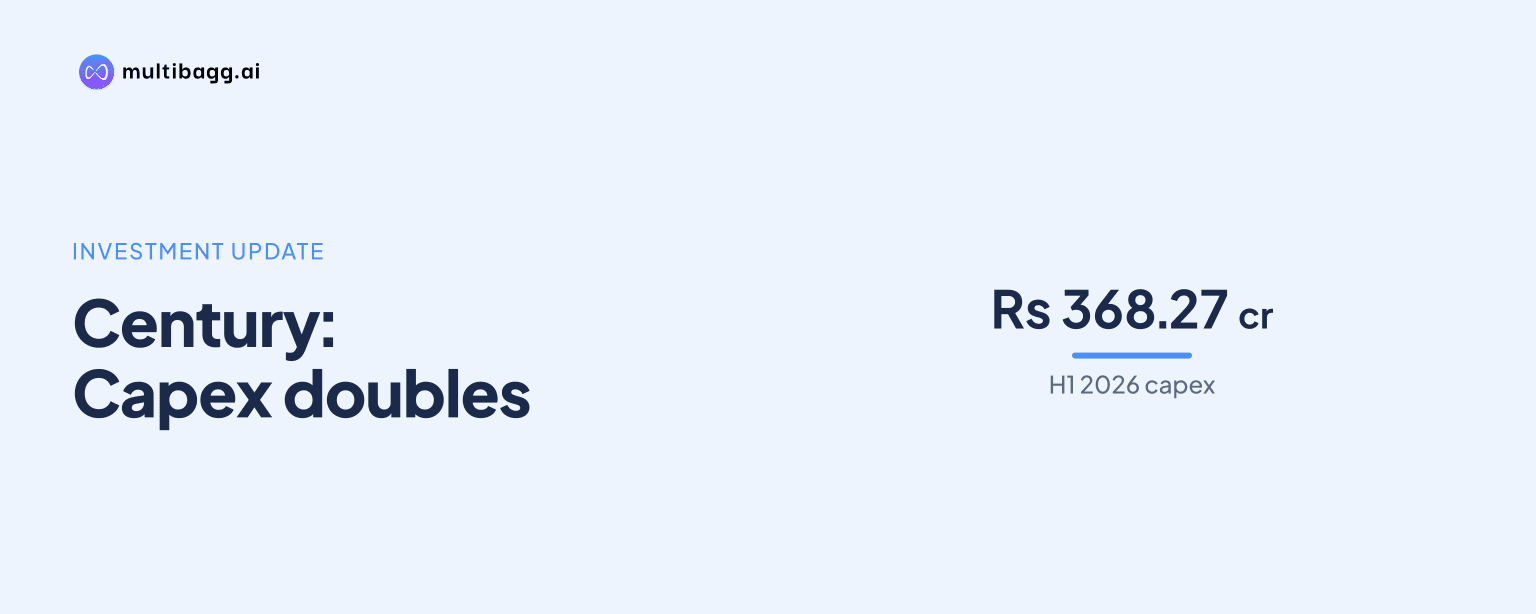
Century Plyboards (India) Limited nearly doubled capital expenditure to Rs 368.2666 crore in the half year ended 30 September 2026, while net operating cash flow fell to Rs 176.3728 crore from Rs 287.8540 crore a year earlier. The investment outlay exceeded operating cash generation and coincided with higher non-current borrowings.
Know Century Plyboards (India) inside out
Results, valuation, peers and who's buying, in one view.
How much did Century Plyboards spend on capital expenditure?
Century Plyboards spent Rs 368.2666 crore on purchases of property, plant and equipment, including capital work in progress, during the half year ended 30 September 2026. This was Rs 175.1726 crore higher than the Rs 193.0940 crore spent in the corresponding half year ended 30 September 2025, an increase of about 91% based on the disclosed cash-flow figures.
The outlay was larger than the Rs 176.3728 crore of net cash generated from operating activities in the latest half year. Operating cash flow was therefore Rs 191.8938 crore below the reported purchases of property, plant and equipment, including capital work in progress. Net cash used in investing activities increased to Rs 364.5517 crore from Rs 202.2838 crore in the year-earlier period.
The balance sheet shows the associated rise in assets at 30 September 2026. Property, plant and equipment, including right-of-use assets, stood at Rs 2,939.6081 crore, compared with Rs 2,794.8346 crore at 31 March 2026. Capital work in progress rose to Rs 283.8888 crore from Rs 170.5826 crore over the six-month interval, a Rs 113.3062 crore increase.
How did Century Plyboards fund its higher investment?
Century Plyboards partly funded the investment through additional non-current borrowings, which increased to Rs 690.6096 crore at 30 September 2026 from Rs 426.6675 crore at 31 March 2026. The Rs 263.9421 crore balance-sheet increase followed Rs 363.7932 crore of proceeds from non-current borrowings during the half year and Rs 50.9175 crore of repayments.
Financing activities produced a net cash inflow of Rs 202.9892 crore in the half year ended 30 September 2026, compared with a net outflow of Rs 77.3278 crore in the corresponding 2025 period. The latest-period financing cash flows included Rs 60.3858 crore of interest paid, Rs 2.9656 crore of other borrowing costs paid and Rs 3.4434 crore of principal payments on lease liabilities.
Current borrowings also rose, although by less than non-current borrowings. They were Rs 1,238.5423 crore at 30 September 2026, compared with Rs 1,203.3972 crore at 31 March 2026. Total liabilities increased to Rs 2,891.9274 crore from Rs 2,473.4922 crore, while total equity rose to Rs 2,795.0785 crore from Rs 2,630.0405 crore.
Got a follow-up? Ask IRIS
Why did Century Plyboards' operating cash flow decline?
Century Plyboards' net operating cash flow declined by Rs 111.4812 crore to Rs 176.3728 crore in the half year ended 30 September 2026, despite profit before tax increasing to Rs 257.4940 crore from Rs 169.0221 crore. Cash generated from operations before direct taxes was Rs 227.2970 crore, below Rs 325.3446 crore in the previous corresponding period.
The largest disclosed working-capital movement was a Rs 171.3450 crore increase in trade receivables, compared with a Rs 95.0241 crore increase in the prior-year half year. Inventories increased by Rs 12.4640 crore in the 2026 half year. These cash uses occurred alongside a Rs 60.3475 crore increase in trade payables and a Rs 2.0798 crore increase in financial liabilities.
Direct taxes paid, net of refunds, rose to Rs 50.9242 crore from Rs 37.4906 crore. Before working-capital movements, Century Plyboards reported operating profit of Rs 437.1392 crore, compared with Rs 333.5060 crore a year earlier, including depreciation and amortisation of Rs 110.7964 crore in the latest period.
What do the cash and asset changes show at 30 September 2026?
Century Plyboards ended 30 September 2026 with cash and cash equivalents of Rs 44.9950 crore, up from Rs 30.1752 crore at the beginning of the year. The Rs 14.8103 crore net increase in cash followed the Rs 364.5517 crore investing outflow and was supported by the Rs 202.9892 crore financing inflow.
Total assets increased to Rs 5,687.0059 crore at 30 September 2026 from Rs 5,103.5327 crore at 31 March 2026. Trade receivables reached Rs 787.2185 crore from Rs 617.6246 crore, while inventories increased to Rs 1,159.5462 crore from Rs 1,087.0822 crore, alongside the rise in property, plant and equipment and capital work in progress.
The half year also recorded higher revenue and profit. Revenue from operations was Rs 3,341.4294 crore, compared with Rs 2,554.8930 crore a year earlier, while net profit was Rs 186.9325 crore against Rs 123.8736 crore. Finance cost rose to Rs 63.4970 crore from Rs 53.2742 crore during the same period.
Conclusion
Century Plyboards' half-year accounts show investment rising faster than internally generated operating cash. Purchases of property, plant and equipment, including capital work in progress, reached Rs 368.2666 crore, while operating cash inflow was Rs 176.3728 crore and non-current borrowings increased by Rs 263.9421 crore from the 31 March 2026 balance.
The next results will show whether capital work in progress of Rs 283.8888 crore is transferred into operating assets and whether receivables, which rose by Rs 169.5939 crore from 31 March 2026, continue to absorb cash. The filing does not disclose a separate capital-expenditure target, project completion date or borrowing target beyond the balances and half-year cash movements reported at 30 September 2026.