










Clean Science Q2 revenue rises 22% as EBITDA margin falls
Key highlights
- Clean Science’s consolidated Q2 FY2027 revenue rose 22% year on year to Rs 299 crore.
- Consolidated EBITDA increased 5% to Rs 92 crore, while EBITDA margin declined to 31.2% from 36.4%.
- Consolidated Q2 FY2027 PAT rose 0.5% to Rs 56 crore, but fell 25% sequentially from Rs 73 crore.
- Newer segments contributed 22% of H1 FY2027 revenue, while performance chemicals accounted for 79% of the revenue mix.
powered by IRIS
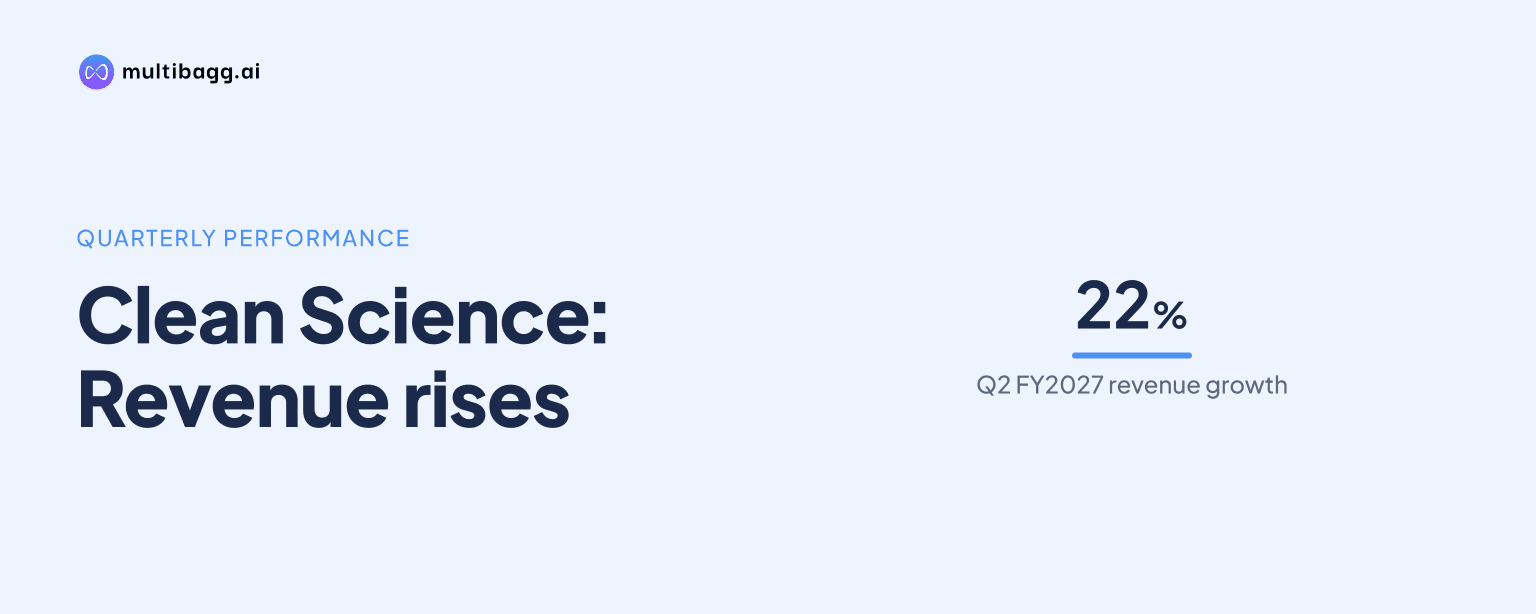
Clean Science and Technology Limited reported 22% year-on-year consolidated revenue growth to Rs 299 crore in Q2 FY2027, helped by about Rs 48 crore of incremental sales from Clean Fino Chem Ltd. (CFCL). Yet earnings before interest, tax, depreciation and amortisation (EBITDA) margin fell 5.2 percentage points to 31.2%, and profit after tax rose 0.5% to Rs 56 crore.
Know Clean Science & Technology inside out
Results, valuation, peers and who's buying, in one view.
Why did Clean Science’s Q2 FY2027 revenue rise 22%?
Clean Science’s consolidated revenue increased because CFCL added about Rs 48 crore of year-on-year sales and turned profit after tax (PAT) positive in Q2 FY2027. Total revenue rose to Rs 299 crore from Rs 245 crore in Q2 FY2026, while sale of products grew 23% to Rs 295 crore from Rs 240 crore. Other operating income was Rs 4 crore, compared with Rs 5 crore a year earlier.
The difference between standalone and consolidated growth points to the contribution from the newer business. Standalone total revenue rose 10% to Rs 233 crore from Rs 211 crore, compared with 22% consolidated growth. Standalone sale of products was Rs 226 crore, up from Rs 206 crore, while consolidated product sales reached Rs 295 crore.
Revenue also increased sequentially in the source’s comparison. Consolidated total revenue rose 12% from Rs 268 crore in the preceding quarter to Rs 299 crore in Q2 FY2027, while standalone revenue rose 12% from Rs 207 crore to Rs 233 crore. That produced an additional Rs 31 crore of consolidated quarterly revenue, although profitability ratios declined.
Why did Clean Science’s EBITDA margin fall to 31.2%?
Clean Science’s EBITDA margin declined because raw-material and other operating expenses increased faster than consolidated revenue. Raw-material expense rose 33% to Rs 128 crore in Q2 FY2027 from Rs 96 crore in Q2 FY2026, lifting its share of revenue to 43.3% from 40.1%. Other operating expenses increased 31% to Rs 80 crore from Rs 61 crore.
Management attributed moderated margins to geopolitical headwinds. The presentation shows power and fuel costs at 12.9% of revenue in Q2 FY2027, compared with 10.9% in Q2 FY2026 and 11.4% in the preceding quarter. Raw-material costs also increased sequentially, to 43.3% of revenue from 36.5%.
EBITDA increased Rs 5 crore year on year to Rs 92 crore despite the Rs 54 crore increase in revenue. Sequentially, EBITDA fell 5% from Rs 96 crore and the margin dropped from 36.5% to 31.2%. Standalone EBITDA margin was higher at 36.3%, but was below 43.6% in Q2 FY2026.
How did Clean Science’s Q2 FY2027 profit change?
Clean Science’s consolidated PAT was nearly flat year on year, increasing 0.5% to Rs 56 crore from Rs 55 crore. Profit before tax (PBT) declined 1% to Rs 74 crore from Rs 75 crore, and PBT margin fell to 25.2% from 31.3%. The movement contrasts with the 22% rise in total revenue and reflects the higher cost shares reported for the quarter.
Profit declined more sharply against the preceding quarter. Consolidated PAT fell 25% from Rs 73 crore, while PBT decreased 24% from Rs 98 crore. Other income was Rs 6 crore in Q2 FY2027, versus Rs 22 crore in the preceding quarter and Rs 7 crore in Q2 FY2026; finance costs were Rs 2 crore, compared with nil in both comparative periods.
Standalone results also recorded lower earnings conversion. Standalone PAT declined 14% year on year to Rs 55 crore from Rs 65 crore, and PAT margin fell to 24.5% from 31.3%. Standalone EBITDA declined 9% to Rs 82 crore even as revenue increased 10% to Rs 233 crore, with raw-material expense rising 30% to Rs 93 crore.
Got a follow-up? Ask IRIS
What do H1 FY2027 results show about Clean Science’s newer segments?
Clean Science’s H1 FY2027 results show that newer segments lifted group sales while consolidated margins declined from the previous year. Consolidated revenue rose 16% to Rs 568 crore from Rs 488 crore, whereas EBITDA increased 1% to Rs 188 crore from Rs 187 crore. EBITDA margin declined to 33.7% from 39.0%, as raw-material expense increased 29% to Rs 233 crore.
The presentation says newer segments contributed 22% of revenue in H1 FY2027. Standalone revenue increased 2% to Rs 440 crore from Rs 431 crore, while consolidated revenue grew 16%, illustrating the larger contribution from the group’s newer activities. Consolidated PAT rose 3% to Rs 129 crore from Rs 125 crore, but PAT margin decreased to 23.1% from 26.2%.
The H1 revenue mix also shifted towards performance chemicals. Performance chemicals accounted for 79% of consolidated H1 FY2027 revenue, up from 75% in H1 FY2026, while pharma and agro intermediates declined to 13% from 16% and FMCG chemicals fell to 7% from 9%. Management said the HALS, or hindered amine light stabiliser, segment grew twofold in H1 FY2027 on higher volumes.
Clean Science also said HALS accounted for 22% of sales and the top four legacy products’ contribution declined to about 58% in the quarter from about 85% in Q4 FY2023. This shows a change in product concentration alongside the revenue-mix shift. The presentation does not provide segment-level profit or margin figures for HALS, CFCL or the legacy products.
What is Clean Science planning after its CFCL investment?
Clean Science incurred about Rs 150 crore of capital expenditure in H1 FY2027 for investment in wholly owned CFCL. CFCL completed advanced HALS product trials with Geneus Chem AG, meeting the quality and regulatory standards cited in the presentation. Management expects a commercial launch in H2 FY2026–27.
Management also expects Performance Chemical 2 to be commercialised in H2 FY2027. At 30 September 2026, consolidated capital work-in-progress was Rs 156 crore, compared with Rs 118 crore at 31 March 2026. Consolidated total assets were Rs 1,920 crore at 30 September, up from Rs 1,783 crore six months earlier.
Conclusion
Clean Science grew consolidated Q2 FY2027 revenue 22% to Rs 299 crore, with CFCL contributing about Rs 48 crore of additional year-on-year sales and becoming PAT positive. However, raw-material costs reached 43.3% of revenue, EBITDA margin fell to 31.2% from 36.4%, and PAT increased only 0.5% to Rs 56 crore.
The next disclosed milestones are CFCL’s expected advanced HALS commercial launch in H2 FY2026–27 and the planned H2 FY2027 commercialisation of Performance Chemical 2. Management’s Rs 150 crore H1 FY2027 CFCL investment and the Rs 156 crore of consolidated capital work-in-progress at 30 September 2026 make the revenue and cost outcome of these projects the next reported item to watch.