










Clean Science and Technology Q2 revenue rises 23% to ₹295 crore
Key highlights
- Clean Science and Technology reported Q2 FY27 consolidated revenue of ₹295 crore, up 23% year on year.
- Consolidated revenue grew 12% quarter on quarter, supported by volume-led growth and HALS sales.
- Standalone revenue rose 11% sequentially to ₹226 crore, while raw-material costs increased to 41% of sales from 35%.
- Export sales accounted for 73% of standalone business in Q2 FY27, up from 64% in the prior quarter.
powered by IRIS
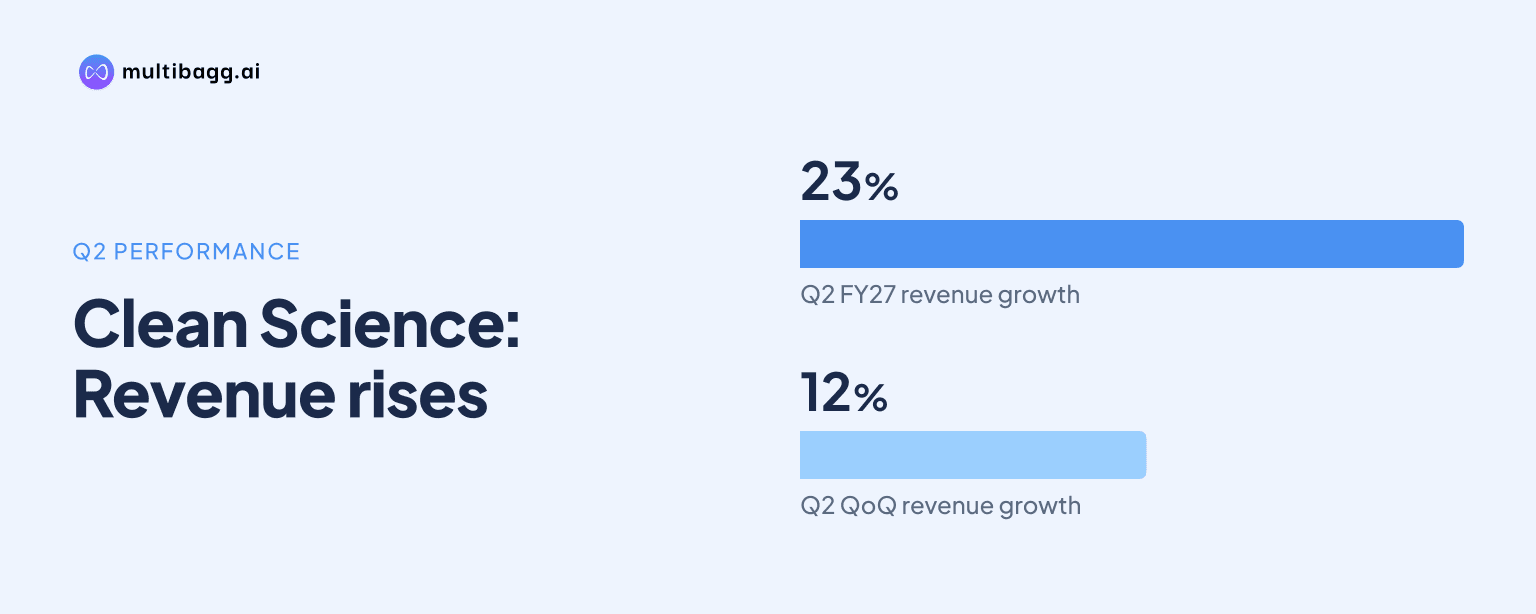
Clean Science and Technology Limited reported Q2 FY27 consolidated revenue of ₹295 crore, up 23% year on year and 12% sequentially, as higher volumes across its businesses and growth in the HALS segment supported sales. The quarter ended September 30, 2026, was described by management as the company’s highest-revenue quarter to date.
Know Clean Science & Technology inside out
Results, valuation, peers and who's buying, in one view.
How did Clean Science and Technology perform in Q2 FY27?
Clean Science and Technology delivered consolidated revenue of ₹295 crore in Q2 FY27, compared with growth of 23% on a year-on-year basis, according to management’s earnings call. Sequential revenue growth was 12%, led by volumes rather than a stated improvement in pricing. The company reported consolidated EBITDA of ₹92 crore and profit after tax of ₹56 crore for the quarter.
The company’s investor presentation separately cited Q2 FY27 consolidated revenue of ₹299 crore, growth of 22% year on year, PAT of ₹56 crore and an EBITDA margin of 31.2%. The earnings-call discussion referred to ₹295 crore in consolidated revenue. Both disclosures indicated that the quarter set a record for consolidated sales, with HALS contributing to growth.
What drove Clean Science and Technology’s revenue growth?
Clean Science and Technology said revenue growth was driven by higher volumes in its performance, pharma and FMCG businesses, alongside the scaling up of its HALS segment. Management said the company is moving from an investment phase towards asset monetisation in HALS, while the established business continued to raise volumes in flagship products.
HALS, or hindered amine light stabilisers, was identified as a key contributor to the record consolidated quarter. Management also said it is pursuing advanced HALS chemistry through a new Swiss strategic collaboration. The information provided did not disclose the revenue contribution from HALS or the financial terms of that collaboration.
The base business remained supported by customer demand despite input-cost pressure. In the standalone business, export sales increased to 73% from 64% in the preceding quarter. This indicates that overseas sales accounted for a larger share of standalone business during the period, although the company did not provide a geographical revenue breakup.
Why did Clean Science and Technology’s standalone margins moderate?
Clean Science and Technology reported standalone revenue of ₹226 crore, up 11% sequentially and 10% year on year, while standalone EBITDA and PAT margins were 36% and 24%, respectively. Standalone EBITDA was ₹82 crore and PAT was ₹55 crore for the quarter.
Management attributed margin moderation to higher raw-material costs that could not be fully passed on to customers. Raw-material costs rose to 41% of standalone sales in Q2 FY27 from 35% in Q1 FY27. The company said customer demand remained resilient, but inflation in inputs affected profitability in the legacy business.
Management highlighted a difference between imported and domestic input costs. It said certain major raw materials are imported from China, where producers were not increasing prices, while some raw materials purchased in India had become almost three times more expensive. This cost mismatch was presented as a reason for pressure on standalone margins.
Got a follow-up? Ask IRIS
What did management say about phenol prices and market conditions?
Clean Science and Technology said phenol prices in India were above $1,550, compared with about $1,300 in China, creating a sizeable price gap between the two markets. Managing Director Siddharth Sikchi said the differential was large enough for Chinese producers to hold prices on hydroquinone and MEHQ.
An investor asked whether commissioning by Haldia Petrochemicals could narrow the India-China phenol price gap. The supplied earnings-call material does not provide a definitive management forecast on the effect of the commissioning. It therefore remains an unresolved factor for input costs and the pricing environment discussed during the call.
The company also said its existing capacities were being used for captive consumption. Small sales had started in Europe and India, according to management. No revenue amount, capacity figure or timeline for a broader commercial ramp-up was disclosed in the material provided.
How should investors assess the Q2 FY27 update?
Clean Science and Technology’s Q2 update shows volume-led growth across the base portfolio and additional support from the HALS business, but it also shows that input inflation weighed on standalone profitability. Consolidated sales grew faster than standalone sales, reflecting the significance of the newer growth areas in the reported quarter.
For investors, the main financial markers are consolidated revenue of ₹295 crore, consolidated PAT of ₹56 crore and standalone raw-material costs of 41% of sales. The company’s ability to maintain volume growth while managing domestic input-cost inflation will remain relevant to operating margins. The supplied material does not include share-price data, guidance, or a quantified margin outlook.
The growth in export share to 73% of standalone business is also relevant because overseas markets form a substantial part of the company’s sales mix. At the same time, management’s comments on Chinese pricing and phenol costs show that conditions in international chemical markets can influence realised margins even when customer demand remains stable.
Conclusion
Clean Science and Technology reported record quarterly sales in Q2 FY27, with consolidated revenue of ₹295 crore rising 23% year on year. Higher volumes in performance, pharma and FMCG products, combined with HALS growth, supported the result, while elevated raw-material costs reduced standalone margin performance.
The next areas to watch are the pace of HALS commercial scaling, the effect of the Swiss strategic collaboration, and movements in Indian and Chinese phenol prices. Management has also identified Haldia Petrochemicals’ commissioning as a market issue raised by investors, but it did not provide a confirmed assessment of its impact.