










Coal India Cuts Receivables by Rs 2,523 Crore in Six Months
Key highlights
- Coal India’s consolidated gross trade receivables fell Rs 2,523 crore to Rs 13,462 crore at 30 September 2026 from Rs 15,985 crore at 31 March 2026.
- DVC and NTPC recorded the largest customer-level reductions, at Rs 1,537 crore and Rs 720 crore respectively.
- WCL and MCL had the largest subsidiary-level receivables at Rs 3,770 crore and Rs 3,353 crore, together accounting for Rs 7,123 crore.
- Coal India’s EBITDA margin declined to 29% from 32%, while its net profit margin fell to 17% from 18%.
powered by IRIS
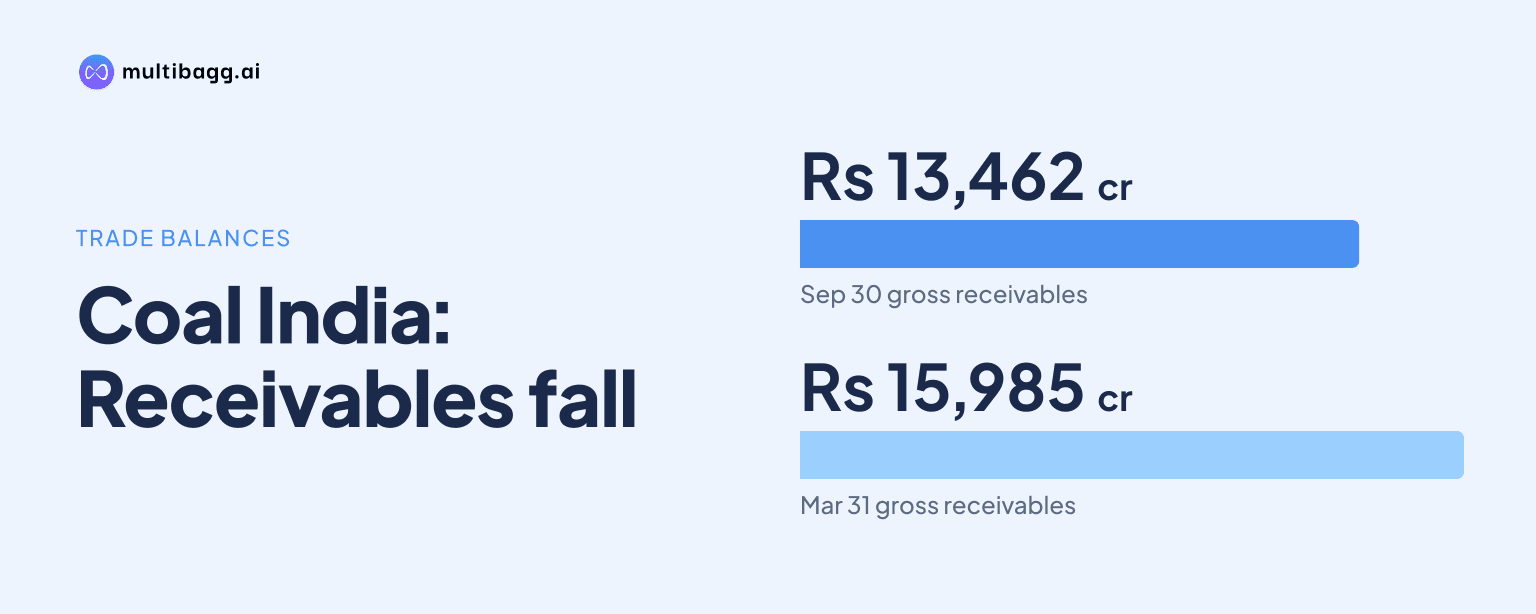
Coal India reduced consolidated gross trade receivables to Rs 13,462 crore on 30 September 2026 from Rs 15,985 crore on 31 March 2026, a Rs 2,523 crore decline in six months. The largest customer-level reductions came from DVC, down Rs 1,537 crore, and NTPC, down Rs 720 crore, although MAHAGENCO remained the largest reported customer balance at Rs 3,588 crore.
Know Coal India inside out
Results, valuation, peers and who's buying, in one view.
Why did Coal India's receivables fall by Rs 2,523 crore?
Coal India's reported consolidated gross trade receivables fell by Rs 2,523 crore between 31 March 2026 and 30 September 2026. The balance declined to Rs 13,462 crore at September-end from Rs 15,985 crore at the March year-end, after standing at Rs 15,834 crore on 30 June 2026. Therefore, Rs 2,372 crore of the six-month reduction occurred during the quarter ended 30 September 2026.
The reported figures are gross trade receivables before adjustment for unbilled incentive, Coal Quality Variance and other items specified by Coal India. Its debtor turnover ratio, measured as months of gross sales, declined to 0.76 at 30 September 2026 from 0.81 at 31 March 2026. Coal India attributed that movement to the decrease in trade receivables.
The decline in the debtor turnover ratio coincided with a fall in the absolute receivables balance, while the current ratio moved to 1.81 from 1.86. Coal India attributed the lower current ratio to higher other current liabilities. The quick ratio increased to 1.65 from 1.62, which management attributed to higher deposits and lower inventory.
Which Coal India customers drove the receivables reduction?
DVC and NTPC accounted for the largest customer-level reductions in Coal India's reported receivables. DVC's balance fell by Rs 1,537 crore to Rs 266 crore at 30 September 2026 from Rs 1,803 crore at 31 March 2026. NTPC's balance declined by Rs 720 crore to Rs 1,107 crore from Rs 1,827 crore.
Together, the Rs 2,257 crore reduction at DVC and NTPC was close to the Rs 2,523 crore fall in Coal India's consolidated balance. The source does not allocate individual customers to particular subsidiaries, so it does not establish which Coal India subsidiary collected these amounts. The customer table instead reports balances at the consolidated level.
Several customer balances increased and partly offset the reductions. MAHAGENCO rose by Rs 89 crore to Rs 3,588 crore, UPRVUNL increased by Rs 340 crore to Rs 623 crore, SAIL rose by Rs 197 crore to Rs 773 crore, and TVNL increased by Rs 59 crore to Rs 701 crore. MAHAGENCO was the largest reported customer balance at 30 September 2026, followed by APGENCO at Rs 1,930 crore and NTPC at Rs 1,107 crore.
Other reported decreases included Rs 509 crore in the category labelled Others, Rs 181 crore at APPDCL and Rs 136 crore at RRVUNL. APGENCO declined by Rs 64 crore, RINL by Rs 40 crore and DPL by Rs 23 crore. These changes, alongside the DVC and NTPC reductions, resulted in the consolidated decline to Rs 13,462 crore.
Got a follow-up? Ask IRIS
Which Coal India subsidiaries had the largest receivables?
WCL and MCL had Coal India's largest subsidiary-level gross trade receivables at 30 September 2026, at Rs 3,770 crore and Rs 3,353 crore respectively. WCL's balance was Rs 90 crore above its Rs 3,680 crore position at 31 March 2026, while MCL reduced its balance by Rs 185 crore from Rs 3,538 crore. Together, they accounted for Rs 7,123 crore of the Rs 13,462 crore consolidated total.
BCCL, SECL and ECL reported the largest subsidiary-level reductions, at Rs 1,048 crore, Rs 831 crore and Rs 672 crore respectively. BCCL closed at Rs 1,634 crore, SECL at Rs 947 crore and ECL at Rs 1,070 crore. By contrast, NCL rose by Rs 231 crore to Rs 1,359 crore, the largest increase among the listed subsidiaries.
CCL's receivables declined by Rs 107 crore to Rs 1,318 crore, while the Coal India standalone balance remained unchanged at Rs 11 crore. The subsidiary movements reconcile to the consolidated reduction reported for 30 September 2026. They also show that the overall fall was not uniform, because WCL and NCL ended the period above their March balances.
How did Coal India's financial ratios move with receivables?
Coal India's debtor turnover ratio declined to 0.76 months of gross sales at 30 September 2026 from 0.81 months at 31 March 2026, matching the lower reported trade receivables balance. Its inventory turnover ratio, measured as months of cost of goods sold, also declined to 1.04 from 1.22. Coal India attributed the inventory movement to a decrease in closing coal stock.
Coal India's debt-equity ratio increased to 0.13 from 0.12 because of higher borrowings, according to the presentation. Its margin before interest, tax, depreciation and amortisation on revenue from operations declined to 29% from 32%, with Coal India attributing the change to higher production costs. Operating margin also declined to 18% from 19%.
Gross profit margin was 23% at 30 September 2026, compared with 25% at 31 March 2026, and net profit margin was 17%, compared with 18%. Earnings per share were Rs 24.94 in the first half of 2026-27, compared with Rs 50.46 at 31 March 2026; Coal India noted that the first-half figure was not annualised. Book value per share increased to Rs 206.84 from Rs 193.26, which the presentation attributed to higher net worth.
Conclusion
Coal India's Rs 2,523 crore reduction in reported gross trade receivables was led by lower balances at DVC and NTPC, while BCCL, SECL and ECL recorded the largest subsidiary-level declines. The movement reduced consolidated receivables to Rs 13,462 crore and coincided with a debtor turnover ratio of 0.76 months, down from 0.81 months at 31 March 2026. However, balances increased at NCL and WCL, and MAHAGENCO remained the largest customer balance.
The next reported receivables balance will show whether Coal India can sustain the reduction from Rs 13,462 crore, particularly at WCL and MCL, which together accounted for Rs 7,123 crore at 30 September 2026. The presentation does not disclose a customer-specific collection plan, a receivables target or a scheduled collection event, leaving subsequent customer and subsidiary balances as the unresolved measure.