










Concord says API growth can exceed historical 18%-19% rate
Key highlights
- Concord's API revenue rose 30% year-on-year to Rs 250.1 crore in Q2 FY '27.
- Management said API growth can be slightly above its historical 18%-19% rate over the next two to three years.
- Concord has more than 30 fermentation-based APIs and another 10-15 products in its pipeline.
- H1 FY '27 EBITDA margin was 33.0%, while gross margin declined to 77.4% from 79.1% a year earlier.
powered by IRIS
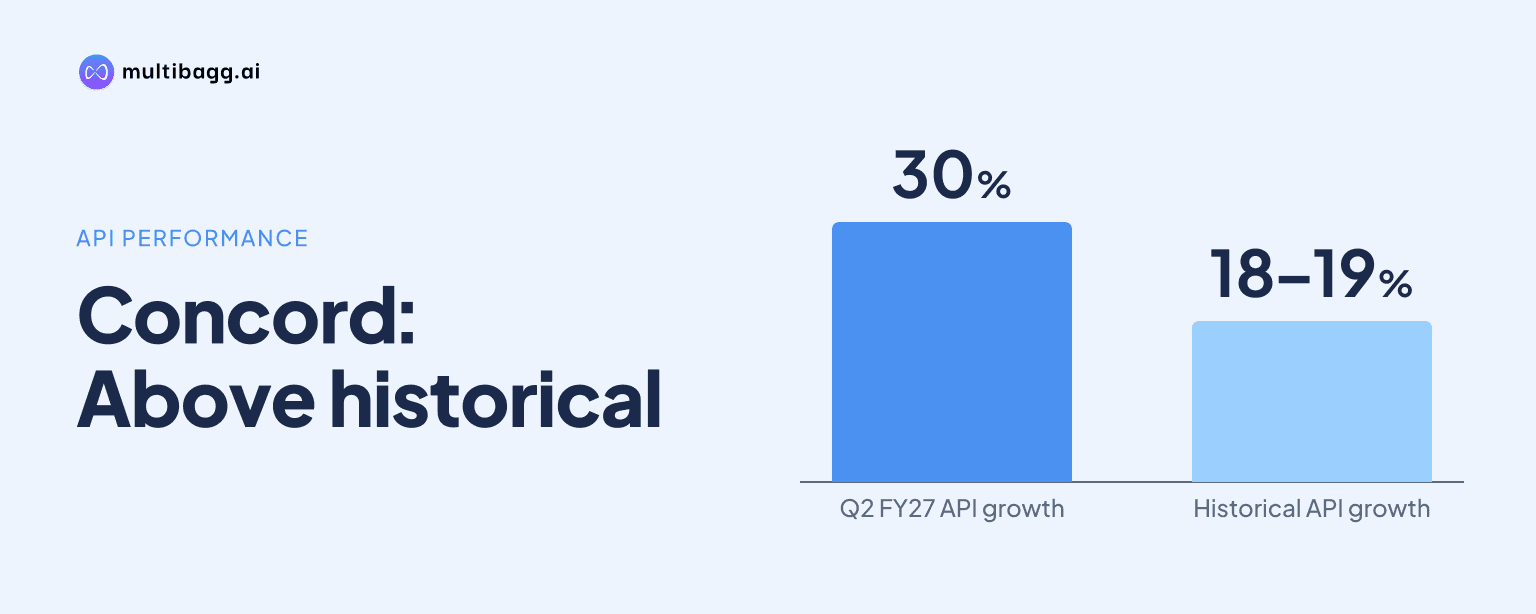
Concord Biotech Limited said on October 28, 2026, that API growth can exceed its historical 18%-19% rate over the next two to three years, after API revenue rose 30% year-on-year to Rs 250.1 crore in Q2 FY '27. Management cited its 30-plus-product fermentation portfolio, 10-15 pipeline products and new customer additions.
Know Concord Biotech inside out
Results, valuation, peers and who's buying, in one view.
What is Concord's API growth outlook?
Concord expects API growth to be slightly above its historical 18%-19% rate over the next two to three years, management said in response to an analyst question. Management said the historical rate was a reasonable base assumption and identified injectables, contract development and manufacturing organisation, or CDMO, work, and finished formulations as additional contributors to overall growth.
The Q2 FY '27 API performance was above that historical range. API revenue increased 30% year-on-year to Rs 250.1 crore, while total revenue rose 25% to Rs 309.1 crore and formulation revenue grew 6% to Rs 58.9 crore. Management attributed the different segment growth rates partly to some emerging-market customers purchasing APIs instead of finished formulations.
For H1 FY '27, total revenue increased 26% to Rs 566.6 crore from Rs 451.1 crore in H1 FY '26. Concord said it evaluates progress through overall end-customer sales and its share of customers' total procurement, rather than the quarterly API-formulation split, because customer sourcing arrangements can alter the reported segment mix.
Which products could drive Concord's API growth?
Concord said its portfolio of more than 30 fermentation-based APIs and a pipeline of another 10-15 products should drive API growth. Management said it had built significant capacity for these products as they become commercial, supplementing its established immunosuppressant business.
Management said growth in the previous six months had been particularly significant in anti-infectives, antifungals and oncology. Nystatin, commercialised about one and a half years earlier, continued to gain traction. Several US customers had qualified Concord as a source and received validation quantities, although commercial supplies to those customers had not begun.
In antibacterials, Concord reported traction in Mupirocin and Mupirocin calcium. Management said initial quantities of Fusidic acid had been supplied and that commercialisation in emerging markets was expected in the coming months or quarters, followed by an extension to global markets. Concord also launched Fidaxomicin and filed a US Drug Master File, or DMF, for the product.
Oncology product Romidepsin gained momentum as some customers launched products in the US, while Everolimus continued to see traction, management said. The immunosuppressant portfolio includes Tacrolimus, Mycophenolate Mofetil, Mycophenolate sodium and Cyclosporine, with growth also reported in Sirolimus and Pimecrolimus.
Where is Concord adding customers and qualifications?
Concord is adding customers across the US, Latin America and Japan, with recent additions linked especially to anti-infective, antifungal and oncology products. Management said products expected to launch in coming quarters were also mainly in anti-infective and antifungal categories, which could bring further customer additions.
US Nystatin qualifications represent an opportunity that has not yet converted into commercial sales. Management said it had supplied validation quantities to several qualified US customers and expects a significant increase in Nystatin revenue when commercial procurement begins. The call did not specify when those customers would start placing commercial orders.
Reported domestic API revenue grew 42% year-on-year in Q2 FY '27, compared with 8% growth in export revenue. Management cautioned that this comparison does not necessarily represent final market demand because some customers buy through Indian subsidiaries and subsequently export products to regulated markets.
Management said Concord can offer customers lower procurement costs than their previous suppliers through fermentation scale, technical expertise and productivity, while retaining profitability in line with its API business. It reported no pricing pressure in Q2 FY '27 and said pricing relative to competing suppliers had helped win customers.
Got a follow-up? Ask IRIS
How did Concord's Q2 FY '27 results compare with last year?
Concord's API revenue grew faster than both total revenue and formulation revenue in Q2 FY '27, while H1 earnings rose despite lower gross margin. The quarterly mix reflected customer procurement choices as well as product demand, with API revenue of Rs 250.1 crore accounting for most of the Rs 309.1 crore total.
Earnings before interest, tax, depreciation and amortisation, or EBITDA, increased about 18% year-on-year to Rs 104.4 crore in Q2 FY '27. Profit after tax, or PAT, rose 10.3% to Rs 69.6 crore. In H1 FY '27, EBITDA increased 25% to Rs 187 crore and PAT rose 19% to Rs 127.3 crore.
Gross margin declined to 76.2% in Q2 FY '27, about 400 basis points below the prior-year quarter, and stood at 77.4% in H1 FY '27 versus 79.1% in H1 FY '26. EBITDA margin was comparatively stable at 33.0% in H1 FY '27 against 33.2% a year earlier.
What could affect Concord's growth and margins?
The timing of product commercialisation, raw-material costs and injectable-facility utilisation could affect Concord's growth outlook and margins. Management said higher solvent prices, geopolitical uncertainty and supply-chain disruption reduced Q2 FY '27 gross margin, while power and fuel costs also affected profitability.
Concord does not plan immediate customer pass-throughs for higher raw-material costs because management views the issue as short term. Management instead cited research and development, productivity gains, cost optimisation and inventory management, and said it expects full-year margin recovery through those measures and revenue improvement.
The company is also funding operations that have yet to reach revenue scale. Excluding expenses tied to the new injectable facility and Stellon, its US formulation platform, H1 FY '27 EBITDA margin would have been about 37.8%, compared with the reported 33.0%.
Unit-IV injectable capacity utilisation was around 5%, compared with 21% at Unit-II for oral solids. Management said several prospective injectable customers had audited the facility in recent months and was optimistic that some contracts would materialise in H2 FY '27, though no contracts were confirmed during the call.
Conclusion
Concord's API outlook depends on broadening products and customers beyond its core immunosuppressant franchise. The 30% increase in Q2 FY '27 API revenue to Rs 250.1 crore was above management's cited historical 18%-19% growth rate, with anti-infectives, antifungals and oncology contributing alongside established products.
The next points to watch are commercial orders from qualified US Nystatin customers, the rollout of Fusidic acid and other pipeline products, and whether injectable contracts materialise in H2 FY '27. Management also expects cost actions, inventory management and revenue growth to address margin pressure after H1 FY '27 gross margin fell to 77.4% from 79.1%.