










Concord Biotech Limited says expansion cut H1 margin by 480 bps
Key highlights
- Concord Biotech reported a 33.0% EBITDA margin in H1 FY '27, versus 33.2% in H1 FY '26.
- Management estimated a 37.8% H1 FY '27 EBITDA margin excluding Stellon and injectable-facility costs, a 480-basis-point difference.
- H1 FY '27 revenue rose 26% year on year to Rs 566.6 crore, while EBITDA increased 25% to Rs 187 crore.
- Unit-IV injectable capacity utilisation was around 5%, compared with 21% at Unit-II.
powered by IRIS
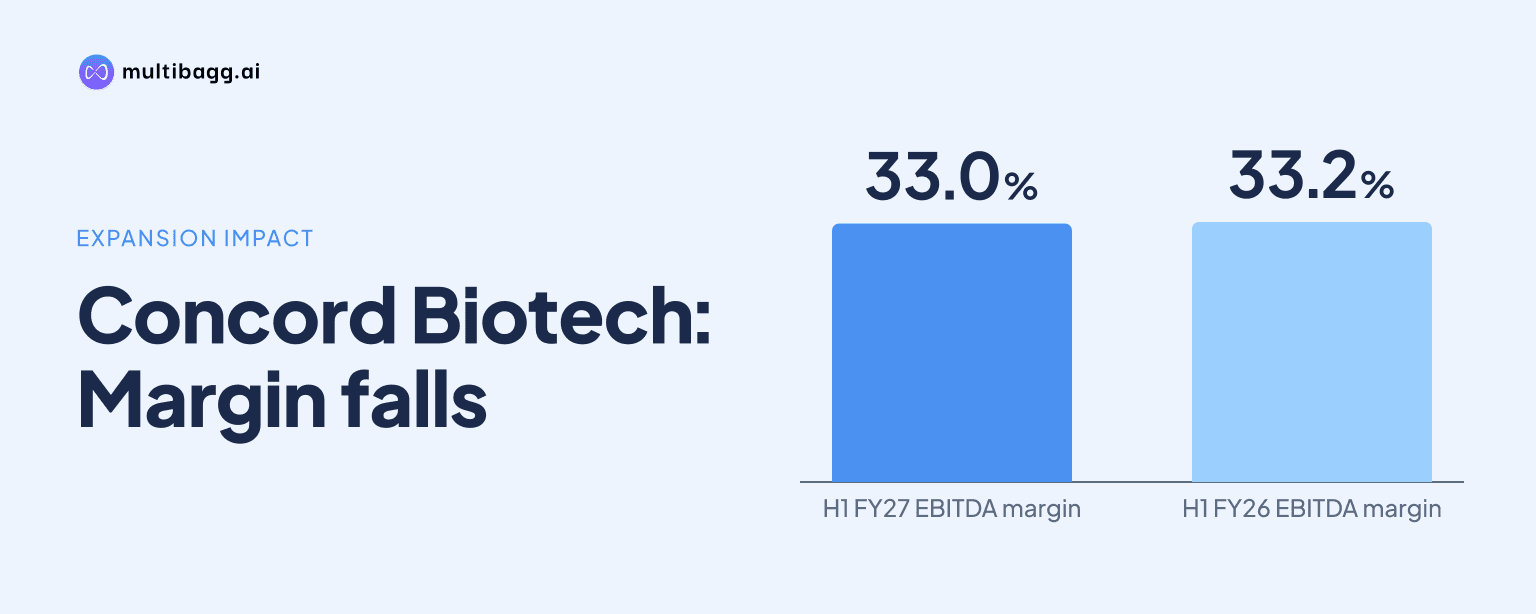
Concord Biotech reported a 33.0% earnings before interest, tax, depreciation and amortisation (EBITDA) margin in the first half (H1) of financial year (FY) '27, while management estimated a 37.8% margin excluding Stellon and injectable-facility expenses, a difference of 480 basis points. Revenue rose 26% year on year to Rs 566.6 crore in the six months ended September 30, 2026.
Know Concord Biotech inside out
Results, valuation, peers and who's buying, in one view.
Why was Concord Biotech's H1 EBITDA margin 33.0%?
Concord Biotech's reported H1 FY '27 EBITDA margin was 33.0%, compared with 33.2% in H1 FY '26, because it absorbed expansion expenses while revenue from Stellon and the injectable facility had not yet scaled. EBITDA rose 25% year on year to Rs 187 crore, broadly in line with the 26% increase in revenue to Rs 566.6 crore.
Management said the H1 margin would have been about 37.8% without expenses associated with Stellon and the new injectable facility. The 4.8-percentage-point difference from the reported 33.0% margin equals 480 basis points and reflects a management calculation, not a separately reported financial measure. Management described the adjusted level as closer to Concord Biotech's historical margin levels.
Gross margin also declined in H1 FY '27, falling to 77.4% from 79.1% in H1 FY '26. Management attributed the 170-basis-point contraction to higher raw-material prices, particularly solvents, as well as changes in product mix. It cited geopolitical uncertainty and supply-chain disruption as contributors to the input-cost pressure.
How much did Stellon and injectables affect profitability?
Stellon and injectable-facility costs lowered Concord Biotech's H1 FY '27 EBITDA margin by about 480 basis points on management's calculation. In the second quarter (Q2) of FY '27, excluding those costs would have lifted the margin from 33.8% to 37.1%, a 330-basis-point difference. The disclosed H1 impact was therefore larger than the September-quarter gap.
Concord Biotech did not disclose the rupee value of these costs or divide them between Stellon and the injectable operation. Management described Stellon, its United States formulation distribution platform, as being at a nascent stage, while revenue from the injectable facility was yet to ramp up. The 37.8% estimate therefore measures their combined effect rather than the cost of either initiative alone.
The injectable operation, Unit-IV, was operating at around 5% capacity utilisation when management spoke on October 28, 2026. Management said several potential customers had audited the facility in the preceding months and expected some contracts to materialise in H2 FY '27. It identified higher utilisation from those contracts as the route to revenue growth and margin improvement.
What other costs pressured Concord Biotech's margins?
Concord Biotech said Q2 FY '27 gross margin was 76.2%, approximately 400 basis points below the comparable quarter, mainly because raw-material costs increased. Management specifically identified solvents, alongside higher power and fuel costs, while the finance team also cited product-mix changes. The Q2 gross-margin decline was steeper than the 170-basis-point reduction recorded over H1.
Management said it did not plan to broadly pass the raw-material increase to customers because it considered the issue short term. Instead, it intends to address the pressure through research and development-led productivity improvements. Management also said Concord Biotech's scale, fermentation expertise and productivity allow it to offer customers lower procurement prices than their existing suppliers while retaining API profitability in line with its business.
Investments in renewable energy during the previous year partly offset higher power and fuel costs, according to management. It expects fuller benefits once those energy costs stabilise, but did not provide a date or rupee saving target. Management also expects cost optimisation, inventory management and improved revenue to help recover the margin effect over the full FY '27.
Got a follow-up? Ask IRIS
Can revenue growth support Concord Biotech's margin recovery?
Revenue growth can support a recovery if injectable contracts and Stellon sales ramp up, according to management. Q2 FY '27 revenue increased 25% year on year to Rs 309.1 crore, including a 30% rise in active pharmaceutical ingredient (API) revenue to Rs 250.1 crore. Formulation revenue rose 6% to Rs 58.9 crore during the quarter.
Management said the slower formulation increase partly reflected emerging-market customers choosing APIs instead of finished formulations. It also cited the transfer of business from Advergent to Stellon. Domestic formulation revenue nevertheless increased 29% in Q2 FY '27, and management said customer procurement patterns can shift reported revenue between APIs and formulations without changing the underlying end-customer opportunity.
Product growth was broad, management said. Immunosuppressants recorded high double-digit growth, while anti-infectives and antifungals grew in line with the company average and oncology nearly doubled from the corresponding period. Management identified the United States, Latin America and Japan as key markets and said growth over the previous six months was particularly significant in anti-infectives, antifungals and oncology.
What could raise capacity use and margins next?
Capacity utilisation can rise through new formulation launches, Stellon's distribution work and injectable customer contracts. Concord Biotech reported 21% utilisation at Unit-II, its oral-solid formulation facility, compared with around 5% at Unit-IV. The difference shows that both plants had unused capacity, with the injectable unit at an earlier stage of commercialisation.
Management said it had already supplied Tofacitinib to Stellon and expected to supply Mycophenolate Mofetil oral suspension in the next quarter. Both products had received abbreviated new drug application (ANDA) approvals. Management did not give revenue or margin guidance for either plant or for Stellon, but said scaling these operations and normalising input costs should progressively improve margins.
Concord Biotech also said its API business had historically grown around 18% to 19%, a range management said could be used as a basis for the core business. The company has more than 30 fermentation-based API products and another 10 to 15 in the pipeline. Management cited injectables, finished formulations and contract development and manufacturing organisation (CDMO) opportunities as potential growth contributors beyond that historical API rate.
Conclusion
Concord Biotech held reported H1 FY '27 EBITDA margin near the prior year's level at 33.0% versus 33.2%, despite gross margin declining to 77.4% from 79.1%. The 37.8% margin estimated after excluding Stellon and injectable-facility costs indicates that start-up expenses were a material part of the difference between reported profitability and the established business, alongside solvent, power and fuel costs.
The next measures to watch are whether some injectable contracts materialise in H2 FY '27, as management expects, and whether Mycophenolate Mofetil oral suspension reaches Stellon in the next quarter. Unit-IV's approximately 5% utilisation, against 21% at Unit-II, leaves the pace of commercial ramp-up and the normalisation of input costs as the unresolved variables in management's margin-recovery plan.