








Cubex says metals-and-ores imports reached $60.5 billion
Max Plan at ₹4,999/yr₹8,999

Find your next multibaggerBe a Pro Investor
Research stocks and track your picks on the go. Download the app.
Key highlights
- India’s metals-and-ores imports rose from $32.2 billion in 2015 to $60.5 billion in 2025.
- Cubex says domestic production meets only around 35% of India’s refined-copper requirements.
- India has 100% import dependence on nickel, a base material for superalloys, according to Cubex.
- The National Critical Mineral Mission has a Rs 34,300 crore outlay over seven years and targets 1,200 exploration projects by FY31.
powered by IRIS
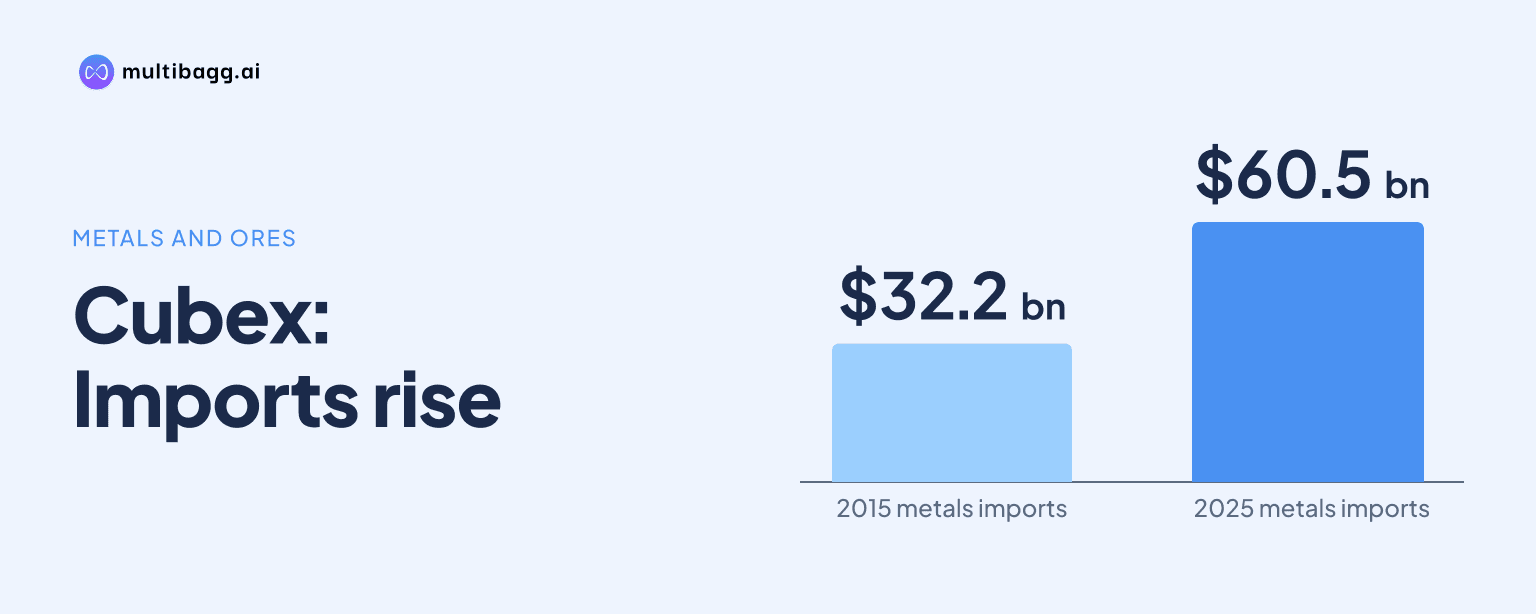
Cubex Tubings Limited says India’s metals-and-ores imports reached $60.5 billion in 2025, versus $32.2 billion in 2015, while domestic output supplies only about 35% of refined-copper requirements. Cubex presents these measures and India’s 100% nickel import dependence as evidence for expanding domestic critical-mineral and alloy processing.
Know Cubex Tubings inside out
Results, valuation, peers and who's buying, in one view.
Why does Cubex see an import-substitution opportunity?
Cubex sees an import-substitution opportunity because India’s strategic-material demand is not fully met by domestic processing capacity. Its presentation says metals-and-ores imports nearly doubled over the decade to 2025, rising to $60.5 billion from $32.2 billion in 2015. It also reports Rs 8,000 crore of imports of specialised steel, superalloys and titanium alloys, putting advanced materials within the wider trade-dependence picture.
Cubex identifies processing as the stage between mineral supply and finished industrial use. The National Critical Mineral Mission, approved by the Cabinet in January 2025, is intended to cover exploration, mining, processing and recovery through FY2030-31. Cubex describes the conversion of critical minerals into usable alloys within India as a missing middle in the supply chain rather than treating mineral extraction alone as sufficient.
The presentation also links the opportunity to changes in global sourcing. It cites an East Asia Forum report dated July 27, 2026, which said Chinese export restrictions were increasing supply-chain diversification challenges. Separately, the International Energy Agency’s Global Critical Minerals Outlook 2026 reported that items under Chinese export controls had tripled since 2023, which Cubex presents as raising the need for diversified material sources.
How dependent is India on imported strategic metals?
India’s dependence is most explicit in nickel, where Cubex says the country relies entirely on imports, and in refined copper, where domestic production meets only around 35% of requirements. The presentation identifies nickel as a base material for superalloys. The refined-copper measure indicates that a substantial share of demand requires supply beyond domestic production, although Cubex does not provide production or consumption volumes.
The $28.3 billion rise in metals-and-ores imports between 2015 and 2025 is the presentation’s largest trade comparison. Cubex does not divide the total between nickel, copper, specialised steel, titanium or other categories. It nevertheless pairs the aggregate import figure with reported Rs 8,000 crore imports of specialised steel, superalloys and titanium alloys.
A Parliamentary Committee on Public Undertakings observation adds a separate domestic-capability comparison. The committee’s 30th report, presented on March 30, 2026, said products worth nearly Rs 8,000 crore that fell within domestic manufacturing capabilities continued to be imported. That measure concerns products that could already be manufactured domestically, while Cubex’s processing argument also concerns developing capacity for advanced materials and mineral recovery.
Got a follow-up? Ask IRIS
What policy measures does Cubex identify for domestic processing?
Cubex identifies the National Critical Mineral Mission as the main policy mechanism, with an outlay of Rs 34,300 crore over seven years. The presentation divides the funding between a Rs 16,300 crore government contribution and Rs 18,000 crore from public-sector undertakings and others. The mission covers exploration, extraction, processing and recycling, with a stated value-chain horizon through FY2030-31.
The plan includes a target of 1,200 domestic critical-mineral exploration projects by FY31. Cubex also cites Rs 1,500 crore of proposed support for recycling-led recovery of critical minerals from battery waste, electronic waste and other secondary materials. These measures address upstream supply and secondary recovery, while the company’s stated opportunity is domestic conversion into higher-value industrial inputs.
Budget and manufacturing measures supplement the mission, according to Cubex. Union Budget 2026 provided a full basic customs-duty exemption on imported capital goods for critical-mineral processing, compared with earlier duties of 5% to 7.5%. Production Linked Incentive schemes covering 14 sectors have an outlay of Rs 1.97 lakh crore, while the Make in India programme is cited for promoting local value addition and domestic supply-chain participation.
How does defence demand support Cubex’s processing case?
Cubex says defence indigenisation supports domestic processing because material demand ultimately flows into strategic equipment and components. Its presentation puts the defence budget at Rs 7.85 lakh crore, up 15%, including capital outlay of Rs 2.19 lakh crore. It also states that Rs 1.39 lakh crore, or 75% of the acquisition budget, is earmarked for Indian industry in FY2026-27.
The cited domestic-industry figures indicate the size of the end markets in the presentation. Defence production reached a record Rs 1.78 lakh crore in FY26, while defence exports were Rs 38,424 crore during the same year. The Defence Acquisition Council had granted more than Rs 6 lakh crore in indigenous defence procurement approvals for Defence Research and Development Organisation-designed systems, according to Cubex.
Cubex also points to titanium-related capability development. Indian Rare Earths Limited, under the Department of Atomic Energy, opened the Rare Earths and Titanium Technology Park in May 2026 to commercialise indigenous technologies, including titanium sponge production. The presentation places this initiative alongside NITI Aayog recommendations for targeted incentives and domestic-content norms for superalloys, titanium and aerospace-grade alloys.
Conclusion
Taken together, the figures show that Cubex’s domestic-processing case rests on gaps across both broad commodity trade and particular strategic inputs. The $28.3 billion increase in metals-and-ores imports over 2015-2025 sits alongside 35% refined-copper self-sufficiency, 100% nickel import dependence and reported Rs 8,000 crore imports of specialised steel, superalloys and titanium alloys. The policy response extends beyond mining to processing, recovery and recycling.
The next disclosed markers are execution of the Rs 34,300 crore National Critical Mineral Mission over seven years, progress towards 1,200 exploration projects by FY31 and the proposed Rs 1,500 crore recycling-led recovery support. Cubex also identifies FY2030-31 as the mission’s value-chain horizon, while the Rs 1.39 lakh crore domestic defence procurement allocation in FY2026-27 remains a stated demand-side policy measure.

