










Cupid export business serves 125+ countries across channels
Key highlights
- Cupid generated ₹208.13 crore of export revenue in FY26, equal to 59.3% of revenue from operations.
- Cupid served more than 125 countries and supplied female condoms to more than 50 countries.
- South Africa’s 2025-30 programme allocates 23.4 million female and about 133 million male condoms annually.
- Male condoms generated ₹74.39 crore, or 65.99%, of Cupid’s H1 FY27 export sales.
powered by IRIS
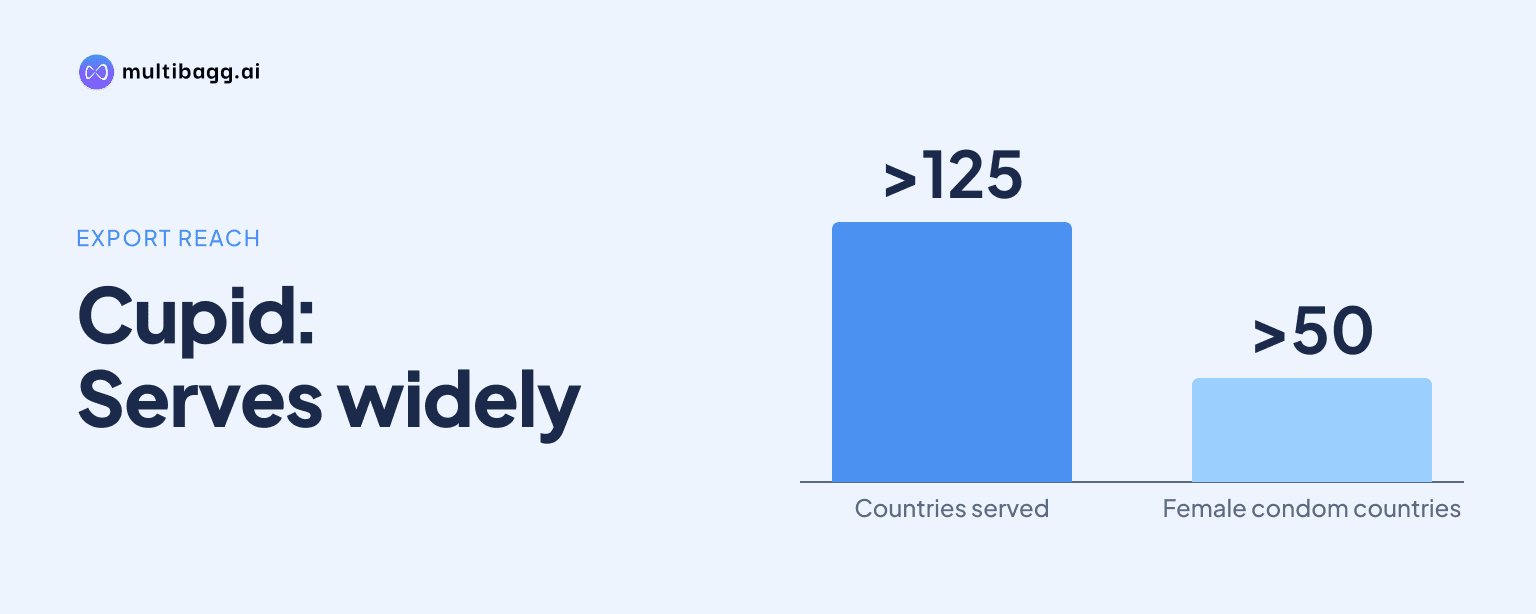
Cupid Limited’s export business served 125+ countries and generated ₹208.13 crore in FY26, or 59.3% of revenue from operations, with institutional supply supported by government, United Nations and other procurement channels. South Africa’s 2025-30 programme allocates 23.4 million female condoms and about 133 million male condoms annually.
Know Cupid inside out
Results, valuation, peers and who's buying, in one view.
How large is Cupid’s institutional export business?
Cupid generated ₹208.13 crore from global exports in FY26, making business-to-business, or B2B, exports its largest reported revenue stream at 59.3% of revenue from operations. In H1 FY27, exports were ₹112.73 crore, equal to 33.4% of sales, while the domestic consumer business accounted for 66.6% of sales in that half year.
The period comparison shows a change in revenue mix rather than a disclosed decline in export activity: domestic consumer revenue was ₹224.63 crore in H1 FY27, compared with ₹112.73 crore for exports. Cupid’s export route begins with latex, nitrile and packaging inventory holding more than six months of cover, followed by manufacture and testing at Sinnar and Palava, tender awards, and either direct export or supply through local distributors.
Cupid identifies four export customer groups: governments and ministries of health, United Nations agencies and procurement bodies, non-governmental organisations and social marketers, and original equipment manufacturer, or OEM, and private-label customers. The company specifically lists long-term agreements with the World Health Organization and the United Nations Population Fund, as well as PFSCM, alongside customers such as MSI, PSI and IDA Foundation.
How is Cupid’s export revenue divided by product?
Male condoms were Cupid’s largest H1 FY27 export product, contributing ₹74.39 crore, or 65.99% of ₹112.73 crore in export sales. Female condoms supplied ₹23.99 crore, or 21.28%, while lubricants, in-vitro diagnostics, or IVD, kits and consumer products together provided ₹14.35 crore, or 12.73%.
The portfolio is supported by product-specific credentials rather than one uniform approval. Male condoms have World Health Organization and United Nations Population Fund prequalification, USFDA, CE and SABS certification; female condoms have prequalification, CE and SABS certification. Water-based lubricants have an India Food and Drug Administration licence, ISO 13485 certification and ANVISA approval, while four rapid IVD kits carry certification under the European Union In Vitro Diagnostic Regulation, or EU IVDR.
Cupid has supplied female condoms to more than 50 countries under the World Health Organization and United Nations Population Fund prequalification framework. This is narrower than its overall footprint of more than 125 countries, indicating that the broader export base includes male condoms, lubricants, IVD products, OEM supply, registrations and tender activity beyond female-condom shipments.
What does the South Africa programme mean for Cupid exports?
South Africa is Cupid’s stated institutional anchor because its national programme runs from 2025 to 2030 and allocates 23.4 million female condoms a year, representing 59% of the allocation, plus about 133 million male condoms annually. The presentation does not disclose the programme’s revenue value, pricing or the volume already supplied under the contract.
Cupid also reports multi-year tenders in Tanzania, Kenya, Ethiopia and Brazil, extending the tender-led model beyond South Africa. In Latin America, Brazil includes female-condom tenders, while Honduras and Chile have generated repeat orders; Argentina is listed as a registration market rather than a disclosed order market.
The tender mechanism is linked to manufacturing and compliance. Cupid says every condom is electronically tested at its Sinnar and Palava facilities, and its supply process moves from raw-material coverage of more than six months to manufacture, quality processes, tender wins and invoicing. The presentation lists World Health Organization and United Nations Population Fund prequalification for both male and female condoms, a credential relevant to public-health procurement channels.
Got a follow-up? Ask IRIS
Which regions are established and which are still targets?
Cupid categorises Africa, Latin America and Asia and the Commonwealth of Independent States, or CIS, as established regions, while the Gulf Cooperation Council, or GCC, and Europe are target markets. Its more than 125-country footprint is served from Sinnar, Nashik, according to the presentation.
In Africa, Cupid cites the South Africa programme and tenders in Tanzania, Kenya and Ethiopia, while IVD registrations are listed in Ghana, Liberia, Sierra Leone and Uganda. In Asia and CIS, Cupid lists IVD registrations in Bangladesh, the Philippines, Bhutan and Nepal, together with OEM male-condom business in CIS markets.
GCC private-market entry remains an opportunity rather than a disclosed operating result. In Europe, Cupid says EU IVDR certification opens the European Economic Area, or EEA, for four IVD kits; this differs from the established-region descriptions because the presentation labels GCC and Europe as targets and does not give sales or tender awards there.
How is Cupid building its diagnostics export opportunity?
Cupid is building an IVD tender opportunity through four EU IVDR-certified rapid-test kits and a plan to double kit capacity from about 4 lakh per day currently to about 8 lakh per day by the end of calendar 2027. The company identifies Europe, Africa and Latin America as the regions for IVD tenders.
Cupid entered IVD kit manufacturing in 2022. It received EU IVDR certification for CupiSURE Pregnancy and CupiKIT Syphilis in October 2025, followed in January 2026 by certification for HIV 1&2 and Hepatitis B. The broader portfolio also includes HIV/Syphilis combination, Hepatitis C, malaria, dengue and typhoid tests, although the presentation highlights only four kits as EU IVDR certified.
For FY27, management says state-government orders are expected and that its products are available through GeM to more than 120 ESIC hospitals. Those are stated opportunities rather than reported orders. The next regulatory item disclosed is World Health Organization prequalification for Malaria Pf/Pv, which is under approval, alongside three kits in development.
Conclusion
Cupid’s export model combined ₹208.13 crore of FY26 revenue with access to more than 125 countries, but H1 FY27 sales show that its domestic business had become the larger revenue stream, at ₹224.63 crore versus ₹112.73 crore of exports. Within exports, male condoms supplied 65.99% of H1 FY27 sales, while the South Africa programme and other multi-year tenders provide the company’s disclosed institutional foundation.
The next points to watch are execution of the 2025-30 South Africa programme, outcomes from tenders in Tanzania, Kenya, Ethiopia and Brazil, and the diagnostics capacity target of about 8 lakh kits daily by calendar-end 2027. Management also identifies pending World Health Organization prequalification for Malaria Pf/Pv and three IVD kits in development, while GCC and European market entry remain stated targets.