










Cupid Limited Palava set to lift male capacity to 1.25 billion
Key highlights
- Palava is scheduled for Q3 FY27 and is planned at approximately 170,000 square feet.
- Cupid’s male-condom capacity is set to rise from 480 million to about 1.25 billion units a year.
- Female-condom capacity is planned to increase from 52 million to about 125 million units a year.
- Sinnar IVD capacity is targeted to double from about 4 lakh to about 8 lakh kits a day by end-2027.
powered by IRIS
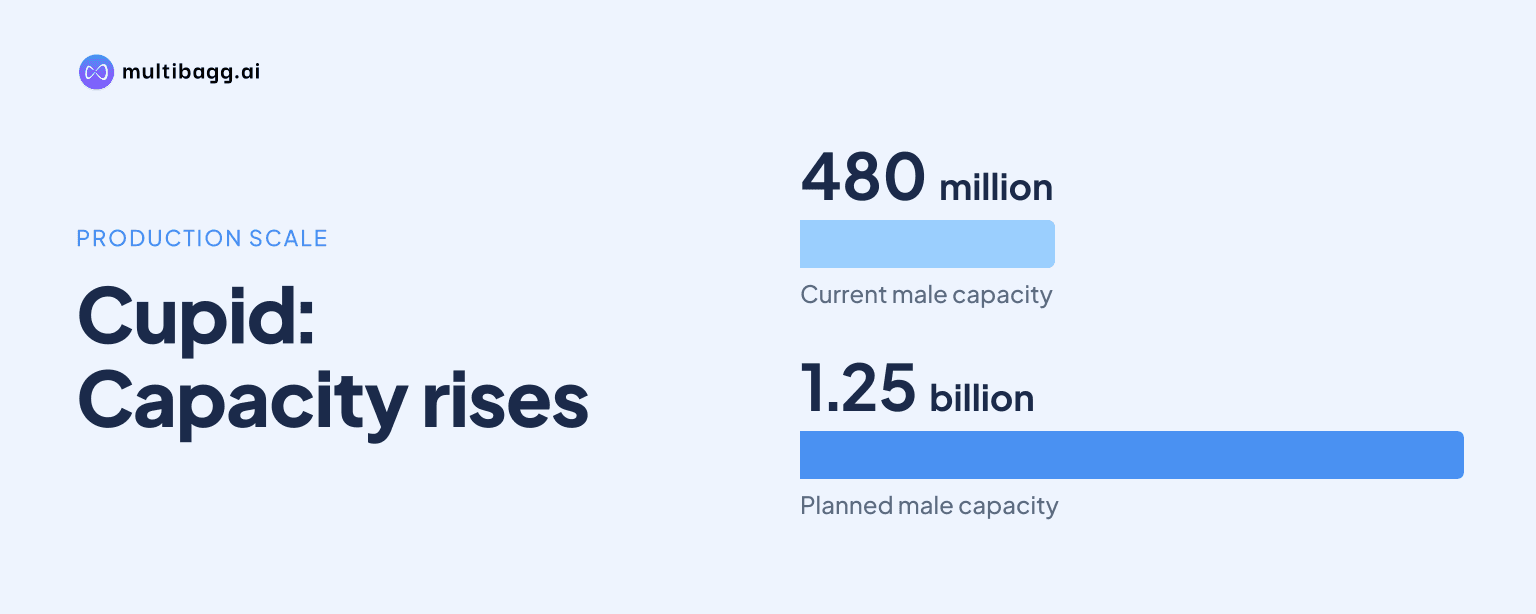
Cupid Limited’s Palava facility is scheduled for Q3 FY27 and is set to increase annual male-condom capacity from 480 million units to about 1.25 billion units, adding roughly 770 million units. The Maharashtra project is also planned to add about 75 million female-condom units a year and latex-plus-nitrile production capability.
Know Cupid inside out
Results, valuation, peers and who's buying, in one view.
How much will Cupid’s Palava plant increase condom capacity?
Cupid says Palava will add about 770 million male condoms annually, taking total annual male-condom capacity from 480 million units to about 1.25 billion units after commissioning. The company describes the approximately 170,000-square-foot Maharashtra facility as under implementation, with completion scheduled for Q3 FY27.
The planned addition exceeds the operating Sinnar plant’s current male-condom capacity of 480 million units a year. Post-Palava male capacity would be about 2.6 times the present level, based on the company’s stated capacities. The presentation does not disclose planned utilisation, production ramp-up, capital expenditure, or customer allocations for the new output.
Cupid separately describes Palava as capable of about 75 million female condoms a year, while its post-Palava table implies an increase of about 73 million units from 52 million to about 125 million. Both disclosures use approximate figures. The stated post-project outcome is female-condom capacity of about 125 million units annually.
When will Cupid’s Palava facility start operating?
Cupid expects Palava to be commissioned in Q3 FY27. The presentation identifies the project as under implementation, unlike the approximately 100,000-square-foot Sinnar facility, which it identifies as operating.
The Q3 FY27 schedule does not establish when commercial production will begin or how quickly output will reach the planned 770 million male-condom units annually. Palava is presented as a render, and the company does not provide a commissioning date within the quarter, a validation milestone, or a separate commercial-production date.
Palava’s disclosed area of about 170,000 square feet is about 70,000 square feet larger than Sinnar’s 100,000 square feet. Its planned male-condom addition of roughly 770 million units annually is also greater than Sinnar’s current output capacity of 480 million units.
What products and technologies will Cupid add at Palava?
Cupid says Palava will manufacture latex and nitrile products alongside about 770 million male condoms and about 75 million female condoms annually. Nitrile capability is linked to Cupid’s nitrile female-condom programme, which the presentation says commenced in March 2026.
Cupid describes nitrile female condoms as a latex-free product in a segment historically served by one manufacturer, with pricing 25% to 35% above latex products. The presentation does not provide sales volumes, revenue targets, margins, or customer contracts for nitrile condoms. The pricing range is therefore a company-stated product attribute rather than a projected financial result.
Cupid is also implementing dual-polymer dipping lines, which it says are intended to provide production flexibility and support tender participation. It does not specify the number of lines, their output, their location, or their completion date. Its existing manufacturing description includes automated latex dipping, automatic sealing and packing, and electronic testing of 100% of condoms under a three-stage quality-assurance process and ISO 13485 certification.
Got a follow-up? Ask IRIS
How does Palava complement Cupid’s Sinnar expansion?
Cupid’s Palava project expands condom capacity, while automation at Sinnar is targeted to double in-vitro diagnostic, or IVD, kit throughput from about 4 lakh to about 8 lakh kits a day by the end of 2027. The two disclosed projects therefore address different products and capacity measures.
Sinnar currently has stated annual capacity for 480 million male condoms, 52 million female condoms, and 210 million lubricant-jelly sachets. Cupid does not say that lubricant-jelly output will move to Palava or provide a revised lubricant capacity. Its Palava disclosure instead specifies male and female condoms, while the Sinnar automation programme specifies IVD kits per day.
Cupid’s wider manufacturing pipeline includes an in-principle South Africa venture announced in August 2026, in which it may hold up to 49% while the partner funds capital expenditure and working capital. A proposed wholly owned subsidiary in West Bengal was also in-principle in August 2026, with land and feasibility under evaluation. Neither project is included in the stated 1.25 billion-unit male-condom capacity figure.
What could the new capacity support in Cupid’s portfolio?
Cupid’s disclosed Palava capacity is intended to support male condoms, female condoms, nitrile female condoms, and tender participation through dual-polymer lines. Its product-development timeline lists World Health Organization and United Nations Population Fund prequalification for condoms in 2012, while the presentation identifies institutional tenders and national programmes as relevant demand channels.
The capacity project sits alongside a consumer portfolio that recorded more than 12 launches in FY26 across fragrances, personal care, beauty, hygiene, and home care. However, the Palava disclosure is limited to latex and nitrile condoms. The presentation does not connect its FY26 consumer launches to output from the new facility.
Cupid also announced “Made In India With Japanese Quality” in March 2026 as a quality positioning for consumers and original equipment manufacturer partners. The presentation identifies a Japanese latex partner under technology collaborations, but does not disclose production volume, contract duration, or revenue related to that collaboration or Palava.
Conclusion
Palava is Cupid’s main disclosed condom-capacity expansion, with annual male-condom capacity set to rise from 480 million to about 1.25 billion units and female-condom capacity to about 125 million units. The project’s latex and nitrile capability also connects it with the company’s nitrile female-condom programme and planned dual-polymer manufacturing lines.
The next disclosed milestones are Palava’s Q3 FY27 commissioning and the end-2027 target to increase Sinnar IVD throughput to about 8 lakh kits a day. The presentation leaves Palava’s commercial ramp-up, utilisation, customer mix, and dual-polymer-line completion timetable unresolved.