










Datamatics Global Services Reports Q3 FY26 Revenue of ₹510 Crore
Key highlights
- Datamatics reported Q3 FY26 revenue from operations of ₹510.1 crore, up 19.9% year on year.
- Q3 FY26 total income was ₹522.6 crore, a 19.8% increase from ₹436.2 crore in Q3 FY25.
- Nine-month FY26 revenue from operations rose 19.7% to ₹1,467.9 crore.
- Datamatics added 5 new clients in Q3 FY26 and reported ₹540 crore in net cash and investments, net of debt.
powered by IRIS
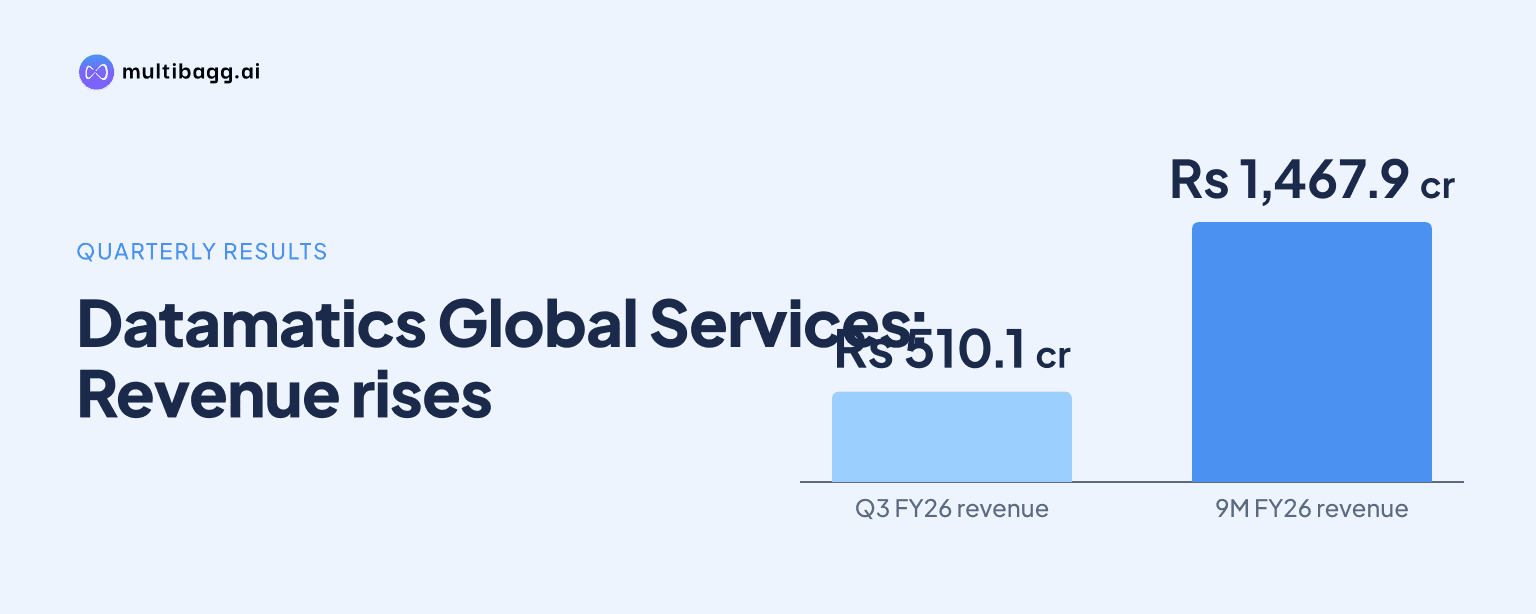
Datamatics Global Services Limited reported Q3 FY26 revenue from operations of ₹510.1 crore, up 19.9% year on year, while total income rose 19.8% to ₹522.6 crore. The performance lifted nine-month operating revenue to ₹1,467.9 crore and reflected continued growth in the company's digital technology, operations and experience offerings.
Know Datamatics Global Services inside out
Results, valuation, peers and who's buying, in one view.
What did Datamatics report for Q3 FY26?
Datamatics reported revenue from operations of ₹510.1 crore for Q3 FY26, compared with ₹425.5 crore in Q3 FY25. Revenue also increased 4.1% sequentially from ₹490.2 crore in Q2 FY26, according to the investor presentation.
Total income for the quarter stood at ₹522.6 crore, against ₹436.2 crore a year earlier and ₹505.9 crore in the preceding quarter. Other income was ₹12.5 crore, lower than ₹15.7 crore in Q2 FY26 and ₹10.7 crore in Q3 FY25.
For the first nine months of FY26, revenue from operations rose 19.7% to ₹1,467.9 crore from ₹1,226.2 crore in the corresponding period of FY25. Total income for the nine-month period increased 19.3% to ₹1,508.4 crore from ₹1,264.5 crore.
The quarterly update was presented as part of Datamatics' investor communication on its financial results. The company describes itself as a provider of digital technologies, operations and experience services for global enterprises.
What supported Datamatics' revenue growth?
Datamatics added five new clients during Q3 FY26 and reported a base of more than 300 significant customers worldwide. The company provides services across digital technologies, operations and customer experience, alongside AI-powered products including TruCap+, TruBot, FINATO, TruBI, TruAI and TruDiscovery.
The company said its digital experience operations use AI in multilingual and omnichannel contact centres located in the Philippines, India and the United States. Its automation offerings are also used for process improvement and workflow management in client operations.
Datamatics has historically operated across IT services, cloud, business process management, digital and mobility solutions, engineering services, robotics and virtual assistants. Its customer base spans sectors including banking and financial services, manufacturing, media and publishing, retail and e-commerce.
The latest presentation did not provide a segment-wise revenue split, client concentration details or a full quarterly profit figure in the material provided. Therefore, the reported revenue data indicate overall growth but do not establish the individual contribution of products, geographies or business lines.
Got a follow-up? Ask IRIS
How does the nine-month performance compare with the previous year?
Datamatics generated ₹1,467.9 crore in operating revenue in the first nine months of FY26, an increase of ₹241.7 crore from the corresponding period of FY25. The 19.7% growth rate was broadly in line with the 19.9% year-on-year increase reported for the third quarter.
Total income for the nine-month period rose by ₹243.9 crore to ₹1,508.4 crore. Other income was ₹40.5 crore, compared with ₹38.3 crore in 9MFY25, an increase of 5.7%.
Datamatics' presentation also reported revenue growth at a 13.9% compound annual rate and PAT after non-controlling interest growth at a 26.6% compound annual rate over the preceding five years. These are company-reported historical growth measures and are separate from the Q3 FY26 quarterly comparison.
The company reported net cash and investments, net of debt, of ₹540 crore. Employee attrition for the first nine months of FY26 was 11.54%, according to the presentation. These figures provide context on balance-sheet liquidity and workforce retention, although the release did not give comparable figures for the prior year in the material provided.
What does the update mean for investors and operations?
For investors, the key reported outcome is that Datamatics sustained close to 20% year-on-year revenue growth through the first nine months of FY26. The quarter also showed a 4.1% sequential increase in operating revenue, taking quarterly revenue above ₹500 crore.
The addition of five clients in the quarter expands the stated customer base, while the company's AI-led products and digital operations remain central to its offerings. However, the investor presentation does not quantify the revenue earned from those new clients or from any specific AI product.
No share-price movement, dividend decision, guidance revision or capital-allocation announcement was disclosed in the supplied material. Investors assessing the update would therefore need to rely on subsequent financial disclosures for detailed margin, profitability, order-book and outlook information.
For customers and employees, the results indicate continuing activity across Datamatics' delivery and client-service operations. The company operates delivery centres across four continents and has positioned its services around enterprise productivity and customer experience.
Conclusion
Datamatics delivered Q3 FY26 revenue from operations of ₹510.1 crore and total income of ₹522.6 crore, with both measures rising by about 20% from the previous year. The nine-month figures of ₹1,467.9 crore in operating revenue and ₹1,508.4 crore in total income show that the quarterly growth was supported by performance over the wider financial year to date.
The next items to watch are future quarterly disclosures on profitability, business-line performance and the contribution from new customer additions. Datamatics has also reported ₹540 crore of net cash and investments and 11.54% attrition for 9MFY26, making future updates on capital deployment and workforce trends relevant.