










National Stock Exchange of India Ltd Reports 2,959 Listed Companies
Key highlights
- NSE website material reports 2,959 listed companies.
- NSE lists its 34th Annual Report for 2026.
- NSE lists financial results for the quarter ended June 30, 2026.
- NSE cites a 50.6% share in equity F&O in 2025, according to WFE.
powered by IRIS
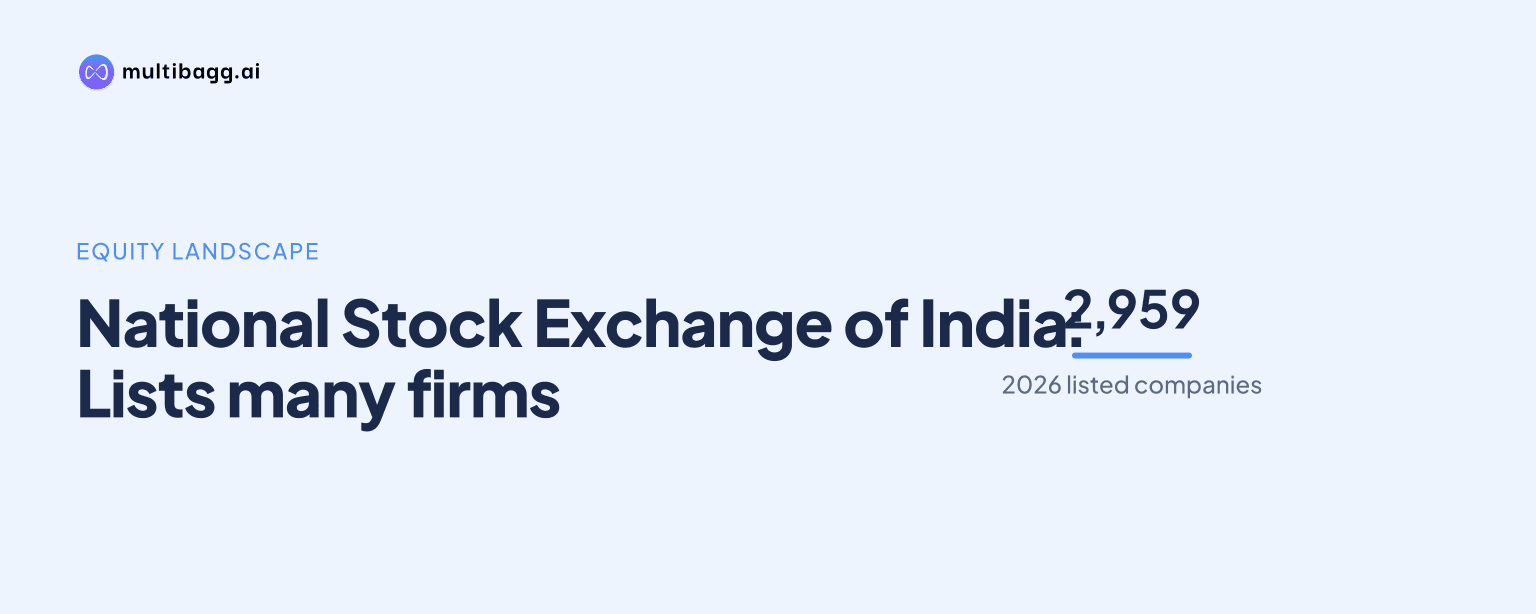
National Stock Exchange of India Ltd reported 2,959 listed companies in website material that also lists its 34th annual report for 2026. The figures provide a current reference point for the scale of the exchange's equity market platform, while the annual-report and financial-results archive sets out the company’s latest disclosed reporting record.
Know National Stock Exchange Of India inside out
Results, valuation, peers and who's buying, in one view.
What does National Stock Exchange of India Ltd report about its market platform?
National Stock Exchange of India Ltd states that it has 2,959 listed companies and identifies itself as the largest multi-asset class exchange. Its website also describes it as the largest derivatives exchange, with a 50.6% share in equity futures and options in 2025 according to the World Federation of Exchanges, and the third-largest equity exchange in 2025.
The listed-company number matters because it indicates the breadth of securities available through the exchange’s equity platform. The NSE equities section provides information on real-time quotes, trading systems, listing, clearing and settlement, risk management, trading volumes, trades, listed companies and market capitalisation.
NSE says it began trading in the capital-market or equities segment on November 3, 1994. It states that within a year it became India’s largest stock exchange by volumes transacted. The exchange was incorporated in 1992, recognised as a stock exchange by the Securities and Exchange Board of India in April 1993, and began operations in 1994 with the wholesale debt market before the cash-market launch.
Which 2026 disclosures are available on NSE’s website?
NSE’s website lists the 34th annual report for 2026, following the 33rd annual report for 2025. The archive also carries annual reports from 2019 through 2024, giving users access to a multi-year record of the exchange’s published reporting documents.
The financials page lists consolidated and standalone financial results for the year ended March 31, 2026. It also lists financial highlights, newspaper publications and related-party disclosures for that year. For the quarter ended June 30, 2026, the website lists consolidated and standalone results as well as a newspaper publication.
These documents are relevant to investors and market participants seeking the company’s formal financial disclosures. The provided material identifies the documents and reporting periods, but does not provide the underlying revenue, profit, expense or balance-sheet figures. Accordingly, the available information supports a review of the disclosure schedule rather than a financial-performance calculation.
How does NSE support foreign portfolio investor participation?
NSE outlines a two-stage process for foreign portfolio investors, or FPIs, seeking to participate on its platform. The process begins with a Single Common Application Form through the NSDL portal, due diligence by a designated depository participant and know-your-customer completion.
The next stage covers custody arrangements, securities and cash accounts, a CGSL account, a custodial participant code, broker selection and trading-account mapping. NSE also refers to the upload of KYC documents to the KRA Central Registry before an investor goes live.
The exchange lists several measures related to FPI access, including a common contract note across exchanges and FPI eligibility to invest in exchange-traded currency derivatives, alternative investment funds, real estate investment trusts and infrastructure investment trusts. It also notes that the timeline for initial public offering listings has been reduced to three days from the closure of an issue.
For investors, these processes show that access to Indian listed securities involves registration, custody, account-opening and broker arrangements. They also show the operational role of the exchange beyond matching trades, including market-access procedures and information for domestic and overseas participants.
Got a follow-up? Ask IRIS
Why should investors note the differing listed-company figures in the material?
Investors should note that the provided material also contains a figure of 2,819 listed companies within an Investor Presentation Analyst Meet 2026 document dated July 24, 2026. That document was submitted by Indian Energy Exchange Limited to NSE and BSE, and it reproduces market-position information about NSE.
The NSE website material separately states 2,959 listed companies. The source excerpt does not explain the difference between the two figures, such as the respective cut-off dates or definitions used. Readers comparing the figures should therefore treat them as disclosures appearing in separate materials rather than assume they measure the same population at the same time.
This distinction is important because listed-company counts can be affected by reporting dates, segment coverage and document updates. The supplied information does not provide enough detail to reconcile the two totals. A review of the original documents and their stated reference dates would be needed for a like-for-like comparison.
How does the exchange’s scale affect the Indian market ecosystem?
NSE’s reported 2,959 listed companies and its stated position across equity and derivatives markets underline its role in India’s market infrastructure. Its systems cover trading, listing information, clearing and settlement processes, and risk-management information, connecting listed issuers, brokers, investors, custodians and other intermediaries.
For retail investors, a broad listed universe can provide access to shares across companies that meet the exchange’s listing requirements. For issuers, the exchange provides a venue for listed securities and market information. The supplied material does not state the number of trading members or provide trading-value data, so the immediate impact on activity or liquidity cannot be quantified from these disclosures.
The release of annual and quarterly documents also provides an established timetable for following NSE’s own corporate disclosures. The records listed for March 31, 2026 and June 30, 2026 are relevant dates for users monitoring the exchange as a company and as a major market operator.
Conclusion
NSE’s website material reports 2,959 listed companies, alongside its 34th annual report for 2026 and financial disclosures through the quarter ended June 30, 2026. The information reinforces the exchange’s role across equities, derivatives and investor-access processes, while the separate 2,819 figure in a third-party presentation highlights the need to compare source dates and definitions carefully.
Investors can watch for subsequent NSE financial results, annual-report updates and any clarification in future official material on listed-company counts. The next useful reference point will be the exchange’s later scheduled corporate disclosures after the June 2026 quarterly-results publication.