










National Stock Exchange of India profit rises 23% in Q2 FY27
Key highlights
- NSE reported Q2 FY27 consolidated PAT of ₹2,578 crore, up 23% year-on-year and down 17.4% quarter-on-quarter.
- Revenue from operations was ₹4,066.8 crore, up 10.6% year-on-year but down 10.8% from Q1 FY27.
- Cash-market average daily traded volume rose 24% year-on-year to ₹1,18,377 crore.
- NSE approved a secondary sale of up to 40% in National Coal Exchange of India Limited.
powered by IRIS
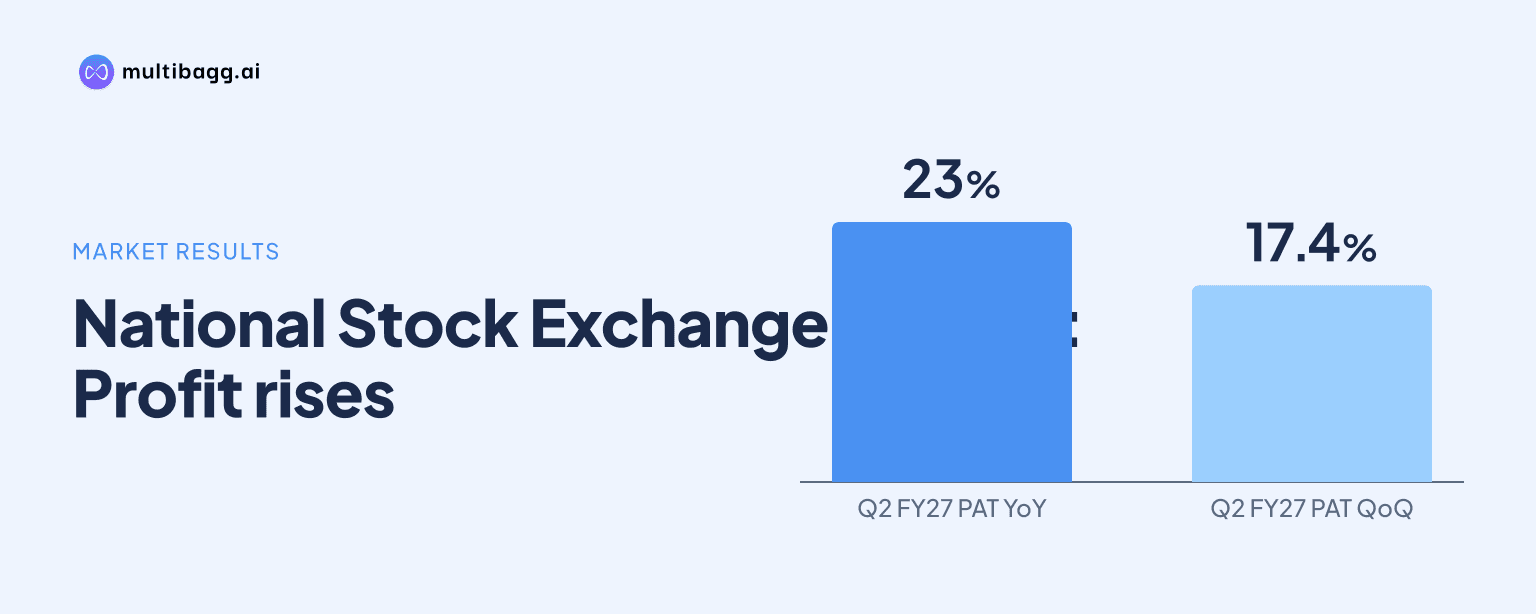
National Stock Exchange of India Ltd reported consolidated profit after tax of ₹2,578 crore for Q2 FY27, up 23% year-on-year but down 17.4% from the preceding quarter, as revenue from operations fell 10.8% sequentially to ₹4,066.8 crore. The exchange also approved a sale of up to 40% in its coal-exchange subsidiary.
Know National Stock Exchange Of India inside out
Results, valuation, peers and who's buying, in one view.
What did NSE report for Q2 FY27?
NSE reported consolidated profit after tax of ₹2,577.62 crore for the quarter ended September 30, 2026, compared with ₹2,098.47 crore in Q2 FY26. Consolidated total income increased 9.5% year-on-year to ₹4,554 crore from ₹4,160 crore. Non-annualised earnings per share rose to ₹10.41 from ₹8.48 a year earlier.
Revenue from operations was ₹4,066.8 crore, an increase of 10.6% from ₹3,676.8 crore in the year-ago quarter. Transaction-charge revenue, NSE's principal operating income stream, rose 9% year-on-year to ₹3,035 crore. The exchange attributed this growth to higher volumes in cash-market and equity-options trading.
The year-on-year comparison also reflects a lower expense base. Consolidated expenditure declined 51% to ₹1,161 crore, against ₹2,354 crore in Q2 FY26. The earlier period included a ₹1,297 crore provision for Securities and Exchange Board of India settlement fees related to colocation and dark-fibre matters.
Why did profit and revenue decline from Q1 FY27?
NSE's consolidated profit declined 17.4% sequentially from ₹3,120.08 crore in Q1 FY27 to ₹2,575.9 crore in Q2 FY27. Revenue from operations fell 10.8% from ₹4,560.4 crore in the preceding quarter to ₹4,066.8 crore, marking a weaker sequential comparison despite year-on-year growth.
Operating EBITDA declined 13.3% quarter-on-quarter to ₹3,079 crore from ₹3,550.93 crore. The EBITDA margin contracted to 75.7% from 77.86% in Q1 FY27. On a year-on-year basis, however, EBITDA was higher because the Q2 FY26 expense base included the SEBI settlement-related provision.
The figures show that the quarter delivered higher income and profit than the corresponding period last year, while activity and earnings were lower than the immediately preceding quarter. NSE did not provide a separate numerical explanation in the supplied information for the sequential movement beyond the reported revenue and operating metrics.
Which trading and non-trading businesses supported NSE revenue?
NSE's cash-market volumes and equity-options activity supported transaction-charge revenue during Q2 FY27. Average daily traded volume in the cash-market segment rose 24% year-on-year to ₹1,18,377 crore, while equity-options average daily traded premium value increased 3% to ₹47,977 crore.
Average daily traded volume in equity futures stood at ₹1,24,574 crore during the quarter. These activity measures are relevant because transaction charges rose to ₹3,035 crore and accounted for a substantial share of the exchange's operating revenue.
Several non-transaction revenue streams also increased. Data connectivity charges were ₹267 crore. Operating investment income rose 9% year-on-year to ₹237 crore, data feed and terminal-services revenue rose 43% to ₹165 crore, and listing-services revenue increased 70% to ₹150 crore.
Got a follow-up? Ask IRIS
What does the National Coal Exchange stake sale involve?
NSE's board approved the divestment of up to 40% of National Coal Exchange of India Limited, its wholly owned subsidiary. The proposed transaction will be undertaken through a secondary sale of equity shares in one or more tranches.
The supplied information does not state a valuation, buyer, transaction timetable, or expected financial proceeds for the sale. It also does not indicate whether NSE will sell the full approved 40% stake. The board approval establishes the maximum stake that may be divested under the stated plan.
For investors, the proposal is separate from the reported quarterly operating performance. Its eventual financial effect will depend on the size, pricing and timing of any completed share sale, none of which were disclosed in the available announcement.
How did NSE perform in the first half and on a standalone basis?
NSE reported consolidated total income of ₹9,807 crore for the first half of FY27, up 9% from ₹8,959 crore in H1 FY26. Operating EBITDA rose 45% to ₹6,674 crore, with an EBITDA margin of 77%, while consolidated net profit increased 13% year-on-year to ₹5,698 crore. Half-year EPS stood at ₹23.02 on a non-annualised basis.
On a standalone basis, total income increased 8% year-on-year to ₹3,956 crore in Q2 FY27. Revenue from operations rose 9% to ₹3,567 crore, standalone EBITDA was ₹2,622 crore with a 74% margin, and standalone profit after tax rose 16% to ₹2,164 crore. The standalone PAT margin was 55%.
The difference between consolidated and standalone profit reflects the contribution of entities included in the group accounts. The reported consolidated PAT growth of 23% was higher than the 16% increase in standalone PAT, while both measures remained below Q1 FY27 consolidated profit on a sequential basis.
Conclusion
NSE's Q2 FY27 results combined year-on-year growth in profit, transaction charges and cash-market turnover with a sequential decline in revenue, EBITDA and profit from Q1. The comparison with Q2 FY26 was also affected by the ₹1,297 crore SEBI settlement-related provision recorded in the prior-year quarter, which reduced the earlier expense and profitability base for comparison.
The next disclosed development to watch is the proposed secondary sale of up to 40% in National Coal Exchange of India Limited. NSE has not disclosed the timing, pricing, buyer or eventual stake size, while future quarterly results will indicate whether transaction volumes and operating margins recover from the Q1 FY27 levels.