










DCM Shriram Q2 FY27 revenue rises 22%, profit falls 33%
Key highlights
- DCM Shriram's Q2 FY27 net revenue rose 22% year on year to ₹3,977 crore.
- Q2 FY27 profit after tax declined 33% year on year to ₹106 crore.
- PBDIT fell 22% to ₹319 crore as chemical input costs and agri-input earnings weighed on profitability.
- The board declared an FY27 interim dividend of ₹4 per share, or 200% of face value.
powered by IRIS
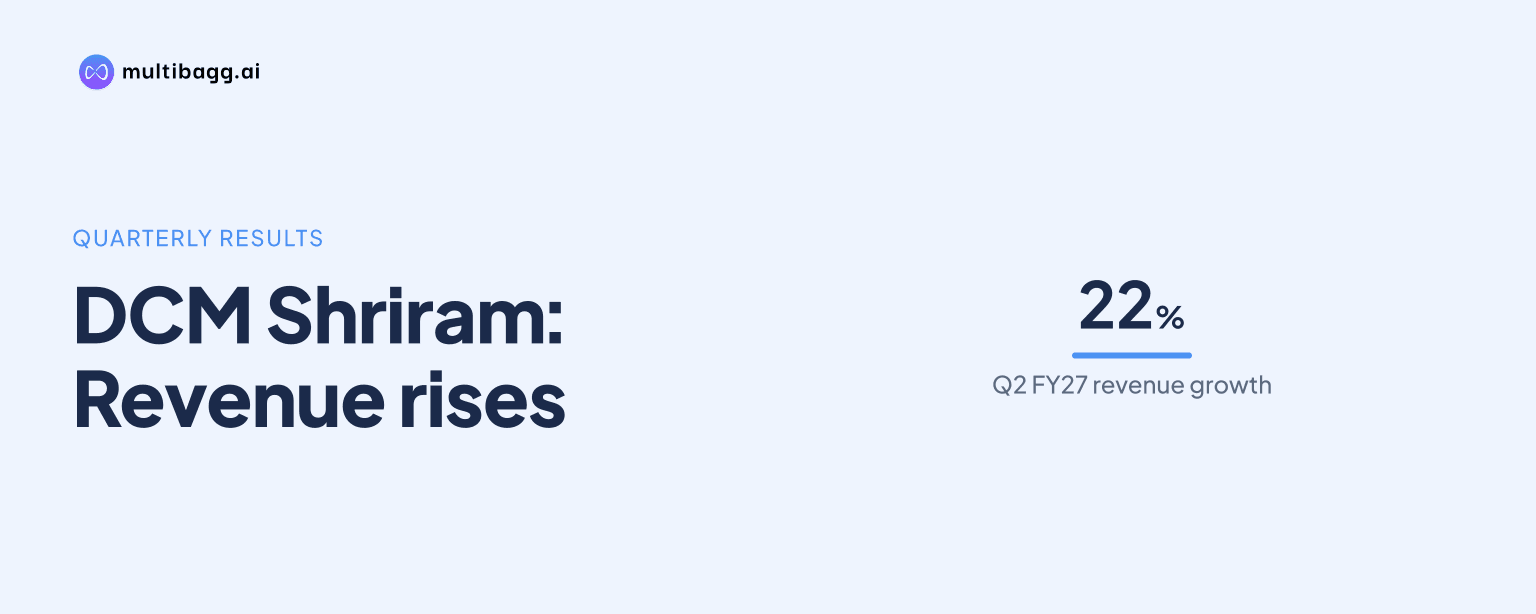
DCM Shriram Limited reported Q2 FY27 net revenue of ₹3,977 crore, up 22% year on year, but profit after tax fell 33% to ₹106 crore as higher chemical input costs and weaker agri-input earnings pressured profitability. The company also declared an interim dividend of ₹4 per equity share.
Know DCM Shriram International inside out
Results, valuation, peers and who's buying, in one view.
What were DCM Shriram's Q2 FY27 financial results?
DCM Shriram reported consolidated net revenue, net of excise duty, of ₹3,977 crore for the quarter ended September 30, 2026, compared with ₹3,272 crore in Q2 FY26. The 22% increase was driven by Chemicals and Vinyl, Sugar and Ethanol, Fenesta Building Systems, and Fertilizer businesses.
However, profitability declined despite the increase in revenue. Profit after tax stood at ₹106 crore, compared with ₹159 crore in the corresponding quarter a year earlier. The decline was also reflected in PBDIT, which fell 22% year on year to ₹319 crore from ₹408 crore.
The company said higher input costs in Chemicals and lower earnings in the agri-input businesses affected quarterly operating performance. Separately reported consolidated figures showed net profit of ₹105.68 crore, compared with ₹158.72 crore a year earlier, which is consistent with the rounded profit figure of ₹106 crore.
Which DCM Shriram businesses drove revenue growth?
Chemicals and Vinyl was DCM Shriram's largest reported business contributor in the quarter, with revenue of ₹1,576.66 crore, compared with ₹1,108.40 crore in Q2 FY26. The company identified this business as one of the main drivers of the consolidated revenue increase.
Sugar and Ethanol, Fenesta Building Systems, and Fertilizer also contributed to the higher top line. Sugar and Ethanol revenue rose 9.5% to ₹1,197.21 crore, while Fenesta Building Systems revenue increased 21.6% to ₹344.44 crore. Fertilizer revenue grew 40.4% to ₹501.87 crore.
The performance was mixed across the agri-input portfolio. Shriram Farm Solutions revenue declined 10.2% to ₹423.06 crore, while Bioseed revenue fell 14.8% to ₹73.36 crore. Bioseed reported a segment loss of ₹42.98 crore during the quarter.
The differing segment trends underline the nature of DCM Shriram's diversified operations. Stronger growth in industrial, building-systems and fertilizer businesses supported revenue, while adverse conditions in parts of the agri-input portfolio affected the overall earnings outcome.
Why did DCM Shriram's profitability decline despite higher revenue?
DCM Shriram's profitability declined because cost and segment-level pressures outweighed the benefit of higher revenue. The company attributed the lower PBDIT primarily to higher input costs in Chemicals and lower earnings from agri-input businesses.
PBDIT declined to ₹319 crore from ₹408 crore, a reduction of ₹89 crore. The profit-after-tax decline was steeper in percentage terms, falling by about one-third to ₹106 crore from ₹159 crore. This indicates that revenue growth did not translate into comparable growth in operating profit during the period.
The company also reported that the previous year's comparison included one-time government incentives that were absent in Q2 FY27. This affected comparability with the year-ago quarter and added to the decline in reported earnings.
For investors, the results place attention on whether growth in Chemicals and Vinyl, Sugar and Ethanol, Fenesta, and Fertilizer can continue while input-cost pressure is managed. The reported figures do not establish a forward earnings trend, but they show that margins were under pressure in the September quarter.
Got a follow-up? Ask IRIS
What dividend and investment decisions did the board approve?
DCM Shriram's board declared an interim dividend of ₹4 per equity share for FY27, equal to 200% of the ₹2 face value per share. The reported aggregate dividend amount was ₹62.38 crore.
The record date for the interim dividend was set as October 30, 2026, with payment due within 30 days of the declaration. The dividend decision came alongside the release of the company's unaudited financial results for the quarter and half year ended September 30, 2026.
The board also approved up to ₹50 crore of equity investment in joint venture Shriram Teknor Limited. In addition, it approved capital expenditure of up to ₹60 crore for cement-plant filter presses, ₹145 crore for a solar plant at Kota, and ₹120 crore for additional electrolysers at the Kota and Bharuch caustic plants.
These approvals show that the company is continuing investments across manufacturing, energy and chemicals operations even as quarterly profitability was lower. The disclosures do not provide a completion schedule or financial-return estimate for these investments.
How should investors assess the Q2 FY27 numbers?
Investors should assess DCM Shriram's Q2 FY27 result as a quarter of solid revenue expansion accompanied by lower profitability. Net revenue increased by ₹705 crore year on year, while PBDIT declined by ₹89 crore and profit after tax fell by ₹53 crore.
The Chemicals and Vinyl business was central to revenue growth, but higher inputs in Chemicals limited the earnings benefit. Meanwhile, growth in Fertilizer, Fenesta Building Systems, and Sugar and Ethanol helped support the top line, whereas Farm Solutions and Bioseed remained weak.
The ₹4-per-share interim dividend provides a direct shareholder distribution, while the approved capital expenditure signals continuing capacity and operating investments. Their eventual financial contribution will depend on project execution, input costs, demand conditions and the operating performance of the underlying businesses.
Conclusion
DCM Shriram delivered 22% year-on-year net revenue growth to ₹3,977 crore in Q2 FY27, led by Chemicals and Vinyl and supported by other businesses. But PBDIT fell 22% to ₹319 crore and profit after tax declined 33% to ₹106 crore, reflecting higher chemical input costs, lower agri-input earnings and the absence of prior-year one-time incentives.
The next developments to watch are operating conditions in the Chemicals and agri-input businesses, the execution of approved projects at Kota and Bharuch, and the payment of the ₹4 interim dividend within the disclosed 30-day period. The company's subsequent results will indicate whether revenue growth can be converted into improved operating profitability.