










DCW Limited Q2 FY27 Revenue Rises 22.9%, Margins Contract
Key highlights
- DCW reported Q2 FY27 revenue of ₹662.9 crore, up 22.9% year on year.
- Reported Q2 FY27 EBITDA was ₹47.5 crore, down 18.1% year on year, with a 7.17% margin.
- Q2 FY27 profit after tax was ₹10.4 crore, down 24.6% year on year.
- DCW approved an open-market buyback of up to ₹40 crore at ₹58 per share.
powered by IRIS
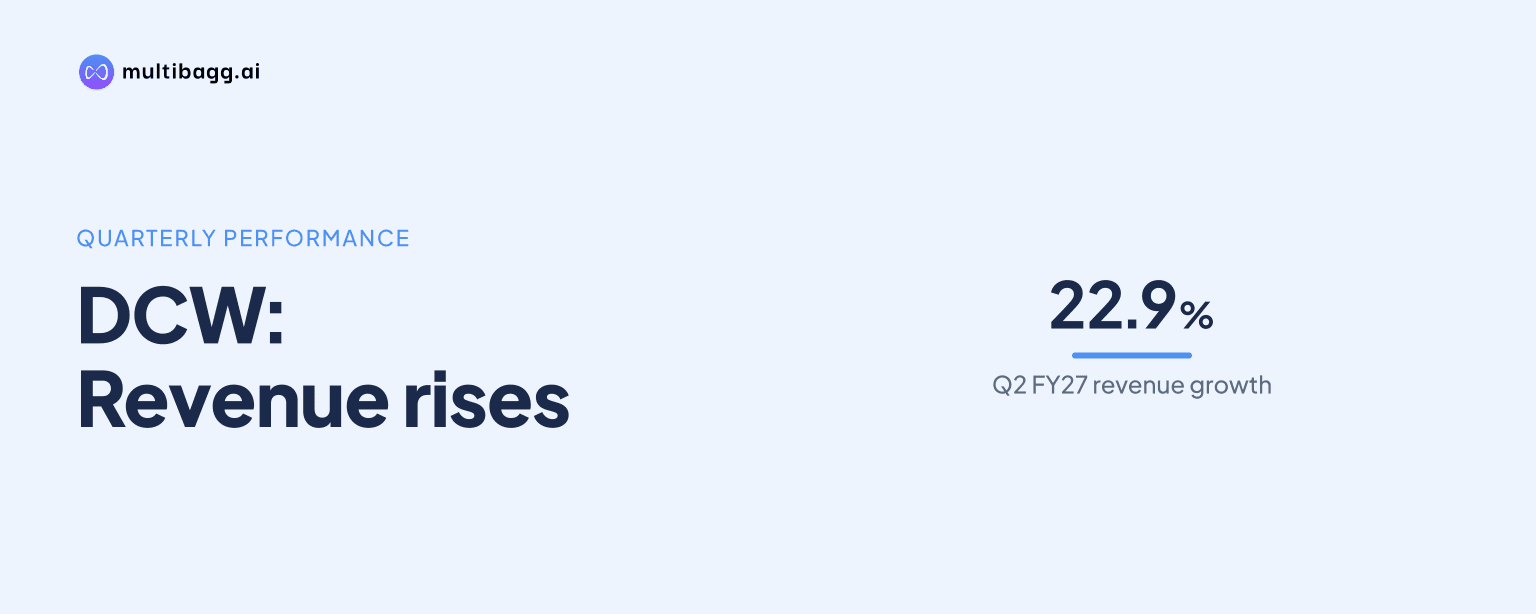
DCW Limited reported revenue from operations of ₹662.9 crore in Q2 FY27, a 22.9% year-on-year increase, but its reported EBITDA fell 18.1% to ₹47.5 crore and EBITDA margin declined to 7.17%. The result shows stronger sales volumes in specialty and basic chemicals alongside continued pressure from CPVC price erosion and industry cost conditions.
Know DCW inside out
Results, valuation, peers and who's buying, in one view.
What did DCW report for Q2 FY27?
DCW reported Q2 FY27 revenue from operations of ₹662.9 crore for the quarter ended September 30, 2026, compared with the prior-year period. The company said revenue growth was supported by both operating segments, with specialty chemicals revenue growing 32% year on year and basic chemicals revenue increasing 20%.
The quarterly presentation reported EBITDA of ₹47.5 crore, down 18.1% year on year, with an EBITDA margin of 7.17%. Profit after tax was ₹10.4 crore, down 24.6% year on year, while PAT margin stood at 1.57%. No exceptional items were reported for the quarter.
During the October 30 earnings call, management also cited EBITDA including other income of ₹55 crore and an 8.2% margin. That disclosure differs from the presentation's reported EBITDA measure of ₹47.5 crore and 7.17%, making the distinction relevant when comparing the company's operating performance with figures that include other income.
Why did DCW's revenue grow while profitability declined?
DCW's revenue growth was driven by stronger demand and volumes across its specialty chemicals and basic chemicals businesses. Management said specialty chemicals benefited primarily from CPVC volumes following capacity expansion, while both segments contributed to the higher quarterly top line.
However, higher sales did not result in higher reported EBITDA. Management pointed to steep market-price erosion in CPVC, which partly offset sequential volume gains in CPVC and SIOP. It also said the industry had faced a challenging margin environment because higher costs had not always translated into improved realisations.
The basic chemicals segment showed a sequential improvement in profitability. Management said segment EBITDA recovered to ₹20 crore in Q2 from a loss of ₹14 crore in Q1 FY27, helped by normalisation in VCM price spreads and a recovery in synthetic rutile volumes after prior inventory liquidation. This improvement supported the quarter-on-quarter recovery, although it did not prevent a year-on-year decline in reported EBITDA.
How did DCW perform in the first half of FY27?
DCW reported first-half FY27 revenue from operations of ₹1,205 crore, up 19% year on year. The company attributed the increase to a 35% expansion in specialty chemicals and 13% growth in basic chemicals, indicating that both businesses contributed to the half-year sales rise.
The half-year result provides context for the quarterly numbers because specialty chemicals grew faster than the group despite pricing pressure in CPVC. Capacity expansion supported CPVC volumes, while management also referred to sequential volume gains in SIOP and CPVC. The reported figures do not establish that higher volumes fully offset lower market prices at the profitability level.
DCW operates in chemical categories including soda ash, CPVC, synthetic rutile and SIOP. The company describes itself as a pioneer in these products and as Asia's largest and only commercial-scale SIOP manufacturer. Its products are linked to demand from housing, infrastructure, water management and manufacturing, which management identified as long-term demand drivers in India.
Got a follow-up? Ask IRIS
What corporate actions and disclosures accompanied the results?
DCW's board approved the unaudited standalone and consolidated financial results for the quarter and half year ended September 30, 2026, on October 29, 2026. The company released its investor presentation in accordance with SEBI listing and disclosure requirements and held an earnings conference call on October 30 with senior management and investor-relations representatives.
The board also approved an open-market equity-share buyback of up to ₹40 crore at a price of ₹58 per share. The supplied disclosures identify the buyback amount and price, but do not provide further details here on the number of shares to be repurchased or the implementation timetable.
What does the Q2 result mean for DCW investors and operations?
For investors, the result presents two different operating signals. Revenue and segment growth demonstrate increased business activity, particularly in specialty chemicals, while the fall in EBITDA, margin and profit after tax shows that pricing and cost conditions remained difficult. The 359-basis-point decline in reported EBITDA margin is the clearest measure of that pressure in the quarterly presentation.
The improvement in basic chemicals from an EBITDA loss in Q1 FY27 to positive EBITDA in Q2 is also relevant. Management linked that change to VCM spread normalisation and synthetic rutile volume recovery, rather than to a broad improvement across every product line. CPVC price erosion remained a stated constraint despite higher CPVC volumes.
DCW is listed on the National Stock Exchange of India and BSE, and its presentation and conference call form part of its disclosures to institutional and retail market participants. The approved buyback adds a separate capital-allocation development, while the results keep attention on the sustainability of volume growth, product pricing and segment profitability.
Conclusion
DCW's Q2 FY27 performance combined 22.9% revenue growth with weaker reported profitability. Specialty chemicals and basic chemicals increased sales, and basic chemicals returned to positive EBITDA sequentially, but CPVC price erosion and broader margin pressure reduced reported EBITDA by 18.1% year on year and lowered PAT to ₹10.4 crore.
The next points to watch are the effect of expanded CPVC capacity on volumes, trends in CPVC market prices, and whether VCM spreads and synthetic rutile volumes remain supportive for basic chemicals. Investors will also track the execution details of the board-approved ₹40 crore open-market buyback at ₹58 per share.