










Deccan Gold narrows Q2 consolidated loss to ₹55 lakh in FY27
Key highlights
- Deccan Gold reported a Q2 FY27 consolidated net loss of ₹55 lakh, compared with ₹8.73 crore in Q1 FY27.
- Deccan Gold reported a ₹14.20 crore share of associate profits in Q2 FY27, versus ₹6.64 crore in Q1 FY27.
- Swarnagiri produced about 135 kilograms of gold in Q2 FY27 and about 224 kilograms in H1 FY27.
- Altyn Tor dispatched a 1.2-kilogram doré bar for refining and settlement validation.
powered by IRIS
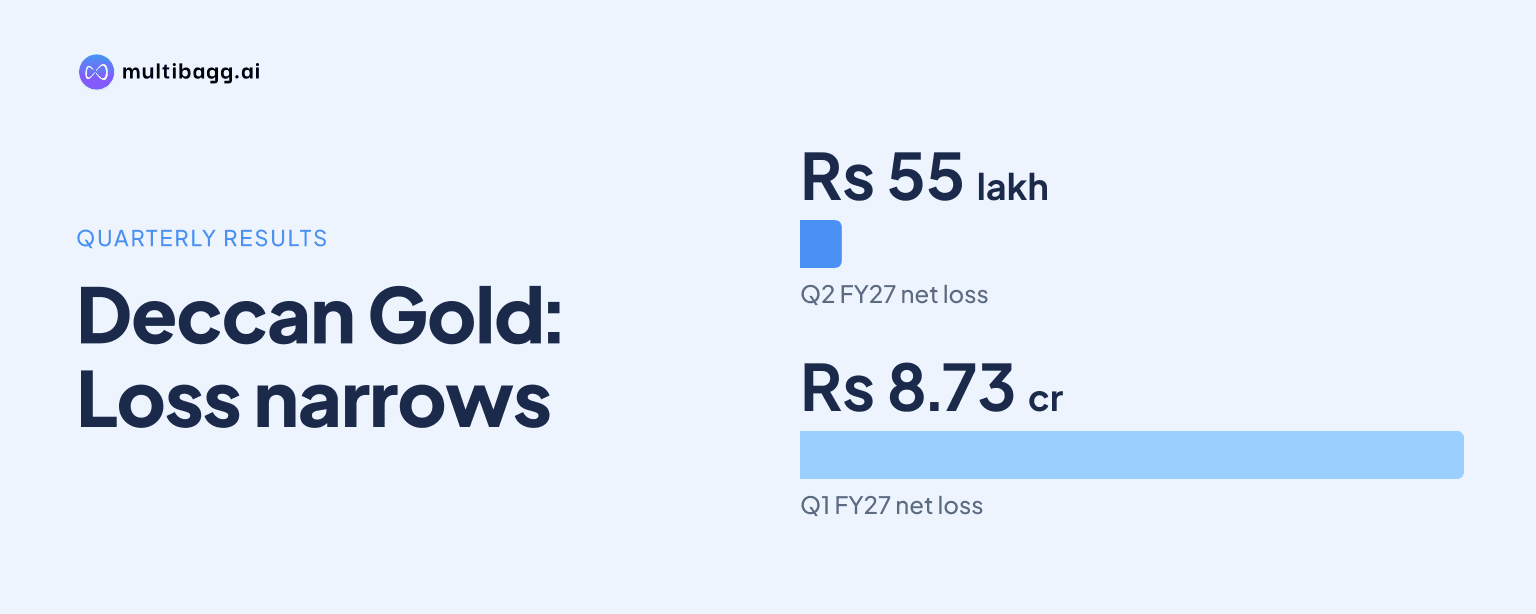
Deccan Gold Mines Limited reduced its consolidated net loss to ₹55 lakh in Q2 FY27 from ₹8.73 crore in Q1 FY27, as its reported share of profits from associates increased to ₹14.20 crore from ₹6.64 crore. Consolidated total income also rose to ₹2.44 crore from ₹60 lakh.
Know Deccan Gold Mines inside out
Results, valuation, peers and who's buying, in one view.
Why did Deccan Gold's consolidated loss narrow in Q2 FY27?
Deccan Gold's consolidated loss narrowed principally alongside a higher reported contribution from associates, which rose by ₹7.56 crore quarter on quarter to ₹14.20 crore in Q2 FY27. Over the same period, consolidated total income increased by ₹1.84 crore to ₹2.44 crore, while the net loss reduced by ₹8.18 crore to ₹55 lakh.
For H1 FY27, Deccan Gold reported consolidated total income of ₹3.04 crore and a consolidated net loss of ₹9.28 crore. The H1 loss remained above the Q1 FY27 loss of ₹8.73 crore because the Q2 loss was ₹55 lakh, but the release identifies the quarter-on-quarter rise in associate profits as the main disclosed factor in the Q2 improvement.
The release gives two slightly different presentations of associate profit. Its financial-performance section reports Deccan Gold's share of profits from associates at ₹14.20 crore in Q2 FY27 and ₹6.64 crore in Q1 FY27. The Swarnagiri operating update instead reports the company's share of that associate's profit at about ₹13.91 crore in Q2 and about ₹6.66 crore in Q1; it does not explain the difference.
How did Deccan Gold's standalone and consolidated results compare?
Deccan Gold reported standalone total income of ₹17.24 crore in Q2 FY27, compared with ₹11.44 crore in Q1 FY27, while consolidated total income was ₹2.44 crore compared with ₹60 lakh. The company reported standalone Q2 net profit of ₹6.51 crore, against ₹1.18 crore in the preceding quarter, whereas the consolidated result remained a ₹55 lakh loss.
For H1 FY27, Deccan Gold reported standalone total income of ₹28.68 crore and standalone net profit of ₹7.69 crore. The announcement does not provide an expense bridge, a reconciliation between the standalone and consolidated income measures, or a separate explanation for why the standalone Q2 result was profitable while the consolidated result recorded a loss.
What did Swarnagiri contribute to Deccan Gold's Q2 results?
Thriveni Lloyds Swarnagiri Private Limited, formerly Geomysore Services (India) Private Limited, produced about 135 kilograms of gold in Q2 FY27 and about 224 kilograms in H1 FY27. Deccan Gold holds a 26% stake in the associate, which is targeting approximately 400 kilograms of gold production for FY27 from the Swarnagiri Gold Project in Andhra Pradesh.
For H1 FY27, the associate reported revenue from operations of about ₹161 crore, profit after tax of ₹79.13 crore and earnings before interest, tax, depreciation and amortisation, or EBITDA, margin of about 70%. It also reported closing gold inventory valued at about ₹134 crore as of September 30, 2026, which the release says can support subsequent refining and sales activities.
Deccan Gold's operating update places its share of Swarnagiri profit at about ₹20.57 crore for H1 FY27, comprising about ₹6.66 crore in Q1 and about ₹13.91 crore in Q2. The Q2 production of about 135 kilograms accounted for more than half of the 224 kilograms reported for the first half, leaving roughly 176 kilograms implied by the associate's approximately 400-kilogram FY27 target.
Got a follow-up? Ask IRIS
What other project milestones did Deccan Gold disclose?
Deccan Gold said the Altyn Tor Gold Project in the Kyrgyz Republic was inaugurated on September 12, 2026, and that a first 1.2-kilogram gold doré bar was dispatched for refining and settlement validation. The project is operated through Avelum Partners LLC, in which Deccan Gold holds a 60% stake.
Avelum has an agreement with state-owned OJSC Kyrgyz Altyn for refining and selling gold-bearing doré from Altyn Tor. Deccan Gold said the initial 1.2-kilogram consignment was intended to validate refining, settlement and related operating procedures, rather than disclosing completed commercial sales or revenue from the project.
At the Bhalukona nickel-copper-platinum-group elements project in Chhattisgarh, preliminary modelling indicated potential for more than 4 million tonnes of mineralisation at an estimated grade of about 0.24% nickel equivalent. The interpretation covers around 25% of a 1.3-kilometre mineralised corridor and follows 15 diamond drill holes totalling 2,773 metres, alongside geological and geophysical surveys.
At the Logrosan tungsten-tin project in Spain, all eight maiden drill holes at the Dehesa target intersected tungsten or tungsten-tin mineralisation. Preliminary modelling indicated more than 2.3 million tonnes of mineralised material, although Deccan Gold said further drilling is required to establish a compliant mineral resource; up to €250,000 of Spanish government grant support has been approved for exploration at La Brujas.
Conclusion
Deccan Gold's Q2 FY27 result combined a sharp reduction in consolidated net loss, to ₹55 lakh from ₹8.73 crore in Q1, with a reported associate-profit contribution of ₹14.20 crore. Swarnagiri was the principal disclosed associate driver, producing about 135 kilograms of gold during the quarter and reporting H1 profit after tax of ₹79.13 crore.
The next disclosed markers are Swarnagiri's target of approximately 400 kilograms of FY27 production and the validation of refining, settlement and operating procedures following Altyn Tor's 1.2-kilogram doré dispatch. Deccan Gold also said further drilling is required at Logrosan, while Bhalukona's present geological interpretation covers only around 25% of the identified 1.3-kilometre corridor.