










DEE operating cash flow turns negative despite profit growth
Key highlights
- DEE recorded Rs 6.7909 crore of net cash used in operating activities in the half year ended 30 September 2026.
- Receivables, inventories, financial assets and other assets absorbed Rs 183.1725 crore of cash in first-half 2026.
- DEE's profit after tax increased to Rs 39.536 crore from Rs 30.9378 crore despite the operating cash outflow.
- DEE used Rs 225 crore of preferential-issue proceeds to repay short-term borrowings by 30 September 2026.
powered by IRIS
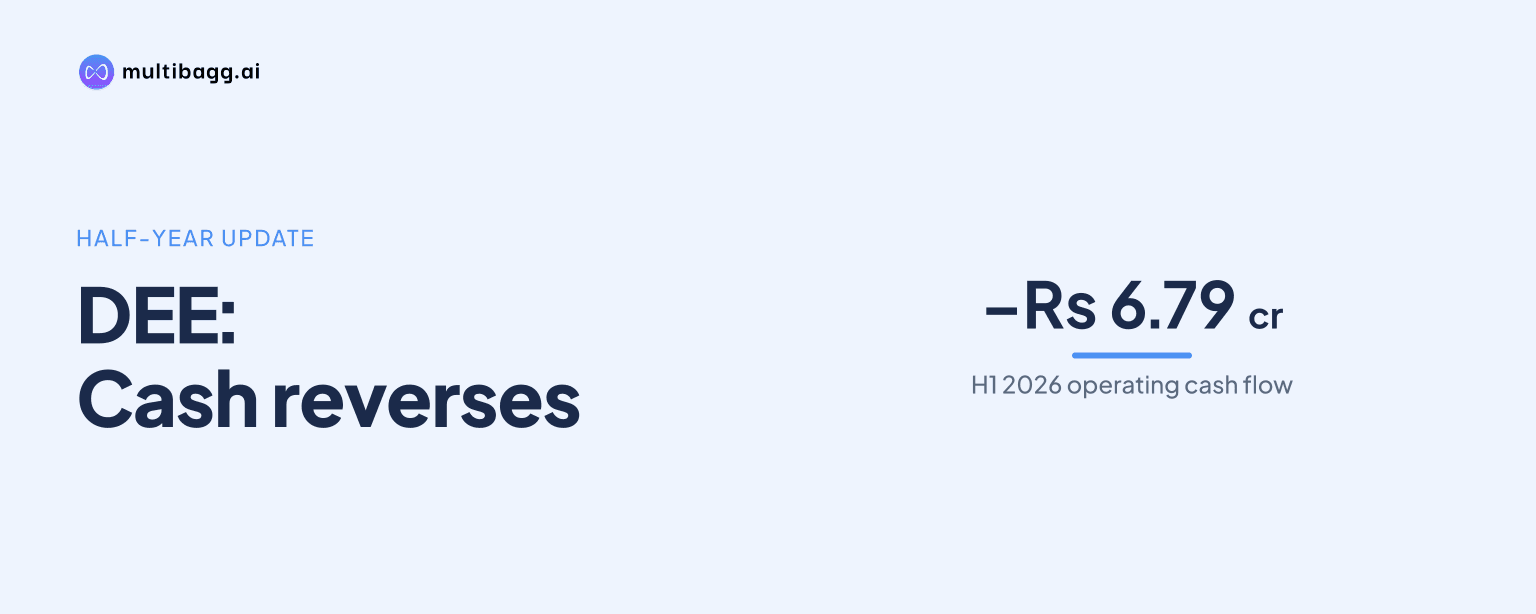
DEE Development Engineers Limited (DEE) recorded net cash used in operating activities of Rs 6.7909 crore in the half year ended 30 September 2026, despite profit after tax rising to Rs 39.536 crore, because increases in receivables, inventories, financial assets and other assets absorbed Rs 183.1725 crore.
Know DEE Development Engineers inside out
Results, valuation, peers and who's buying, in one view.
Why did DEE report negative operating cash flow?
DEE reported negative operating cash flow because Rs 5.9291 crore of cash generated from operations did not cover income-tax payments of Rs 12.72 crore in the half year ended 30 September 2026. This resulted in net cash used in operating activities of Rs 6.7909 crore, compared with net operating cash generated of Rs 3.2734 crore in the corresponding half year ended 30 September 2025.
The reversal occurred even as operating profit before working-capital changes increased to Rs 112.5754 crore from Rs 92.5315 crore a year earlier. Profit before tax rose to Rs 49.9176 crore from Rs 38.1199 crore, while depreciation and amortisation was Rs 30.8532 crore and finance costs were Rs 32.4667 crore in the latest half year.
DEE's cash generated from operations fell to Rs 5.9291 crore from Rs 11.2802 crore after working-capital movements. The filing therefore shows a difference between higher reported profit and cash conversion during the period, driven by movements in operating assets and liabilities rather than a decline in first-half earnings.
Which working-capital movements absorbed DEE's cash?
DEE used Rs 63.4198 crore in trade receivables, Rs 57.0094 crore in inventories and Rs 61.6296 crore in other assets during the half year ended 30 September 2026. Including a Rs 1.1137 crore use from financial assets, these four movements absorbed Rs 183.1725 crore of cash.
Inventory cash use rose from Rs 33.3105 crore in the prior-year half to Rs 57.0094 crore in the latest period. Cash used in other assets widened to Rs 61.6296 crore from Rs 14.4027 crore, while receivables absorbed Rs 63.4198 crore, broadly unchanged from Rs 63.4294 crore a year earlier.
The balance sheet showed inventories of Rs 633.0246 crore at 30 September 2026, compared with Rs 576.0152 crore at 31 March 2026. Trade receivables rose to Rs 446.4057 crore from Rs 383.3405 crore, while other current assets increased to Rs 177.8366 crore from Rs 111.3197 crore. The filing does not give a further item-by-item explanation of the cash-flow line for other assets.
What offset DEE's increase in operating assets?
DEE partly offset asset-related cash use through a Rs 61.3234 crore increase in trade payables and a Rs 17.1884 crore increase in other liabilities in the latest half year. Provisions added Rs 67.95 lakh, while financial liabilities used Rs 2.6651 crore, leaving the liability movements insufficient to fully offset the Rs 183.1725 crore asset-related use.
Trade payables were a material change from the prior-year period, when they used Rs 49.1446 crore of cash rather than supplying cash. Other liabilities supplied Rs 17.1884 crore in the latest half, below the Rs 75.9885 crore contribution in the half year ended 30 September 2025.
DEE's current borrowings declined to Rs 402.4072 crore at 30 September 2026 from Rs 553.452 crore at 31 March 2026. The cash-flow statement records net repayment of short-term borrowings of Rs 160.2597 crore and Rs 6.6513 crore of proceeds from trade credits from banks and others.
During the September 2026 quarter, DEE issued 59,76,096 equity shares at Rs 502 each for gross proceeds of Rs 300 crore. After issue-related expenses of Rs 6.4411 crore, the company disclosed net proceeds of Rs 293.5589 crore, of which Rs 225 crore had been used to repay short-term borrowings and Rs 68.5589 crore for general corporate purposes by 30 September 2026.
Got a follow-up? Ask IRIS
How did DEE's profit and segments perform?
DEE increased revenue from operations to Rs 587.449 crore in the half year ended 30 September 2026 from Rs 493.7582 crore in the corresponding 2025 period. Profit after tax increased to Rs 39.536 crore from Rs 30.9378 crore, and profit before tax increased to Rs 49.9176 crore from Rs 38.1199 crore.
The piping division was the largest reported business segment, with revenue of Rs 535.8083 crore, up from Rs 443.809 crore, and segment profit before interest and tax of Rs 81.0602 crore, up from Rs 61.8776 crore. Heavy fabrication revenue rose to Rs 33.2956 crore from Rs 29.3508 crore, but its segment result declined to Rs 7.8633 crore from Rs 8.6534 crore.
The power division recorded a segment loss before interest and tax of Rs 2.7098 crore, compared with a Rs 2.5787 crore loss in the prior-year half. DEE also reported Rs 133.596 crore of net cash used in investing activities, including Rs 58.0185 crore for property, plant and equipment, capital work-in-progress and intangible assets under development, plus Rs 58 crore invested in mutual funds.
Financing activities generated Rs 141.6538 crore, principally reflecting Rs 300 crore of share-capital proceeds alongside borrowing repayments, interest and issue expenses. Cash and cash equivalents consequently increased by Rs 1.2669 crore during the half year to Rs 40.5351 crore at 30 September 2026.
What disclosed matters could affect DEE's future cash generation?
DEE disclosed uncertainty over the future cash flows and asset carrying value of subsidiary Malwa Power Private Limited, whose assets were Rs 50.6334 crore at 30 September 2026. The subsidiary operates a 6 megawatt biomass plant whose previous power purchase agreement expired on 27 April 2025, and its tariff remains subject to proceedings and an appeal before the Appellate Tribunal for Electricity.
Management said tariff determination and the ongoing proceedings had adversely affected Malwa Power's operational viability and created uncertainty over future cash flows. Management was unable to assess the consequential impact on the Rs 50.6334 crore carrying value pending the final appeal outcome and evaluation of strategic alternatives.
The independent auditor said it was unable to determine whether impairment was required for these assets because sufficient appropriate audit evidence regarding their carrying value was unavailable. The auditor's review conclusion was subject to the possible effects of that observation, while also drawing attention to separate tariff litigation involving DEE's 8 megawatt Abohar biomass plant.
Conclusion
DEE's first-half results show that higher revenue and profit did not translate into positive operating cash flow in the half year ended 30 September 2026. Asset-related working-capital movements used Rs 183.1725 crore, exceeding the support from higher operating profit and from increases in trade payables and other liabilities, while Rs 12.72 crore of tax payments moved operating cash flow to an outflow.
The next results will show whether receivables of Rs 446.4057 crore, inventories of Rs 633.0246 crore and other current assets of Rs 177.8366 crore at 30 September 2026 continue to absorb cash. Investors can also watch the final appeal outcome and management's strategic-alternatives evaluation for Malwa Power, given the disclosed uncertainty around its Rs 50.6334 crore asset carrying value.