










DhanSafal Finserve FY26 Revenue Rises 152% to ₹12.23 Crore
Key highlights
- DhanSafal Finserve's FY26 revenue from operations rose 151.72% to ₹12.23 crore.
- FY26 total income increased 141.80% to ₹12.50 crore from ₹5.17 crore.
- FY26 profit after tax grew 97.44% to ₹0.73 crore.
- Q1 FY27 profit after tax was ₹0.58 crore, compared with ₹0.15 crore a year earlier.
powered by IRIS
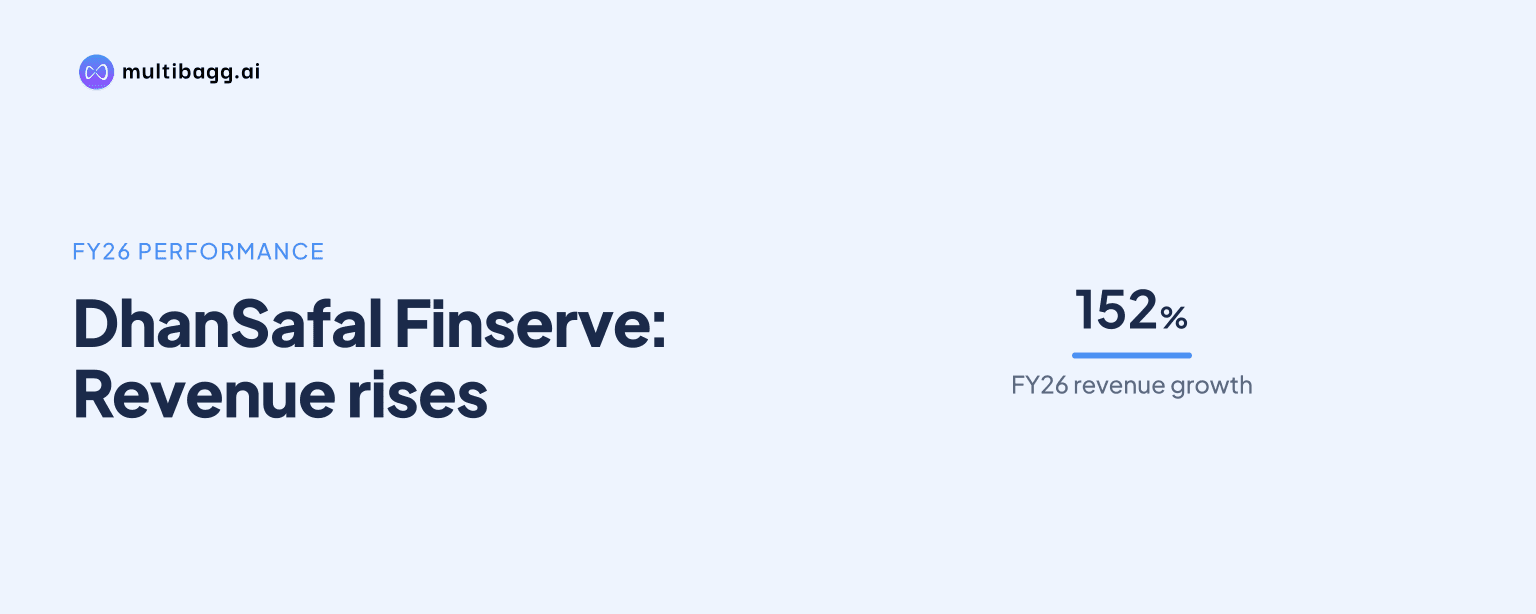
DhanSafal Finserve Limited reported revenue from operations of ₹12.23 crore in FY26, a 151.72% increase from ₹4.86 crore in FY25, while profit after tax rose 97.44% to ₹0.73 crore. The performance reflects growth in its lending business and an expanded loan portfolio during the year ended March 31, 2026.
Know Dhansafal Finserve inside out
Results, valuation, peers and who's buying, in one view.
What did DhanSafal Finserve report for FY26?
DhanSafal Finserve Limited reported a sharp increase in income and profitability for FY26, according to its 45th annual report. Total income rose 141.80% year-on-year to ₹12.50 crore from ₹5.17 crore in FY25. Revenue from operations accounted for ₹12.23 crore, compared with ₹4.86 crore a year earlier.
The company attributed the operating-income increase primarily to 151.72% growth in its lending business and expansion of its loan portfolio. DhanSafal is a non-banking finance company that provides retail financial services in India. Its annual report was presented with audited financial statements for the year ended March 31, 2026.
Profit before tax increased to ₹1.06 crore in FY26 from ₹0.57 crore in FY25. Profit after tax rose to ₹0.73 crore from ₹0.37 crore. The 97.44% increase in post-tax profit was lower than revenue growth in percentage terms, but it marked a near-doubling of annual earnings from the preceding year.
How did lending activity support DhanSafal's financial performance?
Lending activity supported DhanSafal's FY26 performance because the company specifically identified growth in its lending business and a larger loan portfolio as the main drivers of higher revenue from operations. The increase in operating revenue was substantially ahead of the growth in total income, indicating that core business activity was central to the annual improvement.
For a retail-focused NBFC, loan-book expansion is directly relevant to interest and other lending-related income. The annual report does not provide the loan-book value or a portfolio mix in the supplied information. It does, however, clearly links the rise in revenue to lending-business growth rather than to an exceptional or non-operating income item.
The improvement continued into the first quarter of FY27. For the quarter ended June 30, 2026, DhanSafal reported total revenue of ₹3.88 crore and revenue from operations of ₹3.74 crore. Quarterly profit after tax was ₹0.58 crore, compared with ₹0.15 crore in the corresponding quarter of FY26, while basic and diluted earnings per share were ₹0.03 each.
What is the latest update on DhanSafal's FY27 results?
DhanSafal scheduled a board meeting on November 12, 2026, to consider, approve and take on record unaudited standalone and consolidated financial results for the quarter and half year ended September 30, 2026. The disclosure placed the company among firms reporting Q2 FY27 earnings on that date.
A separate update in the provided information states that the board approved H1 FY27 standalone results with net profit of ₹1.60 crore, compared with a net loss of ₹1.55 crore in H1 FY26. This represents a shift from loss to profit for the six-month period, although the supplied material does not state H1 revenue, loan-book size, margins or the detailed composition of the result.
The company also said its trading window was closed from October 1, 2026, and would remain closed until 48 hours after the declaration of the September-quarter and first-half results, through November 14, 2026, inclusive. Such closures are part of the framework that restricts dealing in company securities around unpublished price-sensitive financial information.
Got a follow-up? Ask IRIS
What corporate actions and governance developments are relevant?
DhanSafal introduced an employee stock option plan during FY26 after the board approved the DhanSafal Finserve - Employee Stock Option Scheme 2025 on May 30, 2025, following the recommendation of its Nomination and Remuneration Committee. Shareholders subsequently approved the scheme under the Companies Act, 2013 and SEBI's share-based employee benefit regulations.
The company was formerly known as Luharuka Media & Infra Limited. The change in corporate identity is relevant because investors reviewing older announcements and historical market disclosures may encounter the previous name. The supplied information also notes the appointment approval of Bobby Singh Chandel as chief executive officer under the former company name.
At the 45th annual general meeting held on September 23, 2026, shareholders considered the adoption of FY26 audited financial statements and other proposals, including a proposed fund raise of up to ₹300 crore and material related-party transactions. The source does not provide the final terms, timing or utilisation of any fund raise, so these matters remain distinct from the audited FY26 operating results.
Why do the FY26 figures matter to investors?
The FY26 figures matter because DhanSafal delivered higher revenue and profit while identifying lending expansion as the operating driver. Revenue from operations grew by more than 150%, and profit after tax rose to ₹0.73 crore. The Q1 FY27 and reported H1 FY27 updates indicate that investors will focus on whether the growth in lending-led income and profitability is sustained in subsequent disclosures.
The results also need to be assessed with the information still unavailable in the supplied disclosures. DhanSafal has not provided, in the material available here, detailed asset quality indicators, borrowing costs, credit-loss provisions, capital ratios or the exact loan-book size for FY26. Those measures are important for evaluating a growing NBFC alongside revenue and profit figures.
Conclusion
DhanSafal's FY26 audited results show a substantial expansion in its lending-led business, with revenue from operations rising to ₹12.23 crore and profit after tax reaching ₹0.73 crore. The June-quarter result and the reported first-half profit update point to continued earnings improvement, while the annual report establishes the FY26 base for comparison.
The next disclosures to watch are the detailed Q2 and H1 FY27 financial statements, including income composition and operating metrics, following the November 12 board meeting. Investors may also monitor any further company communication on the proposed fund raise of up to ₹300 crore and the implementation of the 2025 employee stock option scheme.