










Dharmaj Crop Guard Q2 Revenue Falls 5.7% to ₹3.3 Billion
Key highlights
- Dharmaj Crop Guard reported Q2 revenue of ₹3.3 billion, or ₹330 crore, compared with ₹3.5 billion a year earlier.
- Q2 revenue declined approximately 5.7% year on year, a ₹20 crore reduction from the prior-year period.
- Revenue from operations was ₹3.841 billion, or ₹384.10 crore, in Q1 FY27.
- Dharmaj Crop Guard reported FY26 revenue of ₹11.38 billion and net profit of ₹550 million.
powered by IRIS
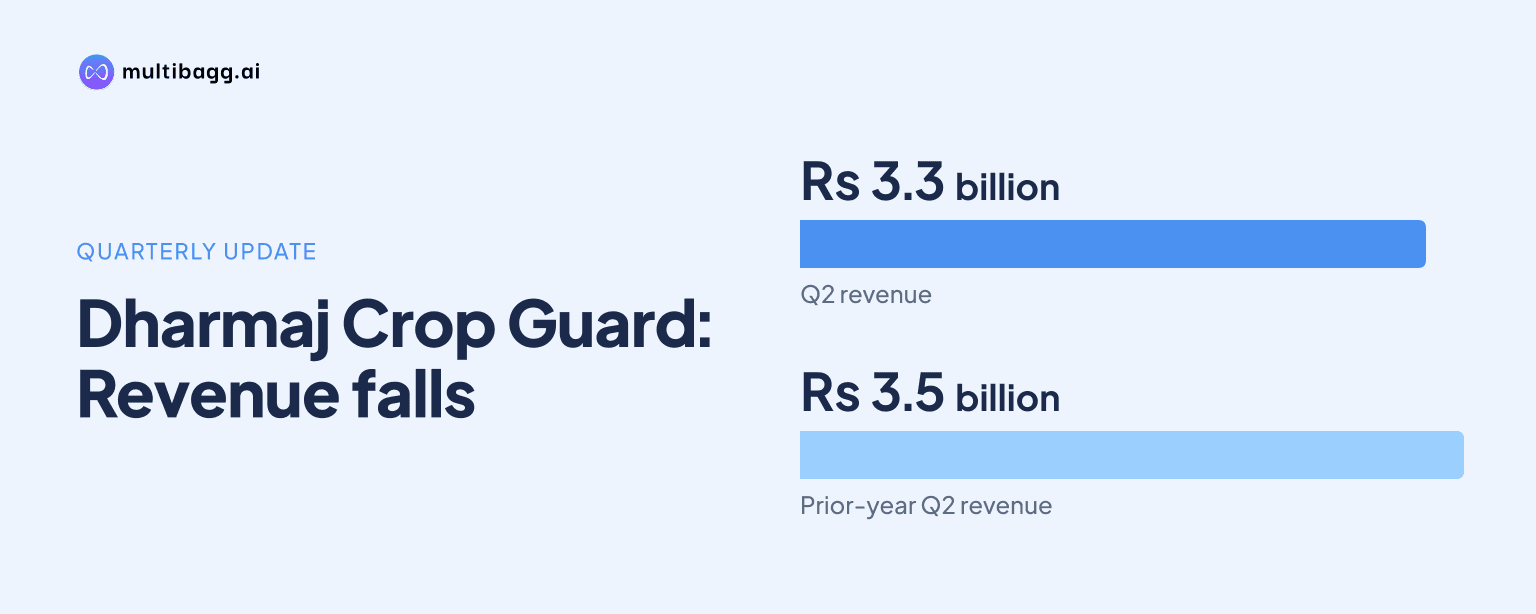
Dharmaj Crop Guard Limited reported Q2 revenue of ₹3.3 billion, or ₹330 crore, a 5.7% year-on-year decline from ₹3.5 billion, or ₹350 crore, as seasonal conditions and domestic agrochemical demand challenges weighed on the top line. The result follows a stronger ₹384.10 crore revenue base in Q1 FY27.
Know Dharmaj Crop Guard inside out
Results, valuation, peers and who's buying, in one view.
Why did Dharmaj Crop Guard's Q2 revenue decline?
Dharmaj Crop Guard's Q2 revenue declined by ₹20 crore from the comparable prior-year quarter. Revenue was reported at ₹330 crore for the September quarter, against ₹350 crore a year earlier. This equates to a 5.7% year-on-year contraction based on the reported figures.
The company linked the weaker top line to seasonal and demand-related challenges across domestic agrochemical segments. Early and erratic monsoon conditions also affected quarterly off-take, according to the information provided. These conditions made Q2 sequentially weaker after the June quarter, when revenue from operations stood at ₹384.10 crore.
Despite the reduction in reported revenue, the company indicated that volumes grew across segments and that technical gross margins improved. The available information does not provide segment-wise revenue, volume data, or a quantified gross-margin figure for Q2. As a result, the extent to which improved volumes and margins offset the lower top line cannot be independently measured from the disclosed data.
What were the key Q2 and recent financial figures?
Dharmaj Crop Guard reported ₹330 crore of Q2 revenue, while revenue from operations in Q1 FY27 was ₹384.10 crore. The Q2 figure was about 14.1% below the immediately preceding quarter, illustrating the seasonal variation in the company's quarterly sales cycle.
A November 4 board-meeting announcement stated that the board approved unaudited Q2 and half-year FY27 results. The same announcement referred to consolidated profit of ₹514.09 million. The provided information does not specify the corresponding prior-year profit base for this disclosed amount, so no year-on-year profit comparison is made here.
How does the Q2 performance compare with FY26?
Dharmaj Crop Guard entered FY27 after a stronger FY26, when it reported revenue growth of 20% to ₹1,138 crore and net profit growth of 57% to ₹55 crore. The FY26 performance included growth in the domestic active-ingredient business, which rose 37%, and the achievement of profit-before-tax breakeven at the technical plant.
However, not all operations expanded at the same rate in FY26. Branded formulation growth was limited to 3%, with seasonal factors identified as a constraint. This backdrop is relevant to Q2 FY27 because domestic agrochemical demand and monsoon conditions continued to be important factors in the company's reported quarterly revenue movement.
The company had also reported an 87-day cash conversion cycle in FY26. It attributed the increase to a strategic build-up of raw-material inventory. Inventory decisions can affect working-capital requirements even where sales volumes and manufacturing activity remain supported, making cash conversion an important measure alongside revenue and profit.
Got a follow-up? Ask IRIS
What does the result mean for investors and agrochemical operations?
The Q2 revenue decline shows that Dharmaj Crop Guard's quarterly performance remains exposed to agricultural seasonality and domestic demand conditions. The ₹330 crore result was below both the ₹350 crore prior-year figure and the ₹384.10 crore reported in Q1 FY27. For investors, the figures underline the importance of comparing the business across seasonal periods rather than relying on a single quarter alone.
Management has guided for overall top-line growth of 18% to 20% in FY27, along with margin improvement. The Q2 outcome places attention on the pace of demand recovery in subsequent quarters and on whether the reported improvement in technical gross margins continues. No revised annual guidance was provided in the information available.
No share-price movement, valuation impact, or market reaction was included in the source material. Therefore, the available disclosures support an assessment of operating and financial trends, but not a conclusion on the immediate stock-market response. The scheduled investor and analyst interaction provides a further forum for management to discuss the Q2 and first-half performance.
What disclosures and events followed the Q2 result?
Dharmaj Crop Guard's board met on November 4, 2026, to consider and approve the unaudited standalone and consolidated financial results for Q2 and the half year ended September 30, 2026. The company had previously communicated that its trading window would be closed from October 1 until 48 hours after the results release.
The company also scheduled an investor and analyst conference call for November 6, 2026, at 12:00 PM IST. The stated participants included the Chairman, Chief Executive Officer, Chief Financial Officer and Whole-Time Director. The call is expected to address Q2 and H1 FY27 earnings performance, based on the company communication.
Conclusion
Dharmaj Crop Guard's Q2 revenue of ₹3.3 billion marked a 5.7% year-on-year decline, reflecting the seasonal and demand pressures cited in domestic agrochemicals. The result contrasts with the company's FY26 revenue and profit growth, while the reported volume growth and improved technical gross margins provide important operating context to the weaker quarterly top line.
The next disclosed event to watch is the November 6, 2026 investor and analyst call, where management is scheduled to discuss Q2 and H1 FY27 performance. Investors will also track progress toward the company's FY27 guidance of 18% to 20% top-line growth, margin improvement and the implications of its 87-day cash conversion cycle.