










Kaarya Facilities & Services Revenue Falls 11.8% in H1FY27
Key highlights
- Kaarya's H1FY27 revenue from operations fell 11.8% year-on-year to ₹17.41 crore.
- Net cash used in operating activities reached ₹1.62 crore in H1FY27, versus ₹0.52 crore used in full-year FY26.
- Trade receivables increased to ₹17.13 crore as of September 30, 2026, from ₹15.66 crore at March 31, 2026.
- Long-term borrowings rose to ₹4.25 crore from ₹1.46 crore over the six-month period.
powered by IRIS
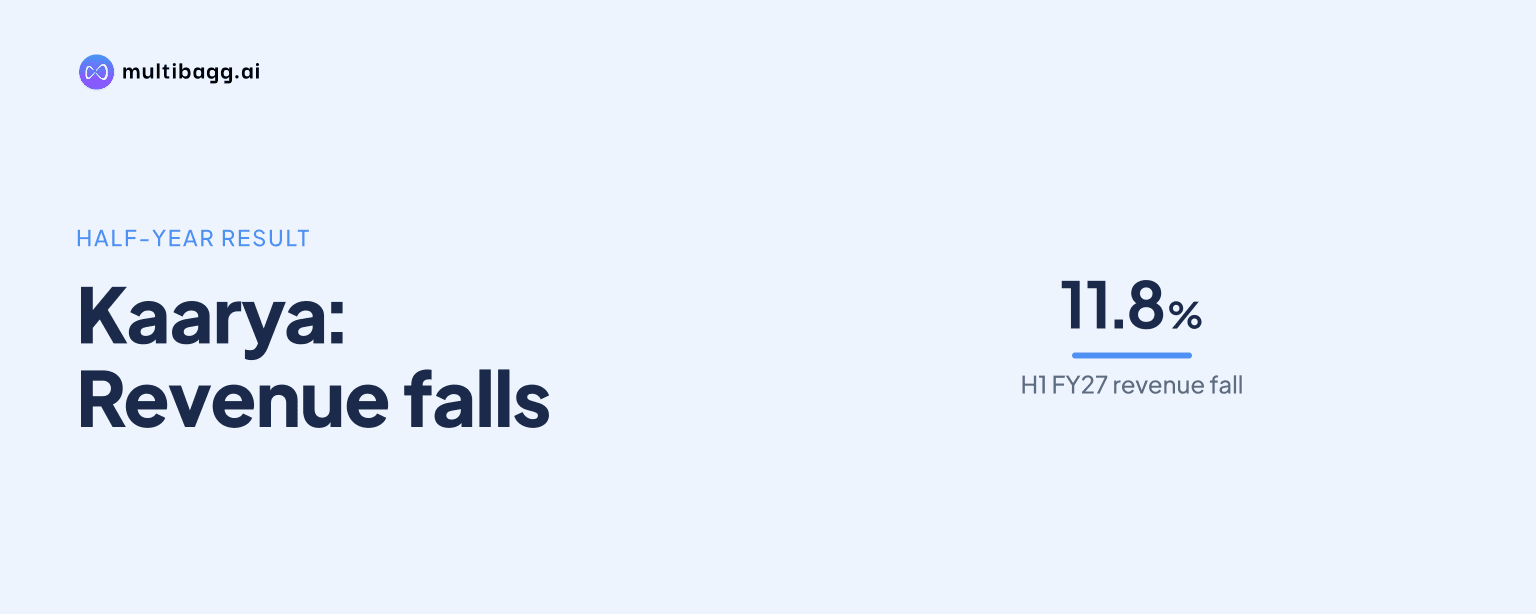
Kaarya Facilities & Services Limited reported an 11.8% year-on-year revenue decline to ₹17.41 crore in H1FY27, while net cash used in operating activities widened to ₹1.62 crore, highlighting weaker collections and increased working-capital pressure during the half year ended September 30, 2026.
Know Kaarya Facilities & Services inside out
Results, valuation, peers and who's buying, in one view.
What did Kaarya report for H1FY27?
Kaarya reported lower revenue and net profit for the half year ended September 30, 2026, in results approved by its board on November 4, 2026. Revenue from operations declined from ₹19.76 crore in H1FY26 to ₹17.41 crore in H1FY27. Other income increased to ₹0.16 crore from ₹0.08 crore, but this did not offset the fall in service revenue.
Net profit declined to ₹0.47 crore from ₹0.46 crore in the year-earlier half. Basic earnings per share rose to ₹0.98 from ₹0.49. The reported EPS increase was linked primarily to changes in the share-capital structure rather than a proportional improvement in profit.
Profit before tax was ₹0.59 crore, compared with ₹0.46 crore a year earlier. However, the comparison is affected by exceptional items. Excluding exceptional items, profit before tax fell to ₹0.72 crore from ₹0.46 crore, indicating a weaker underlying operating performance despite the increase in reported pre-tax profit.
Why did Kaarya's operating performance weaken?
Kaarya's revenue contraction came alongside a reduction in employee benefit expenses, its largest cost head. Employee benefit expenses fell to ₹13.36 crore in H1FY27 from ₹15.49 crore in H1FY26. This cost reduction helped limit the decline in profitability as sales of services decreased.
Other expenses edged up to ₹2.15 crore. At the same time, finance costs rose sharply to ₹1.07 crore from ₹0.79 crore in H1FY26. The higher interest burden absorbed a significant part of the savings in employee expenses and placed pressure on the bottom line.
The company had reported revenue of ₹38.89 crore for FY26, following ₹38.10 crore in FY25. The H1FY27 revenue figure represents a slower start to the new financial year, following the ₹19.76 crore reported in the corresponding half of FY26.
Got a follow-up? Ask IRIS
How did receivables and cash flow change at Kaarya?
Kaarya's operating cash flow weakened materially in H1FY27. Net cash used in operating activities was ₹1.62 crore during the half year, compared with ₹0.52 crore used during the full FY26. The half-year outflow exceeded the cash consumed in the entire previous financial year, pointing to increased working-capital requirements.
Trade receivables increased to ₹17.13 crore as of September 30, 2026, from ₹15.66 crore at March 31, 2026. This increase occurred even as revenue fell 11.8% over the comparable period. The divergence between lower sales and higher receivables indicates that collections lagged billed business during the period.
Short-term loans and advances rose to ₹2.81 crore from ₹0.75 crore at the end of FY26. Cash and cash equivalents declined to ₹2.14 crore from ₹2.38 crore. These movements contributed to the reduction in liquidity available on the balance sheet.
How is Kaarya funding its working-capital requirement?
Long-term borrowings more than doubled to ₹4.25 crore as of September 30, 2026, from ₹1.46 crore at March 31, 2026. Short-term borrowings were broadly unchanged at ₹7.95 crore. The increase in long-term debt coincided with the growth in receivables, loans and advances, and the negative operating cash flow.
The reported figures show that Kaarya relied more on borrowing while internal cash generation remained under pressure. Rising finance costs are consistent with the larger debt burden. For investors, the relevant financial issue is the relationship between receivable collections, operating cash flow and interest costs, rather than reported profit alone.
Kaarya's board approved the unaudited results for the quarter and half year ended September 30, 2026, along with the statutory auditors' limited review report, on November 4. Earlier, shareholders at the 17th annual general meeting on September 28, 2026 adopted the FY26 audited financial statements and appointed Bhasin Hota & Co as statutory auditors for FY27.
Conclusion
Kaarya entered H1FY27 with lower service revenue, a small decline in net profit and substantially weaker operating cash flow. Lower employee costs provided some support, but higher finance costs and the increase in receivables limited the benefit. The rise in debt alongside lower cash balances makes working-capital execution a central factor in assessing the company's financial position.
Management has not provided explicit forward guidance in the reviewed disclosures. Investors will therefore watch whether future results show improvement in trade-receivable collections, operating cash generation and finance costs, as well as whether revenue stabilises after the 11.8% H1FY27 decline.