










Dhyaani Tradeventtures has Rs 45.50 crore pending tax dues
Key highlights
- Dhyaani Tradeventtures' reviewer reported about Rs 45.50 crore of pending income-tax dues relating to the last two years.
- Trade receivables were Rs 59.58 crore at September 30, 2026, versus Rs 62.97 crore at March 31, 2026.
- Cash and cash equivalents declined to Rs 2.93 lakh at September 30, 2026 from Rs 3.07 lakh at March 31, 2026.
- The November 5, 2026 limited-review conclusion was not modified despite the disclosed compliance and receivables matters.
powered by IRIS
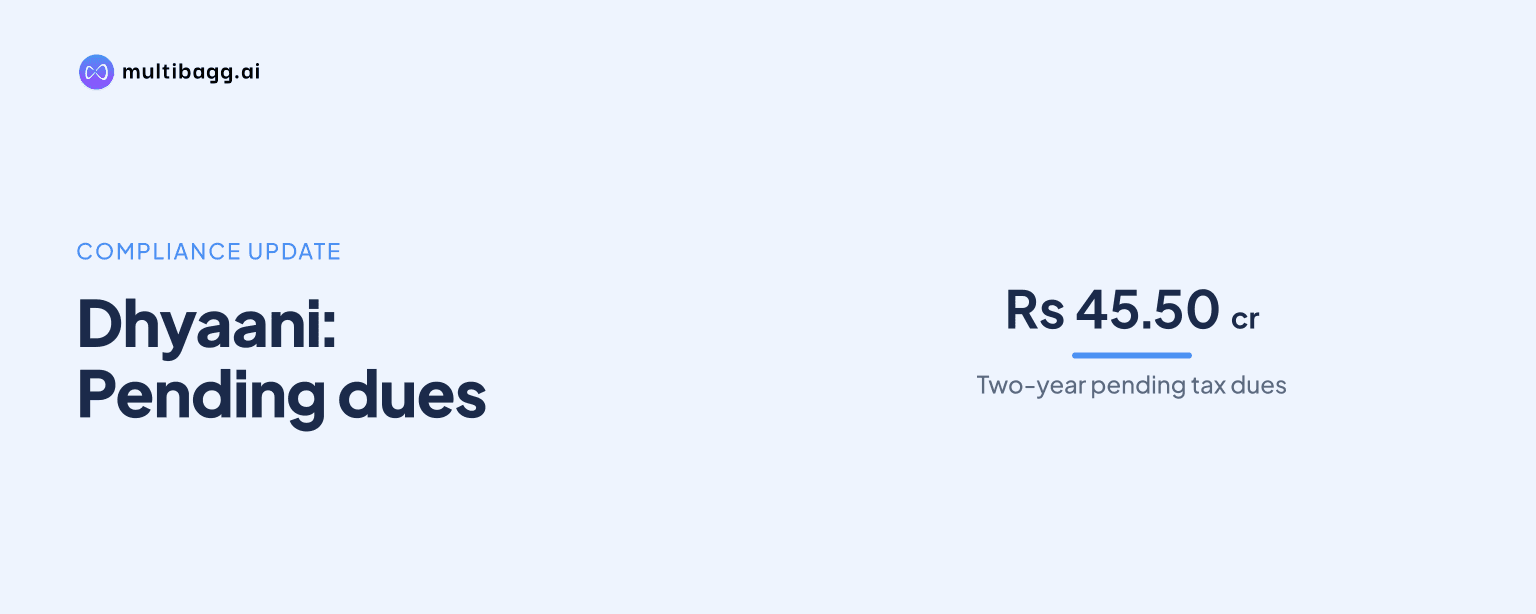
Dhyaani Tradeventtures Limited had about Rs 45.50 crore of pending income-tax dues for the last two years in the limited review for the half year ended September 30, 2026, while the reviewer also cited delayed statutory payments and receivables overdue beyond six months. The review conclusion was not modified.
Know Dhyaani Tradeventtures inside out
Results, valuation, peers and who's buying, in one view.
What did Dhyaani Tradeventtures' reviewer identify in its tax position?
Dhyaani Tradeventtures' reviewer identified pending income-tax dues of around Rs 45.50 crore relating to the last two years. The amount was disclosed in the limited review report dated November 5, 2026, covering standalone unaudited financial results for the half year ended September 30, 2026. The report does not split the dues between the two years, state whether they are disputed, or identify payment dates.
Dhyaani Tradeventtures reported current tax liabilities of Rs 24.53 lakh at September 30, 2026, compared with Rs 2.28 lakh at March 31, 2026. That balance-sheet line is separate from the reviewer’s statement about about Rs 45.50 crore of pending income-tax dues, and the filing does not establish that the two figures represent the same obligation. The reviewer separately said the company was not regular in paying statutory dues on time.
Which statutory compliance lapses did Dhyaani Tradeventtures disclose?
Dhyaani Tradeventtures did not comply with statutory requirements related to e-way bills and e-invoices, according to the review report for the half year ended September 30, 2026. The filing does not quantify affected transactions, specify the periods of non-compliance, or disclose a penalty, demand or corrective programme related to the e-way bill and e-invoice matters.
Dhyaani Tradeventtures also did not comply with Section 194Q of the Income Tax Act, 1961, for tax deducted at source, or TDS, on purchases of goods exceeding Rs 50 lakh from one party. The November 5, 2026 report does not state the affected purchase value, the amount of TDS involved, or whether any shortfall was subsequently paid. The observation is separate from the reviewer’s statement on the Rs 45.50 crore of pending income-tax dues.
How do overdue receivables affect Dhyaani Tradeventtures?
Dhyaani Tradeventtures had trade receivables outstanding for more than six months at September 30, 2026, and the reviewer said the prolonged position may adversely affect liquidity and working capital. The report added that continued non-realisation could affect the company’s ability to meet financial obligations as they fall due. It does not disclose the value of receivables overdue beyond six months or identify the counterparties involved.
Dhyaani Tradeventtures' total trade receivables declined to Rs 59.58 crore at September 30, 2026 from Rs 62.97 crore at March 31, 2026, a reduction of Rs 3.39 crore. The lower closing balance does not show whether the movement resulted from collections, provisions, reclassification or another factor. The filing also says outstanding trade receivables, trade payables and unsecured loans received remain subject to confirmation and supporting documents.
Got a follow-up? Ask IRIS
What changed in Dhyaani Tradeventtures' balance sheet?
Dhyaani Tradeventtures' total assets fell to Rs 68.15 crore at September 30, 2026 from Rs 74.07 crore at March 31, 2026, while trade receivables remained its largest stated current-asset line. Cash and cash equivalents were Rs 2.93 lakh at September 30, down from Rs 3.07 lakh at March 31. The September figures are unaudited standalone balances, while the March comparator is audited.
Dhyaani Tradeventtures reported equity share capital of Rs 17.02 crore at both September 30, 2026 and March 31, 2026, while other equity rose to Rs 18.34 crore from Rs 17.61 crore. Non-current borrowings were Rs 1.27 crore at both dates. These reported balances provide context for the reviewer’s warning that delayed recovery of receivables older than six months may affect working capital.
What did the limited review conclude?
Dhyaani Tradeventtures received a conclusion that nothing had come to the reviewer’s attention to indicate that the standalone unaudited results for the half year ended September 30, 2026 were materially misstated or inadequately disclosed under Regulation 33 of the Securities and Exchange Board of India (SEBI) Listing Obligations and Disclosure Requirements Regulations, 2015. S D P M & Co. stated that its conclusion was not modified in respect of the matters it highlighted, including the Rs 45.50 crore of pending income-tax dues.
Dhyaani Tradeventtures' review was conducted under Standard on Review Engagement 2410, which the report says provides moderate assurance through inquiries of company personnel and analytical procedures. The report says a review provides less assurance than an audit and that the reviewer did not perform an audit or express an audit opinion. An unmodified review conclusion therefore appears alongside the disclosed tax, statutory compliance, balance-confirmation and receivable-collection matters.
Conclusion
Dhyaani Tradeventtures' September 30, 2026 filing combines an unmodified limited-review conclusion with several unresolved matters identified by the reviewer: about Rs 45.50 crore of income-tax dues, delayed statutory payments, e-way bill and e-invoice non-compliance, Section 194Q TDS non-compliance, and receivables outstanding beyond six months. Total receivables declined by Rs 3.39 crore from March 31, but the filing does not quantify the aged portion.
The next disclosures to watch are whether Dhyaani Tradeventtures confirms receivable, payable and unsecured-loan balances with supporting documents, collects receivables overdue beyond six months, and resolves the two-year income-tax and statutory compliance matters. The November 5, 2026 report provides no payment timetable, quantified TDS exposure, or stated corrective plan.