










Diamond Power Says Existing Assets Support Rs 10,000 Crore Revenue
Key highlights
- Diamond Power said existing infrastructure can support Rs 10,000 crore of revenue.
- Management said about Rs 366 crore of capex across six or seven projects is aimed at margins, while Rs 75 crore of balancing equipment adds volume.
- Diamond Power expects EBITDA margin of 11%-13% until polymer starts in December 2027, followed by a 14%-16% range in the next year.
- Capacity utilisation was approximately 45% of the level expected after all balancing equipment is operational.
powered by IRIS
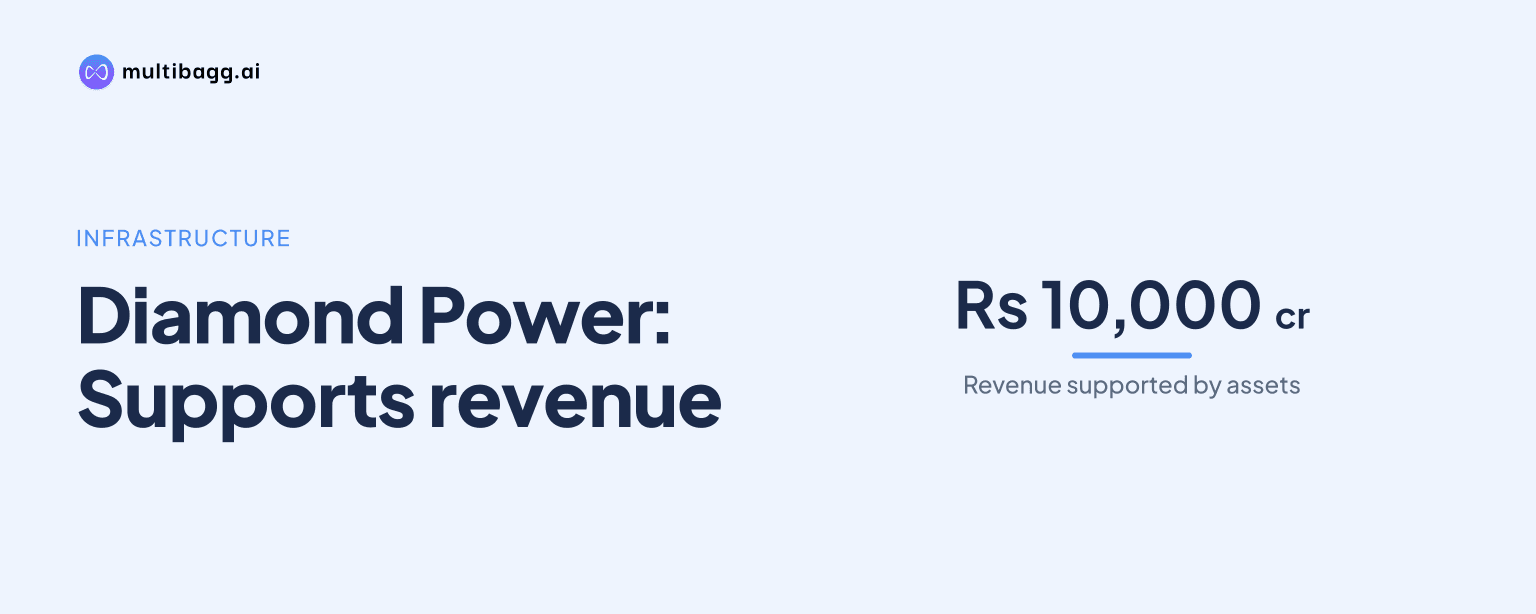
Diamond Power said its existing infrastructure can support Rs 10,000 crore of revenue, while management expects earnings before interest, tax, depreciation and amortisation (EBITDA) margin to remain between 11% and 13% until its polymer project gets on stream in December 2027. Only Rs 75 crore of planned balancing equipment is intended to add volume.
Know Diamond Power Infrastructure inside out
Results, valuation, peers and who's buying, in one view.
Can Diamond Power reach Rs 10,000 crore revenue without major volume capex?
Yes, Diamond Power said the capital expenditure and infrastructure required for its Rs 10,000 crore revenue objective are already in place. Management said it is undertaking about Rs 366 crore of additional capital expenditure across six or seven projects, but described these projects as steps to improve margins through backward integration and additional value-added products rather than to create sales volume.
Management identified Rs 75 crore of balancing equipment as the exception within the spending programme, saying that amount would add volume. Its distinction was that most of the Rs 366 crore programme is directed at improving the economics and value addition of output, while the balancing equipment supports higher throughput from the existing production base.
The polymer project illustrates the difference management drew between volume expansion and margin-led investment. In response to a question about third-party sales, management said roughly Rs 170 crore of polymer capex could generate around Rs 800 crore of revenue if the output were sold outside. However, it presented polymer and related investments principally as measures to increase value addition and EBITDA margin.
Management did not provide a date for achieving the Rs 10,000 crore revenue objective in this discussion. The analyst framed the question around the next three to four years, but management's response focused on the availability of infrastructure, the Rs 366 crore programme and the Rs 75 crore balancing-equipment requirement rather than confirming a revenue timetable.
What EBITDA margin does Diamond Power expect before polymer starts?
Diamond Power expects EBITDA margin to remain between 11% and 13% until the polymer operation gets on stream in December 2027. Management gave this range after an analyst asked whether the 12.9% EBITDA margin reported in the second quarter could rise to 15% or more in the second half, and whether an 18% to 20% medium-term range was possible.
Management did not endorse either of the higher ranges raised by the analyst. It said it would aim to provide a 14% to 16% EBITDA-margin band in the year after the polymer operation starts, while revenue growth before then should increase absolute EBITDA rather than materially alter EBITDA as a percentage of sales.
Management also said return on investment and return on capital employed should improve as revenue grows, without providing numerical targets for either measure. The stated margin path therefore rests on the December 2027 polymer start-up and on the value-added and backward-integration projects included in the Rs 366 crore capital-expenditure programme.
Metal-price movements can affect the reported percentage even when order-level contribution is unchanged, according to management. It said price-escalation contracts use a lag of about 30 days before dispatch, meaning a September dispatch would use an August price; aluminium-price movements can therefore cause a plus-or-minus 1% effect on EBITDA margin.
Management said higher metal prices increase the sales denominator and may make EBITDA margin look lower in percentage terms, while lower metal prices can have the reverse effect. It cited this mechanism in response to the analyst's observation that second-quarter revenue grew 135% but margin improved by only 70 basis points, saying absolute contribution remained broadly unchanged from the level envisaged when orders were taken.
Got a follow-up? Ask IRIS
How much of Diamond Power's capacity is currently utilised?
Diamond Power said capacity utilisation is approximately 45% of the level it expects once all balancing equipment is operational. Management did not disclose output capacity in tonnes, cable kilometres or revenue at that post-balancing-equipment level, but the measure indicates that it sees additional throughput potential after the Rs 75 crore equipment programme is completed.
Management discussed utilisation alongside the expected conductor-to-cable mix. In response to a question framed around tonnage, it said the current proportion was broadly 30% to 31% and expected a 25:75 mix for the current year and the following year, because cable business growth is expected to exceed conductor business growth.
The expected mix change places more weight on cable while the company brings balancing equipment into operation. Management said the 45% utilisation level refers to the capacity configuration after the entire balancing-equipment programme is operational, rather than providing a comparison with a separately disclosed current nameplate capacity.
Diamond Power also said its focus within conductors is AL59 eco-conductors rather than aluminium conductor steel reinforced (ACSR) conductors, which it said it has not manufactured for five years. Management estimated that high-temperature low-sag (HTLS) conductors could comprise 2% to 4% of the conductor market and said it had targeted HTLS at no more than 5% of its own revenue at best.
What demand and execution risks did Diamond Power identify?
Diamond Power identified exposure to government-linked infrastructure as a risk category, saying power, road and related infrastructure businesses are 60% to 70% dominated or controlled by government. Management said geopolitical risk is associated with such businesses, although it did not see a major risk that could disrupt its plans overnight.
On demand, management said there were Rs 32,000 crore of live enquiries due to be finalised by customers over the next 90 days across medium-voltage and extra-high-voltage cables. It clarified that these were enquiries available to cable players, not orders awarded to Diamond Power and not revenue that the company had secured.
Management said almost 90% of its order book came from renewable energy, disaster management, vertical urbanisation and underground cabling, data centres and railways, while 10% came from traditional industry segments. It described those five newer areas as collectively comparable with the Rs 25,000 crore to Rs 30,000 crore traditional-industry market it cited for 2022, but declined to estimate first-half industry growth because competitors' numbers were not yet available.
For exports, Diamond Power said it had applied for Underwriters Laboratories approval for medium-voltage cables in the United States and sent samples for type testing in Europe. Management expects most export pre-qualifications to be completed before the end of March 2027, with aluminium cables relevant for Africa and copper cables for Europe and the United States.
Conclusion
Diamond Power's disclosures present the Rs 10,000 crore revenue objective as primarily an execution and utilisation opportunity, rather than one dependent on substantial fresh volume capex. Management separated the Rs 75 crore balancing-equipment investment from the broader Rs 366 crore programme, which it said is intended to lift value addition and margins, while current utilisation is about 45% of the expected post-equipment level.
The next disclosed milestones are the completion of most export pre-qualifications before the end of March 2027 and the polymer project getting on stream in December 2027. Management has linked the latter event to a prospective 14% to 16% EBITDA-margin band in the following year, while the near-term range remains 11% to 13%; the finalisation of Rs 32,000 crore of industry enquiries over the next 90 days is another item to watch.