










DIC India profit falls 64% as September-quarter costs rise
Key highlights
- DIC India’s September 2026-quarter profit after tax fell 64.1% to Rs 1.32 crore.
- Revenue from operations increased 22.8% year on year to Rs 274.02 crore.
- Cost of materials consumed rose 32.7% to Rs 220.12 crore in the September quarter.
- Nine-month profit after tax increased to Rs 20.43 crore from Rs 12.13 crore.
powered by IRIS
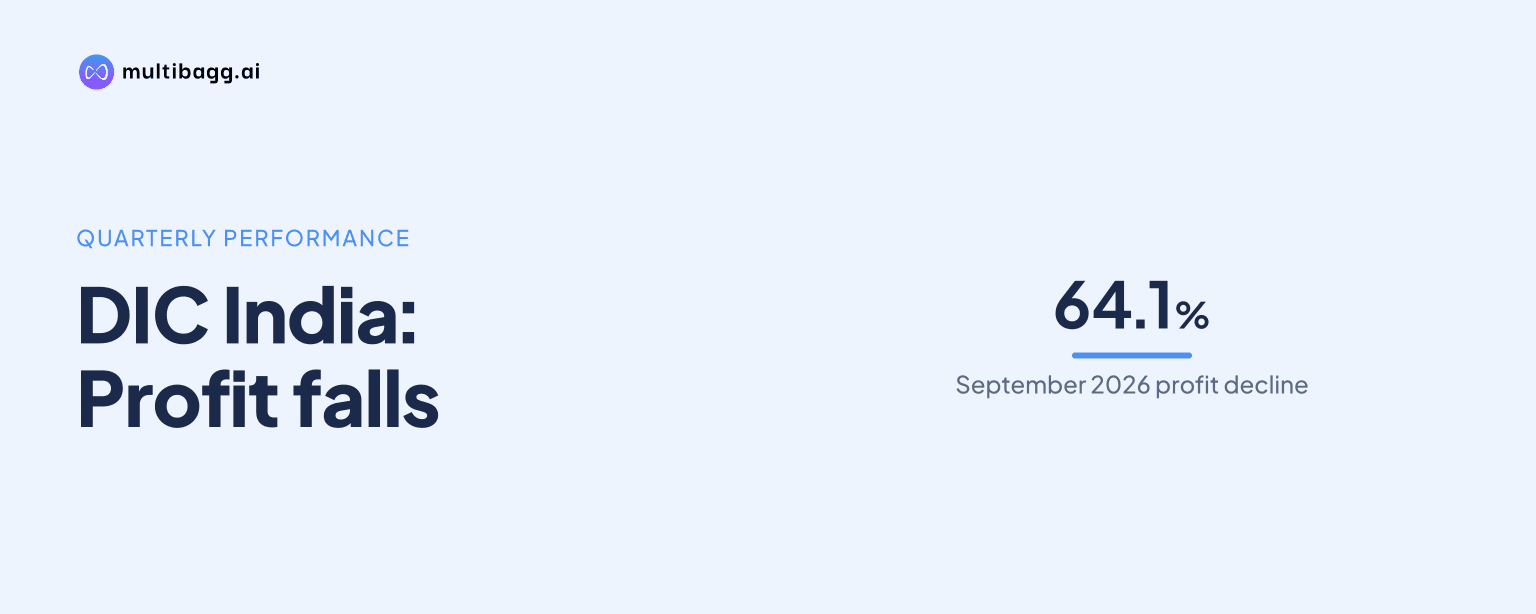
DIC India Limited reported profit after tax of Rs 1.32 crore for the quarter ended September 30, 2026, 64.1% below Rs 3.67 crore a year earlier, although revenue from operations increased 22.8% to Rs 274.02 crore, alongside higher costs and a smaller inventory-related offset.
Know DIC India inside out
Results, valuation, peers and who's buying, in one view.
Why did DIC India’s September-quarter profit fall?
DIC India’s September-quarter profit fell even as operating revenue increased because the company reported higher material, employee and other expenses, while the inventory movement provided a smaller reduction in costs than a year earlier. Profit before tax was Rs 2.55 crore in the quarter ended September 30, 2026, compared with Rs 7.93 crore in the corresponding quarter ended September 30, 2025.
Profit after tax declined by Rs 2.35 crore year on year, to Rs 1.32 crore from Rs 3.67 crore. The quarterly statement was reviewed by the Audit Committee and taken on record by DIC India’s board on November 3, 2026.
DIC India’s results are unaudited and were subject to a limited review by Price Waterhouse Chartered Accountants LLP. The auditor’s November 3, 2026 report said that nothing had come to its attention to indicate that the statement was materially misstated, while also noting that a limited review provides less assurance than an audit.
Which costs increased for DIC India in the quarter?
DIC India’s cost of materials consumed rose 32.7% year on year to Rs 220.12 crore in the September 2026 quarter from Rs 165.83 crore. The Rs 54.29 crore increase in this cost line exceeded the Rs 50.85 crore rise in revenue from operations over the same period.
Employee benefits expense increased to Rs 19.11 crore from Rs 15.51 crore, and other expenses rose to Rs 33.72 crore from Rs 30.25 crore. Finance costs increased to Rs 47.52 lakh from Rs 33.24 lakh, while depreciation and amortisation declined marginally to Rs 4.61 crore from Rs 4.66 crore.
DIC India also recorded a smaller favourable inventory movement. Changes in inventories of finished goods, stock-in-trade and work-in-progress were negative Rs 4.64 crore in the latest quarter, against negative Rs 20.36 crore a year earlier. Since this line is reported as a negative expense, the smaller negative value reduced the offset to the increases in materials and other costs.
How did DIC India perform in the first nine months?
DIC India’s profit after tax for the nine months ended September 30, 2026 increased to Rs 20.43 crore from Rs 12.13 crore in the corresponding nine months of 2025. The nine-month result therefore moved in the opposite direction to the September quarter, despite the quarter’s lower profit.
Revenue from sale of goods rose to Rs 705.52 crore in the nine-month period from Rs 657.28 crore a year earlier. Profit before tax increased to Rs 27.01 crore from Rs 17.45 crore, according to the unaudited statement for the period January 1, 2026 to September 30, 2026.
Materials costs for the nine months rose to Rs 590.93 crore from Rs 455.35 crore. Employee benefits expense increased to Rs 57.94 crore from Rs 56.69 crore, while other expenses rose to Rs 101.66 crore from Rs 88.97 crore, showing that cumulative profit growth occurred alongside higher reported input and operating expenses.
Got a follow-up? Ask IRIS
What business does DIC India report as its operating segment?
DIC India reported that its operations are predominantly the manufacture of printing inks and that management treats the business as a single operating segment under Indian Accounting Standard 108, Operating Segments. The September 2026 statement therefore does not provide separate revenue, margin or profit figures across multiple product segments.
Revenue from sale of goods was Rs 273.04 crore of DIC India’s Rs 274.02 crore revenue from operations in the September quarter. Other operating income was Rs 97.64 lakh, compared with Rs 93.64 lakh in the corresponding quarter of 2025, leaving goods sales as the principal disclosed operating revenue source.
DIC India did not disclose a revenue target, cost-reduction target or earnings outlook for its printing inks operations in the November 3, 2026 results announcement. The filing confines its operational disclosure to the financial statement and the single-segment classification.
What board changes were disclosed with DIC India’s results?
DIC India appointed Tony Sirohi and Shalini Kapoor as additional non-executive independent directors for three years from November 3, 2026, subject to shareholder approval. The company said neither appointment is liable to retire by rotation.
DIC India also disclosed the resignations of Prabal Sarkar and Pritha Dutt as non-executive independent directors from the close of business on November 5, 2026. Both resignation letters state that the directors had completed six years of appointment and that their departures did not arise from a difference of opinion with the board or management.
Sirohi’s profile cites more than 30 years of experience in general management, profit-and-loss leadership and business transformation, including roles with packaging companies. Kapoor’s profile cites more than 34 years of legal practice before the Supreme Court of India, Delhi High Court and tribunals, including civil litigation, commercial arbitration and mediation.
Conclusion
DIC India’s September 2026 quarter showed that higher operating revenue did not translate into higher earnings: revenue from operations rose 22.8% to Rs 274.02 crore, while profit after tax fell 64.1% to Rs 1.32 crore. Higher materials, employee and other expenses, together with a smaller inventory-related cost offset, accompanied the decline in quarterly profit.
The next disclosed governance event is shareholder approval of Sirohi’s and Kapoor’s appointments as additional independent directors, each effective from November 3, 2026 subject to that approval. DIC India gave no operating target or cost plan, leaving future quarterly disclosures to show how materials costs, inventory movements and other expenses develop after September 2026.