










Ramky Infrastructure Limited Q2 revenue reaches Rs 604.54 crore
Key highlights
- RIL's Q2 FY27 consolidated revenue rose 28.2% to Rs 604.54 crore, its highest quarterly level in 20 quarters.
- RIL's Q2 FY27 consolidated PAT increased 35.9% to Rs 102.81 crore from Rs 75.63 crore.
- RIL's H1 FY27 consolidated revenue rose 26.4% to Rs 1,075.77 crore while PAT declined 7.2% to Rs 141.61 crore.
- RIL disclosed an order book of more than Rs 12,000 crore.
powered by IRIS
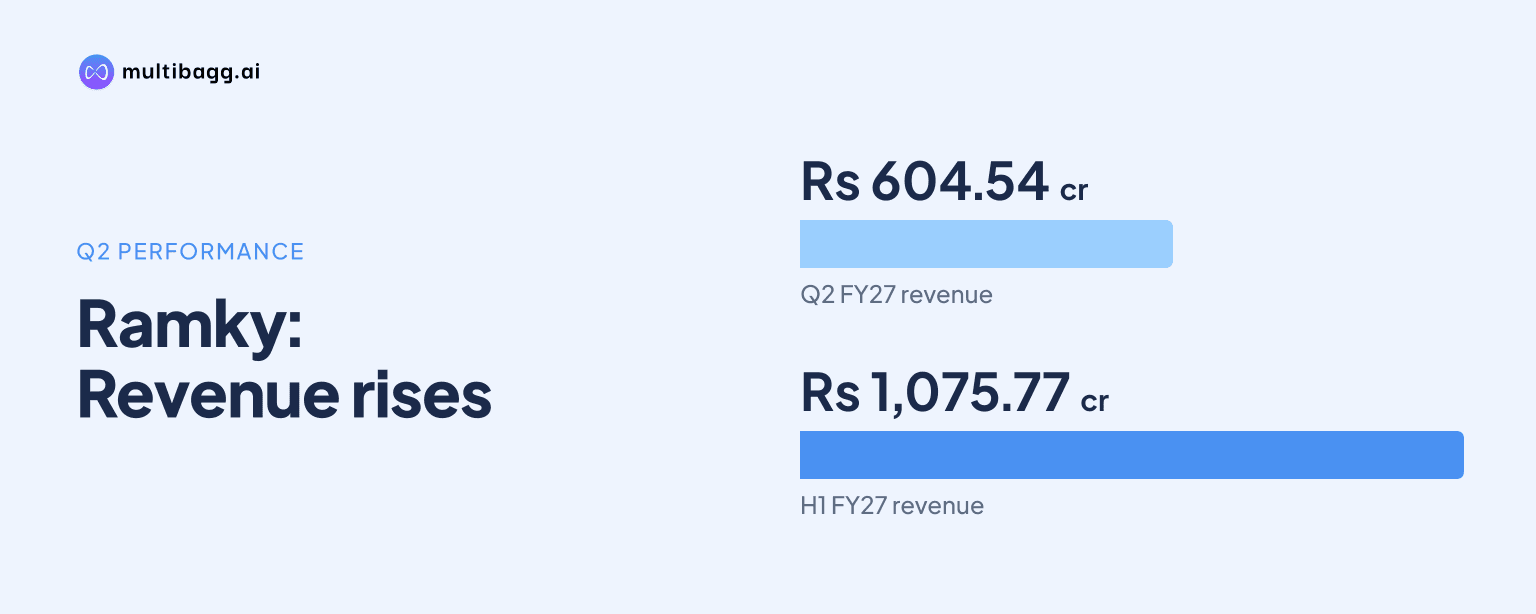
Ramky Infrastructure Limited reported consolidated revenue from operations of Rs 604.54 crore in Q2 FY27, up 28.2% year on year and its highest quarterly revenue in 20 quarters, while consolidated profit after tax (PAT) rose 35.9% to Rs 102.81 crore. The quarterly outcome contrasted with a 7.2% fall in H1 FY27 consolidated PAT.
Know Ramky Infrastructure inside out
Results, valuation, peers and who's buying, in one view.
How did RIL perform in Q2 FY27?
RIL increased consolidated revenue from operations by 28.2% to Rs 604.54 crore in Q2 FY27 from Rs 471.64 crore in Q2 FY26. Consolidated profit before tax (PBT) rose 15.3% to Rs 124.02 crore from Rs 107.55 crore, while PAT increased 35.9% to Rs 102.81 crore from Rs 75.63 crore.
Standalone revenue from operations increased 21.2% to Rs 538.94 crore in Q2 FY27 from Rs 444.79 crore a year earlier. Standalone PBT rose 4.8% to Rs 99.58 crore from Rs 94.98 crore, and standalone PAT increased 13.4% to Rs 75.98 crore from Rs 66.99 crore.
The quarterly comparison shows faster growth in consolidated revenue than in standalone revenue, at 28.2% versus 21.2%. Consolidated PAT also grew faster, at 35.9% versus 13.4% for standalone PAT, although the November 6, 2026 release does not provide a reconciliation for the difference between the two results.
Why did RIL's H1 FY27 consolidated PAT decline?
RIL's consolidated PAT declined 7.2% to Rs 141.61 crore in H1 FY27 from Rs 152.66 crore in H1 FY26, despite revenue from operations increasing 26.4% to Rs 1,075.77 crore from Rs 850.88 crore. Consolidated PBT fell 14.0% to Rs 179.20 crore from Rs 208.37 crore across the same six-month periods.
The half-year movement differed from the quarterly trend because revenue growth did not translate into higher consolidated PBT or PAT. Chief Financial Officer Rayapudi Sravanth said the movement in H1 consolidated profitability underlined the importance of attention to project economics, costs and working capital, but the release gives no numerical bridge for the PBT decline.
Standalone operations moved differently in H1 FY27, with revenue increasing 24.0% to Rs 990.43 crore from Rs 798.87 crore. Standalone PBT rose 12.7% to Rs 189.96 crore from Rs 168.62 crore, while standalone PAT grew 21.2% to Rs 147.44 crore from Rs 121.60 crore.
Got a follow-up? Ask IRIS
Which RIL segments contributed to Q2 FY27 revenue?
RIL said Q2 FY27 consolidated revenue included Rs 267 crore from the investor-operator segment and Rs 337 crore from the engineering, procurement and construction (EPC) segment. On that presentation, EPC was the larger revenue contributor and the two segment figures total Rs 604 crore, close to reported consolidated revenue of Rs 604.54 crore.
A segment table in the same release instead lists investor-operator revenue of Rs 250 crore and EPC revenue of Rs 355 crore, totalling Rs 605 crore. The table reports earnings before interest, depreciation and tax (EBIDTA), excluding other income, of Rs 68 crore for investor-operator and Rs 39 crore for EPC, for a total of Rs 107 crore.
Both disclosures identify EPC as the larger Q2 FY27 revenue segment, but they differ by Rs 17 crore for investor-operator revenue and Rs 18 crore for EPC revenue. RIL did not explain those differences, nor did it state segment PAT, PBT or the basis for the different segment revenue presentations.
What is RIL's stated order-book and bidding strategy?
RIL disclosed a well-diversified order book of more than Rs 12,000 crore and said it plans to bid selectively for investor-operator projects with sustainable cash flows and niche jobs in its focus areas. The release does not provide the order book's project count, sector split, execution timetable or expected profitability.
Chief Executive Officer Sunil S Nair identified industrial parks, water and wastewater, urban infrastructure and sustainable income as areas linked to the investor-operator model. He cited government infrastructure development and increased private-sector participation as opportunities in industrial parks and water and wastewater, which represent management's outlook rather than announced contract awards.
RIL also said it will focus on execution, operational efficiency and disciplined financial management while evaluating opportunities in industrial, water and wastewater activities. It said it will pursue overseas opportunities in line with its capabilities and strategic priorities, without disclosing a revenue target, investment amount or timetable for overseas business.
When were RIL's Q2 FY27 results approved?
RIL announced its unaudited results on November 6, 2026, for the quarter and half year ended September 30, 2026. The Audit Committee reviewed the results and the Board of Directors approved them at its November 6 meeting, according to the exchange filing dated November 7, 2026.
The filing distinguishes the Rs 604.54 crore Q2 FY27 consolidated revenue result from standalone revenue of Rs 538.94 crore. That distinction is particularly relevant in H1 FY27, when standalone PAT rose to Rs 147.44 crore while consolidated PAT declined to Rs 141.61 crore.
Conclusion
RIL's Q2 FY27 results show a 28.2% increase in consolidated revenue to Rs 604.54 crore and a 35.9% increase in PAT to Rs 102.81 crore, alongside growth in standalone operations. The H1 comparison, however, shows a different earnings outcome: consolidated revenue rose 26.4% while consolidated PAT fell 7.2%, even as standalone PAT increased 21.2%.
Next, readers should watch whether RIL's selective investor-operator bidding, execution focus and order book of more than Rs 12,000 crore support later revenue and consolidated profitability. Management also plans to evaluate opportunities in industrial, water and wastewater activities and pursue overseas business, but the filing gives no target or timetable for these plans.