










Ramky reaches milestones on ₹2,085 crore Godavari scheme
Key highlights
- Ramky’s ₹2,085 crore Godavari scheme was appointed on 24 June 2026 and had achieved its first milestone.
- The Godavari project includes 65 km of raw-water main, 42 km of clear-water main and 190 MLD of named WTP capacity.
- Ramky’s ₹75 crore V.O. Chidambaranar Port desalination project produces 3 MLD and had achieved its second milestone.
- Water & Wastewater represented ₹2,500 crore, or 21%, of Ramky’s ₹12,000 crore unexecuted order book at 30 September 2026.
powered by IRIS
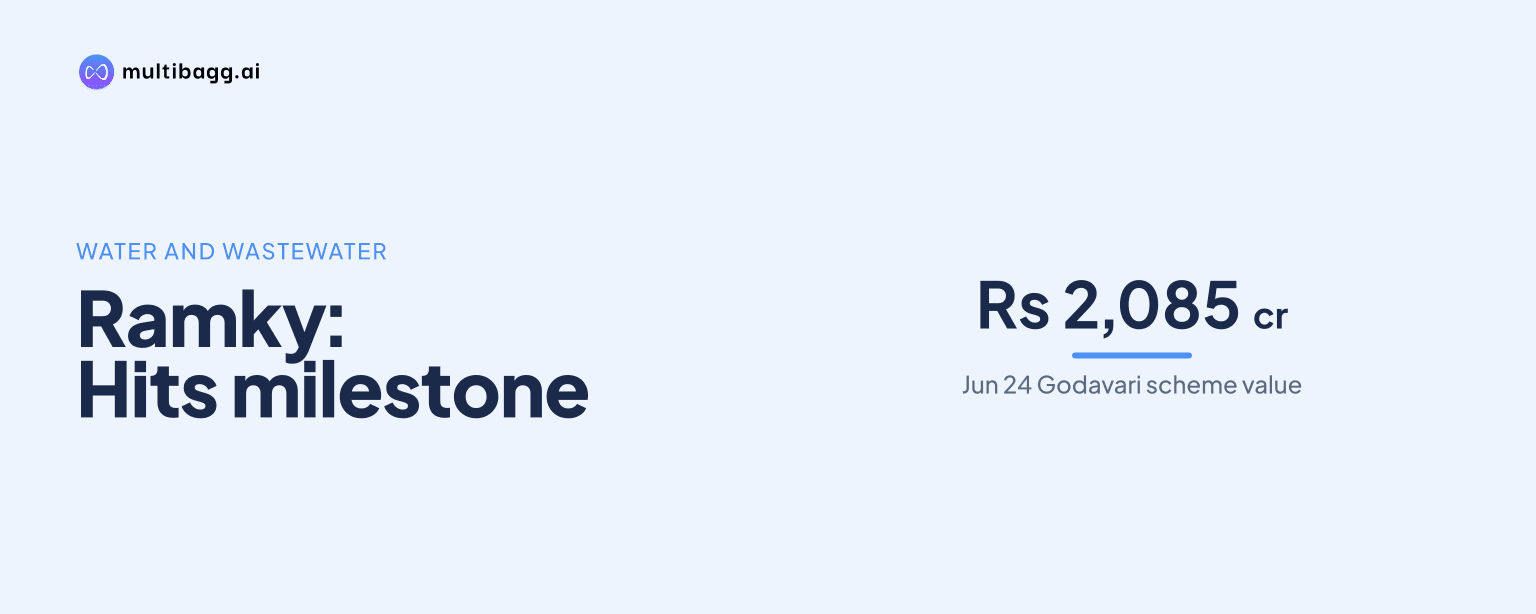
Ramky Infrastructure Limited had achieved the first milestone on its ₹2,085 crore Godavari Drinking Water Supply Scheme after its 24 June 2026 appointed date, while its ₹75 crore, 3 MLD desalination project for V.O. Chidambaranar Port had achieved the second milestone. The projects carry 10-year and five-year operation commitments, respectively.
Know Ramky Infrastructure inside out
Results, valuation, peers and who's buying, in one view.
What does Ramky’s Godavari water scheme include?
Ramky’s Godavari Drinking Water Supply Scheme is designed to bring Godavari water to Hyderabad’s Osmansagar and Himayatsagar reservoirs through pipelines, treatment plants, pumping systems and reservoirs. The ₹2,085 crore project is presented as strengthening Hyderabad’s water infrastructure and supporting Musi River rejuvenation.
The transmission scope includes a 65-kilometre raw-water main with a 2,200-millimetre diameter to Osmansagar and Himayatsagar, and a 42-kilometre clear-water main with a 2,400-millimetre diameter between Ghanpur and Muthangi. These two pipeline systems serve different stages of the water-transfer arrangement described by Ramky.
Ramky also lists two water treatment plants, or WTPs, with 120 million litres per day, or MLD, at Osmansagar and 70 MLD at Himayatsagar. The project further includes 102.5 ML of membrane bioreactor, or MBR, capacity at Ghanpur and Golden Mile, although the presentation does not assign separate costs or completion dates to these facilities.
How is Ramky’s Godavari scheme structured and progressing?
Ramky’s Godavari scheme uses a Hybrid Annuity Model, with a two-year construction period followed by 10 years of operation and maintenance, or O&M. Its appointed date was 24 June 2026, and Ramky recorded the first milestone as achieved in its Q2 FY27 presentation.
The presentation does not disclose the value or technical requirements of the first milestone, the construction start date, or the share of the ₹2,085 crore project executed. It also does not provide the annuity payment schedule, leaving progress reporting limited to the appointed date, the first-milestone status and the stated two-year construction period.
What is Ramky’s V.O. Chidambaranar Port desalination project?
Ramky’s joint venture is developing a 3 MLD seawater reverse osmosis, or SWRO, desalination plant for V.O. Chidambaranar Port under a ₹75 crore Design-Build-Operate contract. Ramky describes the facility as an integrated system covering seawater intake, treatment and water discharge, intended to provide the port with an independent water source.
The plant is designed to produce 3 MLD and includes a 450-millimetre seawater intake pipeline and a 250-millimetre water-discharge pipeline. The process shown by Ramky runs from seawater through treatment to fresh water for port use, rather than the reservoir-linked transmission and treatment arrangement in the Godavari project.
The desalination project’s appointed date was 07 February 2026, more than four months before the Godavari scheme’s 24 June 2026 appointment, and it had reached the second milestone. Ramky does not disclose the expected commissioning date, daily port water demand, joint-venture partner or requirements for the second milestone.
Got a follow-up? Ask IRIS
How do Ramky’s two water contracts differ?
Ramky’s two water contracts differ in value, delivery model and operating term: the Godavari project is worth ₹2,085 crore and has 10 years of O&M, while the port desalination plant is worth ₹75 crore and has five years of O&M. The Godavari project is therefore ₹2,010 crore larger than the desalination contract.
The Godavari scheme combines 107 kilometres of named transmission pipelines, two WTPs with 190 MLD of stated capacity and 102.5 ML of MBR capacity. By comparison, the port contract centres on 3 MLD of SWRO output, a 450-millimetre intake line and a 250-millimetre discharge line, making its disclosed scope narrower and based on seawater treatment.
Both projects include post-construction operating responsibilities, but Ramky does not disclose project financing, revenue recognition, equity commitments or cash-flow terms for either contract. The source also does not identify the procuring authority for the ₹2,085 crore Godavari scheme.
How do these projects fit Ramky’s water order book and plans?
Ramky reported an unexecuted order book of ₹12,000 crore at 30 September 2026, with Water & Wastewater accounting for ₹2,500 crore, or 21%. Industrial Solutions was the largest segment at ₹7,500 crore, or 62%, while Urban Infrastructure accounted for ₹2,000 crore, or 17%.
The ₹2,085 crore Godavari project is close in value to the ₹2,500 crore Water & Wastewater segment, whereas the ₹75 crore desalination project is substantially smaller. Ramky does not reconcile either contract to the ₹2,500 crore segment figure, so the presentation does not establish how much of the water order book these projects represent.
Across the ₹12,000 crore order book, Investor-Operator work represented 65% and engineering, procurement and construction, or EPC, represented 35%; Ramky described the total as 4.6 times FY26 revenue excluding O&M. Management’s plans include desalination plants, tertiary water treatment and 24x7 water supply, as well as recurring revenue through annuity and O&M arrangements.
Conclusion
Ramky has reported early execution milestones on two water projects with distinct roles: the ₹2,085 crore Godavari scheme combines bulk-water transmission, treatment and a 10-year O&M term, while the ₹75 crore port plant provides 3 MLD of desalinated water under a five-year O&M term. Their first- and second-milestone statuses show progress beyond their respective appointments in February and June 2026.
The next disclosed items to watch are milestone updates, Godavari construction progress against its two-year schedule, and operating progress at the 3 MLD plant. Management also plans to pursue desalination, tertiary treatment and 24x7 water supply, while focusing on receivable realisation and cash-flow discounting on committed receivables.