










Ramky Infrastructure Q2 revenue reaches five-year high, PAT up 36%
Key highlights
- Ramky Infrastructure reported Rs 605 crore consolidated Q2 FY27 revenue, up 28% year on year.
- Consolidated Q2 FY27 PAT rose 36% year on year to Rs 103 crore, with a reported 17% margin.
- Standalone Q2 FY27 revenue was Rs 539 crore, the highest level reported in the last six quarters.
- The consolidated order book stood at Rs 12,000 crore as of 30 September 2026.
powered by IRIS
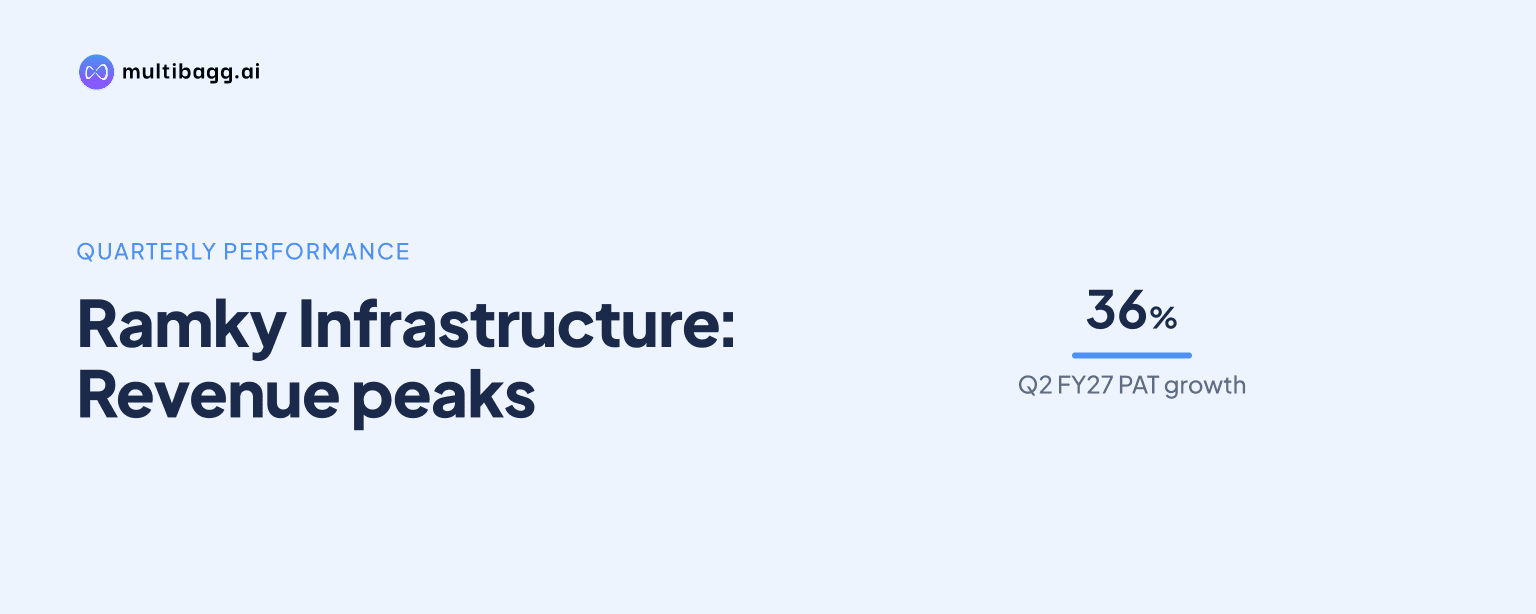
Ramky Infrastructure Limited reported Rs 605 crore of consolidated revenue from operations in Q2 FY27, its highest quarter-wise performance in five years according to the presentation, while earnings before interest, taxes, depreciation and amortisation (EBITDA) rose 28% to Rs 179 crore and profit after tax (PAT) rose 36% to Rs 103 crore.
Know Ramky Infrastructure inside out
Results, valuation, peers and who's buying, in one view.
Why did Ramky Infrastructure reach a five-year quarterly high?
Ramky Infrastructure reached its stated five-year quarterly high as consolidated revenue from operations rose 28% year on year to Rs 605 crore in Q2 FY27. The presentation describes the period as a “600 Cr quarter-wise performance” and the highest ever in the last five years, alongside a 30% EBITDA margin and a 17% PAT margin.
The earnings increase extended beyond revenue. EBITDA increased 28% year on year to Rs 179 crore, matching the revenue growth rate, while PAT rose faster at 36% to Rs 103 crore. Management also stated that PAT doubled from Q1 FY27, although the supplied presentation does not disclose the Q1 FY27 PAT figure needed to calculate the sequential change in rupees.
The presentation reports two nearby quarterly revenue totals without explaining the difference. Its consolidated headline shows Rs 605 crore of revenue from operations, while the segment table totals Rs 604 crore for Q2 FY27. Revenue by type, comprising Rs 355 crore of engineering, procurement and construction (EPC) revenue and Rs 250 crore from investor-operator activity, adds to Rs 605 crore.
How did Ramky Infrastructure's consolidated and standalone results compare?
Ramky Infrastructure's consolidated Q2 FY27 revenue, EBITDA and PAT were each above the standalone figures, and consolidated growth was faster for EBITDA and PAT. Consolidated revenue was Rs 66 crore above standalone revenue, EBITDA was Rs 56 crore higher and PAT was Rs 27 crore higher in the quarter.
Consolidated EBITDA margin was 30%, compared with 23% on a standalone basis, a reported-margin difference of 7 percentage points. Consolidated PAT margin was 17%, compared with 14% standalone, a difference of 3 percentage points. The presentation does not identify specific subsidiaries, projects or accounting items behind the margin gap.
Standalone revenue of Rs 539 crore was described as the highest level clocked in the last six quarters, despite its 21% year-on-year growth being below the 28% consolidated rate. Ramky Infrastructure also said standalone PAT had normalised after a couple of quarters without exceptional gains, but did not disclose the amount of such gains in the earlier periods.
Got a follow-up? Ask IRIS
Which businesses produced Ramky Infrastructure's Q2 revenue?
Ramky Infrastructure's Q2 FY27 consolidated revenue was distributed across three closely sized operating segments, with Industrial Solutions the largest at Rs 217 crore. Industrial Solutions and Urban Infrastructure each represented 34% of the Rs 604 crore segment total, while Water & Wastewater represented 32%.
For H1 FY27, Industrial Solutions remained the largest segment at Rs 368 crore, followed by Urban Infrastructure at Rs 362 crore and Water & Wastewater at Rs 346 crore. The three-segment total was Rs 1,075 crore, but the presentation does not provide H1 FY26 segment figures for a year-on-year comparison by vertical.
EPC accounted for Rs 355 crore, or 59%, of Q2 FY27 revenue by type, while investor-operator revenue was Rs 250 crore, or 41%. EPC revenue was therefore Rs 105 crore above investor-operator revenue during the quarter, even as investor-operator activity represented more than two-fifths of the reported revenue mix.
What execution progress and plan did Ramky Infrastructure disclose?
Ramky Infrastructure reported a consolidated order book of Rs 12,000 crore as of 30 September 2026, compared with a standalone order book of Rs 8,500 crore. The Q2 FY27 update also cited the first billing milestone for a water transmission project and consistent annuity income from a stabilised road asset, without disclosing the billing or annuity amounts.
At the standalone level, the company said EPC work at Maharashtra Integrated Township Limited was in full swing in Industrial Solutions. It said work at Godavari Drinking Water Supply and VOC Port had picked up momentum in Water & Wastewater, while building work remained consistent in Urban Infrastructure and operations and maintenance continued to contribute steady revenue.
Management's stated plan is to bid selectively for investor-operator projects with sustainable cash flows and niche work in industrial parks, water and wastewater, and urban infrastructure. The plan includes in-house execution, lifecycle operations and maintenance, and monetisation of mature assets and claims; management did not provide an FY27 revenue, margin, capital-expenditure or order-intake target.
Conclusion
The Q2 FY27 figures show that Ramky Infrastructure's three main segments were broadly balanced, with contributions ranging from Rs 192 crore to Rs 217 crore, while consolidated margins exceeded standalone margins by 7 percentage points for EBITDA and 3 percentage points for PAT. The reported Rs 250 crore investor-operator contribution also shows the current scale of the model management is prioritising.
The next disclosed markers are execution of the Rs 12,000 crore consolidated order book, progress after the first water-transmission billing milestone and continued annuity income from the stabilised road asset. Management's selective investor-operator plan provides the stated direction, but the presentation does not set numerical FY27 targets or a timetable for order-book conversion.