










DiGiSPICE agent-loan losses remained below 2.5% to date
Key highlights
- DiGiSPICE said risk on closed Adhikari loan portfolios was below 2.5% of disbursements to date.
- Adhikari-loan disbursements were running at nearly Rs 28 crore a quarter, pointing to nearly Rs 110 crore in FY27 versus Rs 65 crore in FY26.
- DiGiSPICE disbursed Rs 223.5 crore of Grahak loans in the latest quarter, up 33% quarter on quarter and 40% year on year.
- DiGiSPICE had onboarded 17.25 lakh agents, including more than 14.4 lakh in Tier 4, Tier 5 and Tier 6 towns.
powered by IRIS
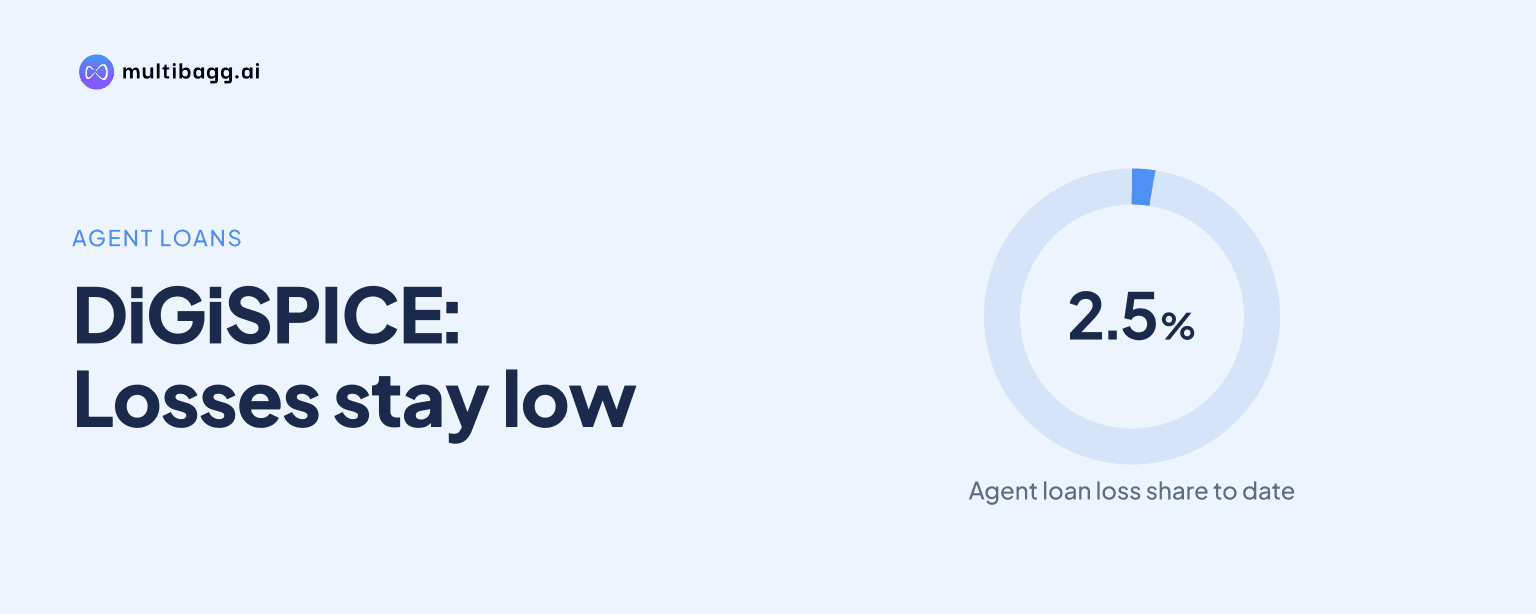
In Q2 FY27, DiGiSPICE said risk on its closed Adhikari agent-loan portfolios was below 2.5% of disbursements to date, against the 5% maximum first-loss default guarantee exposure management cited, while Adhikari-loan disbursements were running at nearly Rs 28 crore a quarter and pointed to nearly Rs 110 crore for FY27.
Know DigiSpice Technologies inside out
Results, valuation, peers and who's buying, in one view.
Has DiGiSPICE’s agent-loan business reached break-even?
An analyst said DiGiSPICE’s credit business had reached break-even during the Q2 FY27 call, and management responded by identifying credit as its major growth engine rather than disputing that characterisation. DiGiSPICE said it provides Adhikari loans to agents using real-time transaction data generated on its platform. It does not currently lend from its own balance sheet, instead operating mainly as a loan service provider with lending partners.
DiGiSPICE said it retains risk on Adhikari loans through a first-loss default guarantee, or FLDG, arrangement linked to its underwriting model. Management said the maximum FLDG risk permitted under the regulations it cited was 5% of total disbursements. On portfolios that had closed, it reported risk below 2.5% of cumulative disbursements to date, while continuing to test loan sizes, tenures and customer cohorts.
The distinction between break-even and portfolio performance matters because the call did not provide a separate credit-business profit-and-loss statement. The evidence disclosed was an analyst’s break-even observation, the sub-2.5% risk outcome and an asset-light operating structure. DiGiSPICE said it seeks to grow approval rates and customer take-up while keeping portfolio quality stable and maintaining tight risk controls.
How fast is DiGiSPICE growing Adhikari loans?
DiGiSPICE said Adhikari-loan disbursements were running at nearly Rs 28 crore per quarter in Q2 FY27, a pace it said could produce nearly Rs 110 crore of disbursements for FY27. That would be close to twice the Rs 65 crore disbursed in FY26. Management presented that expansion as a current-run-rate indication rather than formal financial guidance.
The planned expansion depends on increasing activity from the existing distribution network. DiGiSPICE had onboarded 17.25 lakh agents, of which more than 14.4 lakh operated in Tier 4, Tier 5 and Tier 6 towns with populations below 20,000. Management said a higher number of transactions per agent, together with broader product adoption, should provide more data to support loan underwriting.
DiGiSPICE also said agent subscription packs were part of that engagement strategy. It sold close to 1.36 lakh packs in the quarter, while management said 58,000 agents enrolled in subscription plans accounted for 48% of gross transaction value, or GTV, versus 42% in the previous year. The call did not reconcile the pack-sales figure with the enrolled-agent figure, but management linked broader usage to recurring revenue and platform stickiness.
Why did DiGiSPICE’s Adhikari loan value flatten in Q2?
DiGiSPICE said lower average ticket sizes explained why total Adhikari-loan value was broadly flat even as the number of loans increased. An analyst cited disbursements of about Rs 29 crore in Q2 versus about Rs 31 crore in Q1. Management said it had widened the top of the funnel by offering smaller-ticket loans to additional and relatively higher-risk customer segments to test its underwriting model.
Management described the usual Adhikari-loan ticket as about Rs 50,000, below Rs 1 lakh. It said the company is testing different ticket sizes and tenures across customer cohorts rather than applying one fixed product structure. This testing is intended to establish whether the underwriting model can retain a similar loss outcome as the addressable borrower pool broadens.
DiGiSPICE’s repeat-loan plan is based on observing an agent over time. Management said agents that remain on the platform, conduct more transactions and use more products can receive a first, second and third loan. It said repeat lending could improve lifetime value relative to customer-acquisition cost, though it did not disclose a target for either measure or a repeat-loan rate.
Got a follow-up? Ask IRIS
How will DiGiSPICE expand credit beyond its agents?
DiGiSPICE said it aims to expand Vyapaari, or merchant, loans after adding a couple of lenders in Q2 FY27 and refining the product journey. The company launched the segment in the middle of the previous year. Management said it was working with lending partners on sourcing and underwriting and expected merchant-lending growth to pick up in Q4.
The merchant opportunity extends beyond DiGiSPICE’s agent base, according to management. It referred to a potential market of about 10 million Vyapaaris outside its million-plus agents, seeking formal unsecured and secured credit. Management said it is looking to use artificial intelligence to collect and process data for more qualified leads, but provided no target for merchant-loan disbursements.
DiGiSPICE also targets a micro loan-against-property, or micro LAP, launch by the end of Q3 or the start of Q4. The timing remains a management target, not a completed product launch. In the separate Grahak consumer-loan category, the company disbursed Rs 223.5 crore in the latest quarter, up 33% quarter on quarter and 40% year on year, after introducing personal loans with multiple lenders.
The wider financial-product distribution model includes current account and savings account, or CASA, sales. DiGiSPICE said it had sold close to 18.9 lakh accounts to date and generated recurring float income of close to Rs 50 lakh per quarter from them. Management said savings and investment products are the next planned additions to increase cross-selling through the agent network.
What supports DiGiSPICE’s broader credit distribution model?
DiGiSPICE’s stated mechanism is to combine on-ground distribution with data from payments and account activity. Management said agents can evolve from cash-withdrawal points into micro-branch-like outlets that open savings and current accounts, distribute loans and help customers use financial products. The network had 17.25 lakh onboarded agents at the time of the Q2 FY27 call.
The company is also building adjacent payment products that can increase agent activity. UPI Cashpoint, launched in March of FY26, reached Rs 908 crore of GTV in Q2 FY27, up 3.3 times from the prior quarter, according to management. DiGiSPICE said its third-party Aadhaar Enabled Payment System, or AEPS, cash-deposit product was expected to go live formally by the end of Q3 or the start of Q4.
Management described the new cash-deposit product as a way for a sender to authenticate with Aadhaar and deposit cash into a recipient’s bank account, initially using Aadhaar details and later potentially a mobile number. That mechanism is intended to address sender know-your-customer requirements in domestic money transfer. DiGiSPICE did not provide a revenue or disbursement forecast for the product.
Conclusion
DiGiSPICE’s disclosed credit model combines lender-funded loans, agent distribution and transaction-data underwriting, with FLDG risk retained on Adhikari loans. The reported below-2.5% risk on closed portfolios was below the 5% maximum exposure management cited, while the nearly Rs 110 crore FY27 Adhikari-loan run rate would be close to double FY26 disbursements of Rs 65 crore. The break-even point was raised by an analyst, while management’s comments focused on scaling the business and testing its underwriting.
The next disclosed milestones are a targeted Q4 pickup in Vyapaari lending and the planned micro LAP launch by the end of Q3 or start of Q4. Investors can also watch whether portfolio risk remains below 2.5% as DiGiSPICE tests smaller tickets and newer cohorts, and whether the formal launch of third-party AEPS cash deposits adds transaction activity to the 17.25 lakh-agent network.