










Digitide receivables rise to Rs 695 crore, DSO reaches 84 days
Key highlights
- Digitide's trade receivables and unbilled revenue rose Rs 36 crore to Rs 695 crore at 30 September 2026.
- Digitide disclosed 84 days of DSO at 30 September 2026, including 53 billed days and 31 unbilled days.
- Net cash from operating activities increased to Rs 51 crore in H1 FY27 from Rs 40 crore a year earlier.
- Balance-sheet cash and cash equivalents declined Rs 73 crore to Rs 125 crore between 31 March and 30 September 2026.
powered by IRIS
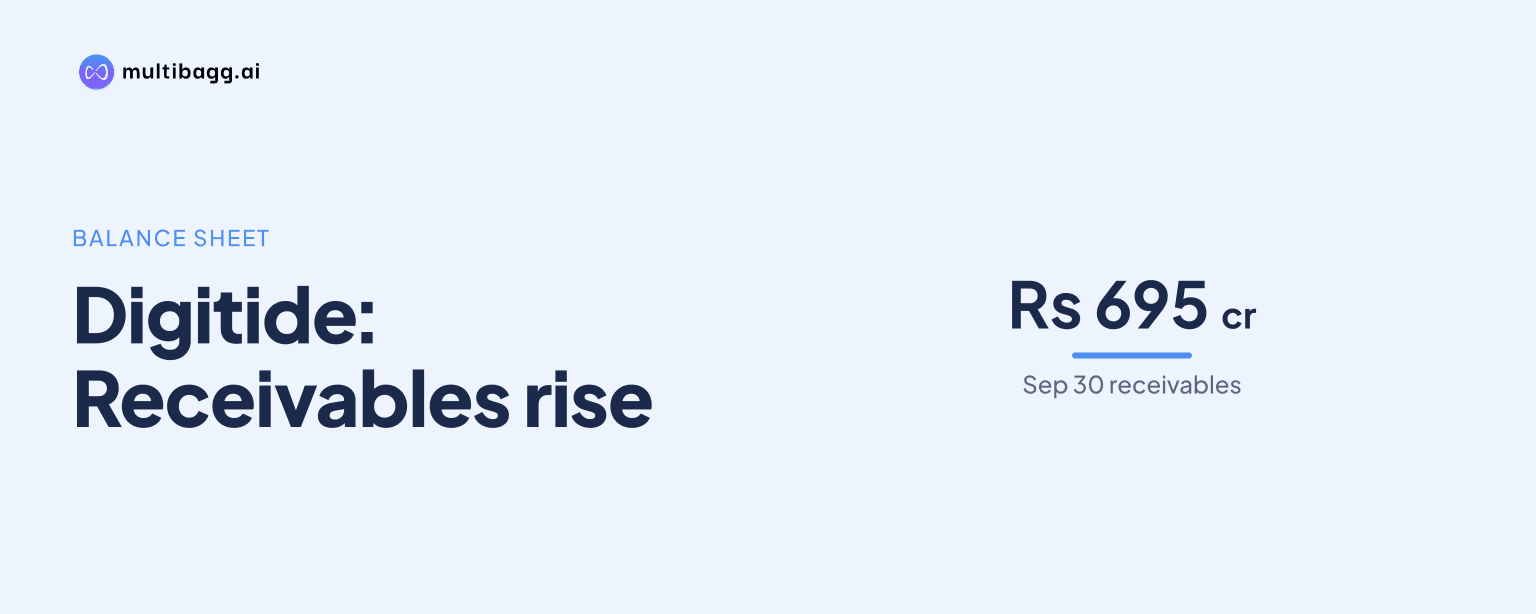
Digitide reported Rs 695 crore of trade receivables and unbilled revenue at 30 September 2026, up Rs 36 crore from 31 March 2026, while days sales outstanding (DSO) stood at 84 days. The increase coincided with a Rs 73 crore decline in balance-sheet cash and cash equivalents to Rs 125 crore, despite Rs 51 crore of operating cash flow in H1 FY27.
Know Digitide Solutions inside out
Results, valuation, peers and who's buying, in one view.
Why did Digitide's receivables increase?
Digitide's trade receivables and unbilled revenue increased to Rs 695 crore on 30 September 2026 from Rs 659 crore on 31 March 2026. The presentation does not attribute the Rs 36 crore increase between billed receivables, unbilled work, revenue growth, customer collections or particular accounts. It reports DSO of 84 days at 30 September 2026, comprising 53 billed days and 31 unbilled days.
Revenue from operations rose 2.3% year on year to Rs 1,535 crore in H1 FY27 from Rs 1,500 crore in H1 FY26. However, Q2 FY27 revenue was Rs 760 crore, down 2.0% from Rs 775 crore in Q1 FY27 and 0.6% below Rs 764 crore in Q2 FY26. The Rs 36 crore balance-sheet increase in receivables and unbilled revenue therefore occurred during a half year in which revenue increased Rs 35 crore year on year.
DSO measures the days represented by sales awaiting billing or collection. Digitide's 31 unbilled days accounted for part of the 84-day total, alongside 53 billed days. The presentation provides no DSO figure for 31 March 2026 or 30 September 2025, so it does not show whether the 84-day measure has increased or decreased over time.
How did working capital affect Digitide's operating cash flow?
Changes in operating assets and liabilities used Rs 125 crore of cash in the six months to 30 September 2026, compared with a Rs 101 crore use in the six months to 30 September 2025. This Rs 24 crore larger use reduced cash generated from operations to Rs 50 crore from Rs 67 crore, despite non-cash expenses and income rising to Rs 164 crore from Rs 155 crore.
Net cash flow from operating activities nevertheless rose to Rs 51 crore in the six months to 30 September 2026 from Rs 40 crore a year earlier. Income taxes paid were shown as a Rs 1 crore inflow in the 2026 period, compared with a Rs 27 crore outflow in the 2025 period. Profit after tax declined to Rs 12 crore from Rs 13 crore, indicating that the reported improvement in operating cash flow did not arise from higher profit after tax.
The cash-flow statement does not identify the portion of its Rs 125 crore operating-assets-and-liabilities movement attributable specifically to receivables. Between 31 March and 30 September 2026, other current assets declined by Rs 32 crore to Rs 109 crore, while other current liabilities declined by Rs 51 crore to Rs 467 crore. Those movements occurred alongside the Rs 36 crore rise in trade receivables and unbilled revenue.
Got a follow-up? Ask IRIS
Why did Digitide's cash balance decline?
Digitide's balance-sheet cash and cash equivalents fell to Rs 125 crore at 30 September 2026 from Rs 198 crore at 31 March 2026. Total current assets declined by Rs 68 crore to Rs 929 crore, while total assets decreased by Rs 82 crore to Rs 1,954 crore. The Rs 73 crore decline in balance-sheet cash was larger than the Rs 36 crore increase in trade receivables and unbilled revenue.
The cash-flow statement recorded a Rs 73 crore net decrease in cash during the six months to 30 September 2026, compared with a Rs 107 crore decrease in the corresponding 2025 period. It reported cash and cash equivalents at the end of the period of Rs 121 crore, while the balance sheet reported Rs 125 crore at 30 September 2026. The presentation reports both figures without explaining the Rs 4 crore difference.
Investing activities used Rs 21 crore in the 2026 half year, compared with Rs 39 crore used a year earlier, even as net capital expenditure rose to Rs 54 crore from Rs 44 crore. Bank deposits and mutual funds contributed Rs 38 crore in the 2026 period versus Rs 9 crore in the earlier period. Financing activities used Rs 103 crore, including Rs 85 crore of lease-related payments, compared with Rs 108 crore used in the prior-year period.
Digitide disclosed net cash of Rs 76 crore and debt to equity of 0.08:1 at 30 September 2026. Its definition of net cash includes cash and cash equivalents, other bank balances and liquid investments in mutual funds, less total borrowings. Current borrowings increased to Rs 71 crore from Rs 33 crore, while non-current borrowings fell to Rs 4 crore from Rs 41 crore, leaving total borrowings at Rs 75 crore versus Rs 74 crore.
Which revenue mix changes coincide with Digitide's receivables position?
Digitide's Q2 FY27 revenue mix included a larger contribution from Tech & Digital (T&D) and international revenue than in Q2 FY26. T&D represented 32.1% of Q2 FY27 revenue, up from 29.9%, while business process management (BPM) declined to 67.9% from 70.1%. International revenue increased to 42.5% from 37.2%, while domestic revenue declined to 57.5% from 62.8%.
The presentation does not link the 84-day DSO or Rs 695 crore receivables and unbilled balance to the shift in service or geographic mix. It does show that the top 10 clients accounted for 38.2% of Q2 FY27 revenue, compared with 34.1% in Q2 FY26. Banking, financial services and insurance (BFSI) remained the largest industry category at 51.7% of Q2 FY27 revenue, up from 51.2% a year earlier.
Conclusion
Digitide's first-half disclosures show higher operating cash flow alongside a larger working-capital use. Net cash from operations rose by Rs 11 crore year on year to Rs 51 crore, but changes in operating assets and liabilities consumed Rs 125 crore, receivables and unbilled revenue rose by Rs 36 crore, and DSO was 84 days at 30 September 2026.
The unresolved collection measure is whether the 53 billed DSO days and 31 unbilled DSO days convert into cash in later disclosures. Digitide provided no earlier DSO comparator, receivables target or collection target, while H1 FY27 included Rs 54 crore of net capital expenditure and Rs 85 crore of lease-related payments that also affected cash movement.