










DOMS Industries Limited revenue up 18.4%, EBITDA margin at 12.4%
Key highlights
- DOMS H1 FY27 revenue from operations rose 18.4% year on year to Rs 1,338.3 crore.
- DOMS H1 FY27 EBITDA fell 16.6% to Rs 165.3 crore and margin declined to 12.4% from 17.5%.
- DOMS recorded a Rs 10.4 crore exceptional expense from Q2 FY27 flooding damage.
- India represented 87.3% of DOMS H1 FY27 gross product sales, up from 85.8% a year earlier.
powered by IRIS
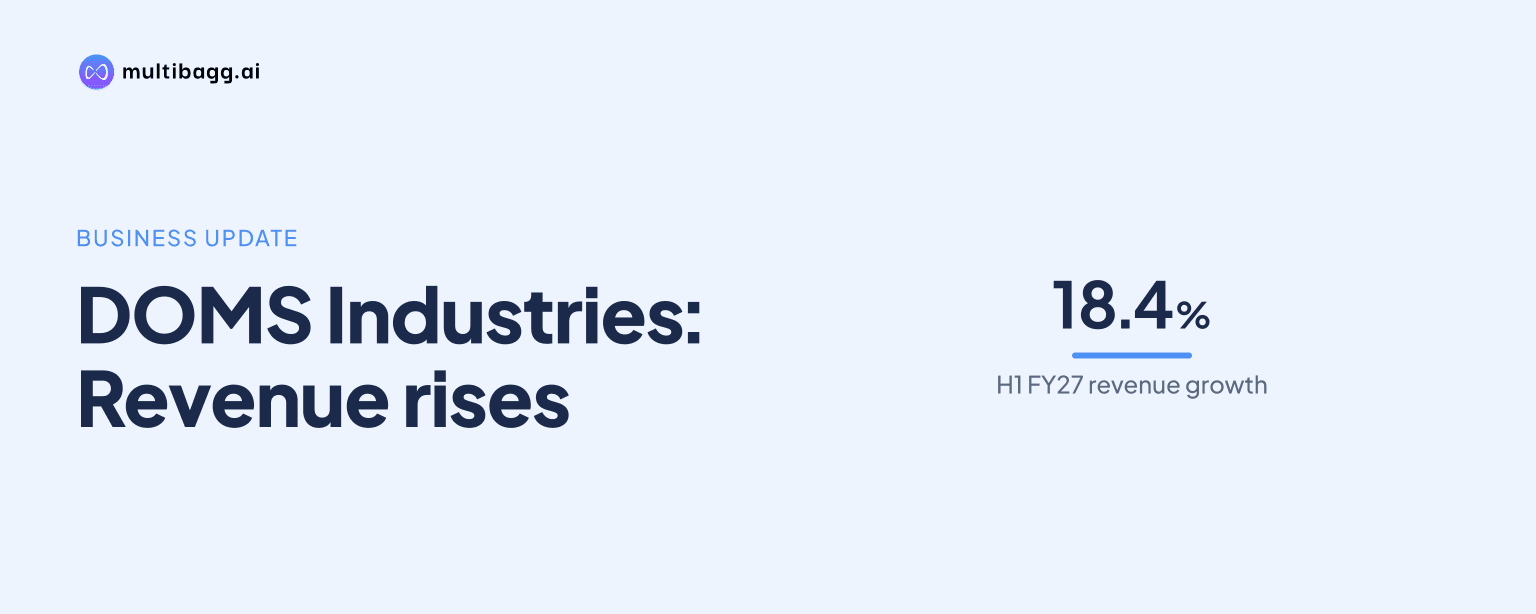
DOMS reported revenue from operations of Rs 1,338.3 crore in H1 FY27, up 18.4% year on year, while earnings before interest, tax, depreciation and amortisation (EBITDA) fell 16.6% to Rs 165.3 crore and the EBITDA margin declined to 12.4% from 17.5%. Higher raw-material costs, Reynolds production start-up overheads and flooding-related losses affected profitability.
Know Doms Industries inside out
Results, valuation, peers and who's buying, in one view.
Why did DOMS’s H1 FY27 EBITDA margin fall?
DOMS’s H1 FY27 EBITDA margin fell by 5.1 percentage points because costs rose faster than gross profit despite higher revenue. Revenue increased by Rs 208.1 crore from Rs 1,130.2 crore in H1 FY26, but gross profit rose by Rs 31.1 crore to Rs 516.7 crore. Consequently, gross profit margin declined to 38.6% from 43.0%, while EBITDA declined by Rs 33.0 crore to Rs 165.3 crore.
Consumption expenses were Rs 821.5 crore in H1 FY27, equal to 61.4% of operating revenue, compared with Rs 644.6 crore in H1 FY26. Employee-benefit expense rose to Rs 195.3 crore from Rs 158.0 crore, and other expenses rose to Rs 156.1 crore from Rs 129.4 crore. Together, these movements left EBITDA at 12.4% of revenue, compared with 17.3% for full-year FY26 and 17.5% in H1 FY26.
What cost factors affected DOMS’s second-quarter profitability?
DOMS attributed the Q2 FY27 pressure to raw-material volatility and higher manpower costs related to Reynolds production. Management said consumption margins improved sequentially as raw-material prices eased in the earlier part of the quarter, before rising significantly in its second half. Q2 consumption expense was Rs 406.8 crore, or 60.9% of operating revenue, compared with Rs 414.7 crore, or 61.9%, in Q1 FY27.
Management said the benefit from the sequential consumption-margin improvement was offset by under-absorption of fixed overheads in the Reynolds team because production commencement faced a transitory impact. Q2 employee-benefit expense was Rs 101.0 crore, up from Rs 81.6 crore a year earlier and Rs 94.3 crore in Q1 FY27. EBITDA was therefore Rs 82.8 crore, marginally above Rs 82.6 crore in Q1 FY27, but its 12.4% margin remained 5.1 percentage points below Q2 FY26.
The quarter’s gross profit margin was 39.1%, up from 38.2% in Q1 FY27 but below 43.8% in Q2 FY26. That sequential improvement did not translate into a comparable EBITDA-margin gain because employee expenses represented 15.1% of Q2 operating revenue and other expenses represented 11.6%. DOMS reported Q2 revenue of Rs 667.8 crore, 17.6% above Rs 567.9 crore a year earlier.
How did flooding affect DOMS’s sales and profit after tax?
Flooding reduced DOMS’s Q2 FY27 sales growth by an estimated 300 to 350 basis points, according to management, and generated a one-time exceptional expense of Rs 10.4 crore. The company attributed the damage to exceptionally heavy rainfall and flooding. It said relevant insurance claims have been lodged and that associated recovery is expected to substantially offset the profit-and-loss impact in due course.
The exceptional expense widened the decline in quarterly profit after tax (PAT), which was Rs 38.3 crore in Q2 FY27 versus Rs 60.9 crore in Q2 FY26. Profit before exceptional expense and tax was Rs 61.4 crore, down 25.0% from Rs 81.8 crore, while reported profit before tax was Rs 51.0 crore, down 37.7%. Q2 PAT margin fell to 5.7% from 10.7% a year earlier.
For H1 FY27, PAT was Rs 83.6 crore, down 30.3% from Rs 120.0 crore, and the PAT margin was 6.2% versus 10.6%. The Rs 10.4 crore exceptional expense was recorded in Q2 and therefore also affected the first-half result. Even before that item, H1 profit before exceptional expense and tax was Rs 122.5 crore, 24.0% below the Rs 161.2 crore reported a year earlier.
Got a follow-up? Ask IRIS
Where did DOMS’s revenue growth come from in H1 FY27?
DOMS said higher sales volumes in both domestic and export markets, capacity additions and new product launches supported H1 FY27 revenue growth of 18.4%. Management also cited calibrated pricing actions intended to partially offset raw-material inflation. Gross product sales increased to Rs 1,383.4 crore in H1 FY27 from Rs 1,175.4 crore in H1 FY26, an increase of Rs 208.0 crore.
India accounted for 87.3% of H1 FY27 gross product sales, up from 85.8% in H1 FY26, while exports represented 12.7%, down from 14.2%. In Q2 FY27, India contributed 86.6% of gross product sales of Rs 690.2 crore, compared with 86.1% of Rs 593.7 crore a year earlier. The geographic mix therefore shifted further toward India even as management described growth in both markets.
Product mix also changed in selected categories. Scholastic Stationery was 31% of H1 FY27 sales, down from 33%, while Office Supplies increased to 17% from 15% and Scholastic Art Material rose to 21% from 20%. The DOMS brand represented 82.2% of H1 gross product sales, versus 79.4% a year earlier; Wowper represented 7.5%, up from 6.3%.
What do DOMS’s sequential results show?
DOMS maintained EBITDA margin at 12.4% in Q2 FY27 versus 12.3% in Q1 FY27, indicating that second-quarter revenue growth of Rs 667.8 crore did not further reduce the first-quarter margin. Q2 gross profit margin increased 0.9 percentage points sequentially to 39.1%, while Q2 operating revenue was slightly below Q1 FY27 revenue of Rs 670.5 crore.
Profit after tax moved in the opposite sequential direction because Q2 included the Rs 10.4 crore exceptional flooding expense. Q2 PAT was Rs 38.3 crore, compared with Rs 45.3 crore in Q1 FY27, and Q2 PAT margin was 5.7% against 6.8%. Depreciation and amortisation was Rs 24.1 crore in Q2, compared with Rs 23.4 crore in Q1, while finance costs were unchanged at Rs 2.0 crore.
Conclusion
DOMS combined double-digit first-half revenue growth with a material reduction in profitability: revenue increased 18.4%, but gross profit increased 6.4%, EBITDA declined 16.6% and PAT declined 30.3%. The figures show that volume growth, capacity additions and pricing actions did not fully offset higher consumption costs, Reynolds-related fixed-cost absorption and the Q2 flooding expense.
The next disclosed matters to watch are the timing and value of the insurance recovery expected to substantially offset the Rs 10.4 crore flooding-related expense, and the resolution of the transitory production-commencement effect on Reynolds fixed-overhead absorption. Management also identified raw-material movements, which eased early in Q2 FY27 before increasing significantly in the latter half, as a continuing factor in consumption margins.