










Dr. Agarwal’s: chains may reach 19% share by FY30P
Key highlights
- Organised eye-care chains are projected to hold 16% to 19% of India’s market by FY30P, up from 14% to 16% in FY26E.
- The organised eye-care market is projected to grow from about Rs 7,030 crore in FY26E to about Rs 13,800 crore in FY30P.
- Surgical treatments represent an estimated 82% to 87% of Indian eye-care market value in FY26E.
- Dr. Agarwal’s had 199 surgical facilities and Rs 1,711 crore of revenue as on March 31, 2025.
powered by IRIS
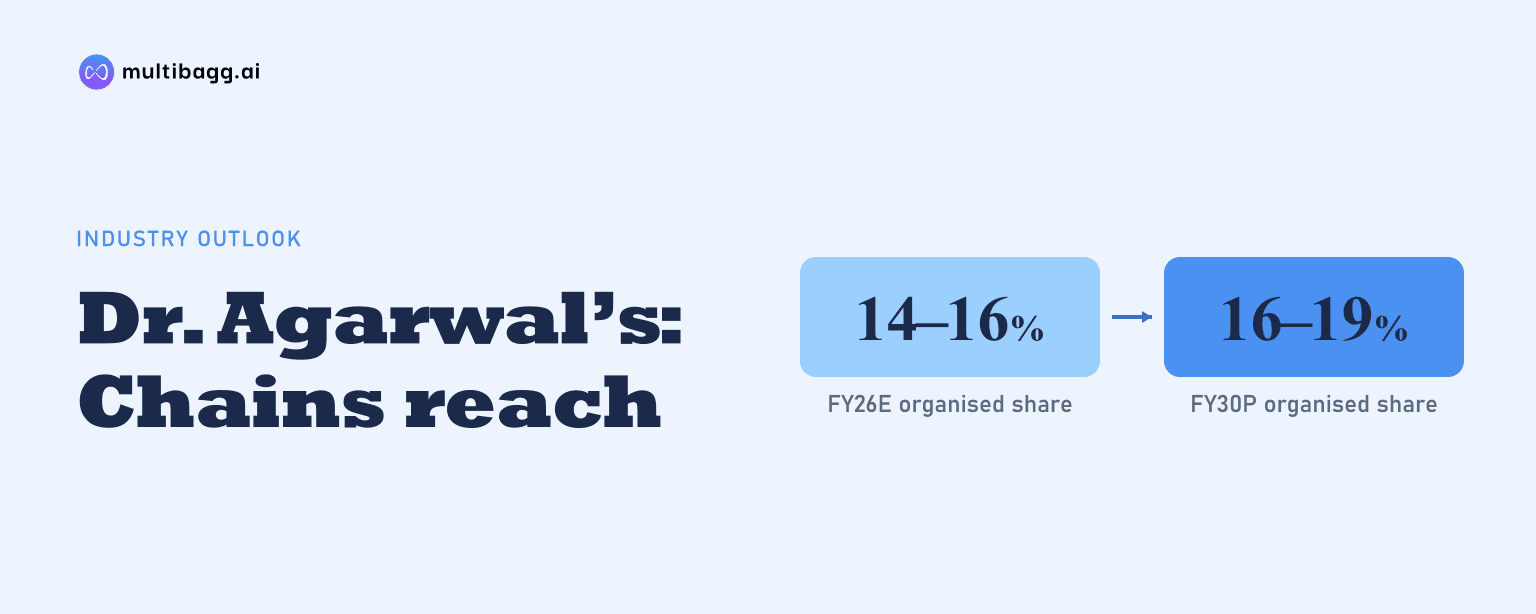
Dr. Agarwal’s Health Care Ltd. presents an outlook in which organised eye-care service chains could account for 16% to 19% of India’s eye-care market by FY30P, up from 14% to 16% in FY26E, while the organised segment is projected to reach Rs 13,800 crore.
Know Dr Agarwals Health Care inside out
Results, valuation, peers and who's buying, in one view.
How fast is India’s eye-care market expected to grow?
India’s eye-care services market is projected to grow at a 12% to 14% compound annual growth rate, or CAGR, from FY26E to FY30P, ahead of the 10% to 12% CAGR projected for the wider healthcare delivery market over the same period. Crisil Intelligence, cited in the presentation, estimates the eye-care market at about Rs 48,500 crore in FY26E, equivalent to 7% of India’s healthcare delivery market of about Rs 7.7 lakh crore.
The presentation places eye care at the fastest-growing single-specialty category over FY20 to FY25, with a 14% growth rate. Dental care grew by 10% to 12%, mother and child healthcare by 6% to 8%, oncology by 9% to 11%, and orthopedics by 10% to 12% over that period. For FY25 to FY30P, eye care and oncology are both forecast to grow at 12% to 14%, compared with 9% to 11% for dental care and 11% to 13% for orthopedics.
India’s private and trust-led healthcare delivery market represented 68% of the estimated FY26E total, while government healthcare represented 32%. Within private and trust-led healthcare, the presentation estimates the single-specialty share at 35% to 45%, against 55% to 65% for multi-specialty healthcare, positioning eye care within a sizeable but narrower delivery segment.
How much of eye care could organised chains control by FY30?
Organised eye-care service chains could control 16% to 19% of the market by FY30P, but standalone centres and hospitals are still projected to account for 81% to 84%. That would mark a shift from FY26E, when chains are estimated at 14% to 16% and standalone providers at 84% to 86%, according to the Crisil Intelligence estimates shown by Dr. Agarwal’s.
The organised eye-care market is projected to rise from about Rs 7,030 crore in FY26E to about Rs 13,800 crore in FY30P. The presentation associates that period with an 18.4% CAGR, following growth from about Rs 2,200 crore in FY20 to the FY26E estimate at a displayed 21.3% CAGR. The slower projected rate still exceeds the 12% to 14% market-wide eye-care growth range, reflecting a forecast of further chain penetration.
Dr. Agarwal’s market share within the organised segment is shown at about 19% in FY20 and 26% to 27% in FY26E. The FY30P cell for the company’s market share is blank, so the presentation does not provide a forecast of its own share even as it sets out a sector-level penetration range for chains.
Got a follow-up? Ask IRIS
Which treatments account for India’s eye-care spending?
Surgical treatments are estimated to account for 82% to 87% of the value of India’s eye-care market in FY26E, leaving 13% to 18% for non-surgical treatments. Cataract is the largest surgical sub-category at 38% to 41% of market value, followed by retina at 24% to 27%, meaning these two categories together represent 62% to 68% of the market by value.
The remaining FY26E treatment mix includes refractive procedures at 7% to 9%, cornea at 6% to 8%, glaucoma at 5% to 7%, and other treatments at 13% to 16%. The presentation says Dr. Agarwal’s has 199 surgical facilities and covers the full range of surgical sub-specialties, linking its facility network to a market where surgery represents the majority of spending.
The sector also has workforce and operating constraints, according to the presentation. India has about 1.5 ophthalmologists against a requirement of about 8.7 eye-care professionals for every 100,000 people as of FY25. Dr. Agarwal’s identifies institutional training, standard operating procedures, brand trust and technology upgrades as entry barriers; named technology areas include cataract surgery, small incision lenticule extraction, laser-assisted in situ keratomileusis and corneal transplant.
What scale does Dr. Agarwal’s have relative to other eye-care chains?
Dr. Agarwal’s was the largest eye-care services provider in India by revenue among the peers presented, with Rs 1,711 crore as on March 31, 2025, versus Rs 1,113 crore for the next-largest peer. The presentation therefore describes its revenue as about 1.5 times that competitor’s size; the third-largest peer listed had Rs 573 crore of revenue.
The group also had 199 surgical facilities, compared with 168 for the next-largest listed peer and 83 for another peer. The peer comparison does not include 200 vision centres operated by Peer #2 under a public-private partnership model, while all facilities are counted for the other peers. This qualification matters when comparing the 199-facility network with the table’s peer counts.
Dr. Agarwal’s total facility count increased from 288 in FY26 to 324 in H1 FY27, with Indian facilities rising from 269 to 305 and international facilities unchanged at 19. Over the same comparison, its doctor count rose from 968 to 1,111. H1 FY27 surgeries totalled 186,923, including 137,170 cataract surgeries, while patients served reached 1,843,809.
Conclusion
The presentation indicates that organised chains may gain share in an eye-care market still predominantly served by standalone centres and hospitals. By FY30P, chains are projected to reach 16% to 19% penetration and an organised market size of Rs 13,800 crore, while surgical treatments are estimated to comprise 82% to 87% of India’s eye-care market value in FY26E.
The next measure to watch is whether the organised segment progresses from Rs 7,030 crore in FY26E toward the projected Rs 13,800 crore in FY30P, alongside a decline in standalone providers’ share toward 81% to 84%. Dr. Agarwal’s does not disclose a FY30P company market-share target, leaving its future position within the projected sector expansion unresolved.