










DSM Fresh Foods reports Rs 27.71 crore operating cash outflow
Key highlights
- DSM Fresh Foods reported a Rs 27.71 crore operating cash outflow for the half year ended September 30, 2026.
- Short-term loans and advances absorbed Rs 41.4832 crore of cash during the September 2026 half year.
- DSM Fresh Foods spent Rs 31.5966 crore on fixed assets in the half year ended September 30, 2026.
- Financing activities generated Rs 41.8445 crore, including Rs 21.6713 crore of long-term borrowing proceeds.
powered by IRIS
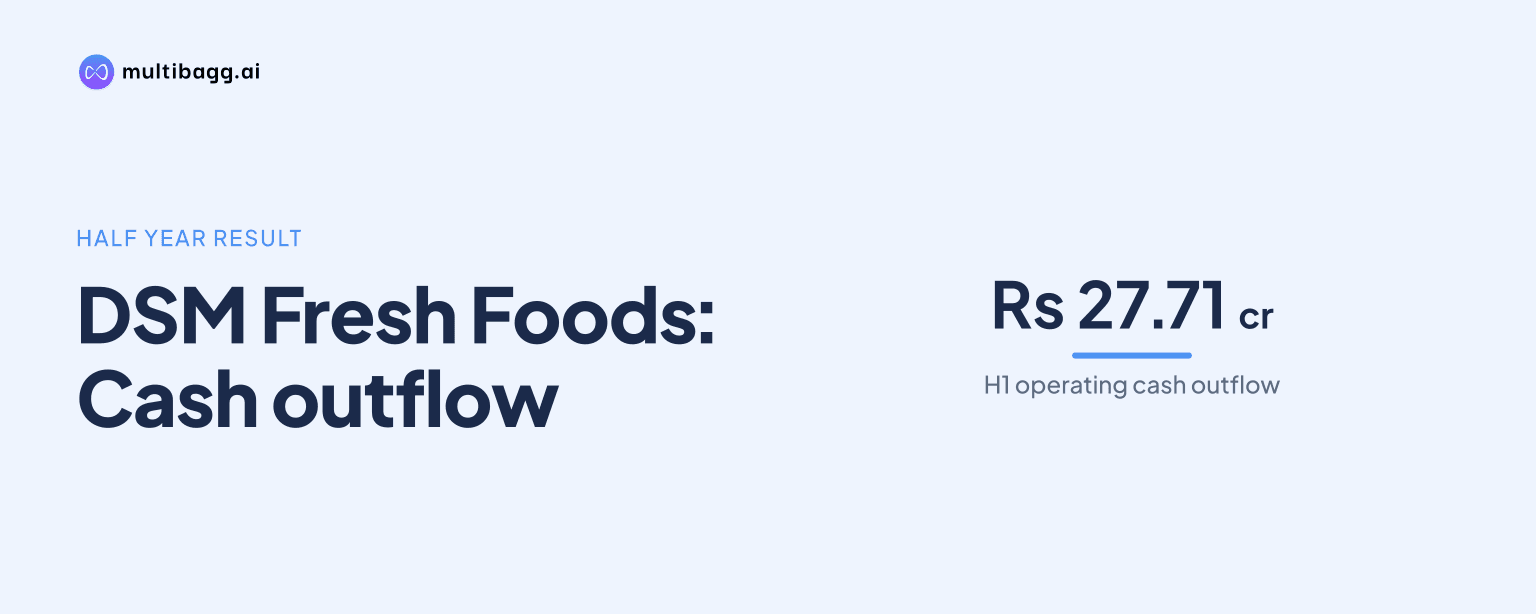
DSM Fresh Foods Limited reported a Rs 27.71 crore consolidated operating cash outflow for the half year ended September 30, 2026, despite profit after tax of Rs 7.3026 crore. A Rs 41.4832 crore increase in short-term loans and advances, alongside Rs 21.2405 crore absorbed by trade receivables, outweighed operating profit before working-capital changes of Rs 17.5808 crore.
Know DSM Fresh Foods inside out
Results, valuation, peers and who's buying, in one view.
Why did DSM Fresh Foods report an operating cash outflow?
DSM Fresh Foods reported the Rs 27.71 crore operating cash outflow because changes in operating assets exceeded the cash produced before working-capital movements in the half year ended September 30, 2026. Profit before tax was Rs 10.2126 crore, while depreciation and amortisation of Rs 2.9391 crore and finance cost of Rs 4.4751 crore were added back. After deducting interest income of Rs 40.44 lakh, operating profit before working-capital changes was Rs 17.5808 crore.
Short-term loans and advances were the largest recorded working-capital cash use, rising by Rs 41.4832 crore during the period. Trade receivables absorbed Rs 21.2405 crore, long-term loans and advances absorbed Rs 16.0385 crore, inventories absorbed Rs 2.6377 crore, and other current assets absorbed Rs 1.6722 crore. These movements took place despite the company reporting Rs 7.3026 crore of consolidated profit after tax.
The outflows from operating assets were partly offset by increases in operating liabilities. Other current liabilities provided Rs 22.8635 crore of cash, trade payables provided Rs 10.1824 crore, and short-term provisions provided Rs 2.9798 crore. Net cash used in operations before direct taxes was Rs 24.6614 crore, and the final operating cash outflow was Rs 27.71 crore after direct taxes paid, including advance taxes.
How did DSM Fresh Foods' cash flow compare with the prior year?
DSM Fresh Foods' Rs 27.71 crore operating cash outflow for the half year ended September 30, 2026 was lower than the Rs 47.8413 crore outflow in the year ended March 31, 2026. The periods are not directly comparable because the latest result covers six months and the earlier figure covers a full audited year, but both periods recorded negative operating cash flow after taxes.
Trade receivables absorbed Rs 21.2405 crore in the latest half year, compared with Rs 38.7533 crore in the year ended March 31, 2026. In contrast, short-term loans and advances absorbed Rs 41.4832 crore in the latest period, above Rs 33.3351 crore in the prior full year. Other current liabilities generated Rs 22.8635 crore of cash in the latest half year, compared with Rs 2.1519 crore in the prior year.
DSM Fresh Foods' investing outflow was Rs 18.441 crore in the half year ended September 30, 2026, against Rs 22.426 crore in the prior full year. The latest period included Rs 31.5966 crore spent on fixed assets, partly offset by a positive Rs 13.1116 crore investment line item and Rs 4.40 lakh of interest received. The cash-flow statement therefore shows funding requirements from both operations and investment activity.
Got a follow-up? Ask IRIS
What changed in DSM Fresh Foods' asset balances?
DSM Fresh Foods' property, plant and equipment balance rose to Rs 36.2166 crore at September 30, 2026 from Rs 7.9182 crore at March 31, 2026, following fixed-asset purchases of Rs 31.5966 crore in the half year. Intangible assets also increased to Rs 1.8218 crore from Rs 1.4627 crore over the same dates.
Long-term loans and advances stood at Rs 18.1319 crore at September 30, compared with Rs 2.0931 crore at March 31, matching the Rs 16.0385 crore cash absorption recorded in the cash-flow statement. Trade receivables increased to Rs 76.8696 crore from Rs 55.6291 crore, while inventories rose to Rs 11.171 crore from Rs 8.5333 crore. These balance-sheet changes align with the working-capital outflows reported during the half year.
Cash and cash equivalents declined to Rs 4.9188 crore at September 30, 2026 from Rs 9.2253 crore at March 31, a decrease of Rs 4.3065 crore. Current investments fell to Rs 5.9636 crore from Rs 19.1064 crore. The company generated financing cash of Rs 41.8445 crore, but that did not fully offset the combined Rs 46.151 crore operating and investing cash outflows.
How did DSM Fresh Foods fund its cash requirements and use IPO proceeds?
DSM Fresh Foods funded its cash requirements mainly through borrowings, with financing activities generating Rs 41.8445 crore in the half year ended September 30, 2026. The cash-flow statement records Rs 21.6713 crore of proceeds from long-term borrowings and Rs 24.6463 crore from short-term borrowings, before finance cost of Rs 4.4751 crore.
Long-term borrowings increased to Rs 30.8045 crore at September 30, 2026 from Rs 9.1332 crore at March 31, 2026. Short-term borrowings were Rs 79.9846 crore at September 30, 2026. In the previous full year, financing cash flow of Rs 78.5547 crore included Rs 52.6671 crore of proceeds from equity shares or preference shares; the latest half-year statement reports no equity-issue proceeds.
DSM Fresh Foods received gross initial public offering proceeds of Rs 59.064 crore on October 7, 2025 and had utilised Rs 58.2505 crore by September 30, 2026. The unutilised balance was Rs 81.35 lakh. Working-capital utilisation was Rs 24.8326 crore, marketing expenditure utilisation was Rs 14.9831 crore, capital-expenditure utilisation was Rs 10.1756 crore, and issue expenses were Rs 6.1377 crore.
Conclusion
DSM Fresh Foods' September 2026 half-year figures show that consolidated profit of Rs 7.3026 crore did not convert into operating cash generation. The Rs 27.71 crore operating cash outflow reflected increases in short-term loans and advances, trade receivables and long-term loans and advances, while fixed-asset purchases of Rs 31.5966 crore added to cash needs.
The next point to watch is the deployment of the remaining Rs 81.35 lakh of IPO proceeds disclosed at September 30, 2026, including Rs 50.19 lakh remaining from the capital-expenditure allocation. Changes in receivables of Rs 76.8696 crore, long-term loans and advances of Rs 18.1319 crore, and borrowings of Rs 110.7891 crore will also determine how the cash-flow position develops after the reported half year.