










DSM Fresh Foods H1 FY27 Revenue Rises 60%, Profit Grows 26%
Key highlights
- DSM Fresh Foods' H1 FY27 standalone revenue rose 60.2% year-on-year to ₹153.6 crore from ₹95.9 crore.
- Standalone net profit increased 25.7% to ₹8.8 crore, while profit before tax was nearly flat at ₹11.8 crore.
- Operating margin declined to 7.7% from 12.2%, and operating cash flow was negative ₹31.8 crore.
- Short-term borrowings rose to ₹79.98 crore, while ₹58.25 crore of ₹59.06 crore in IPO proceeds was utilised.
powered by IRIS
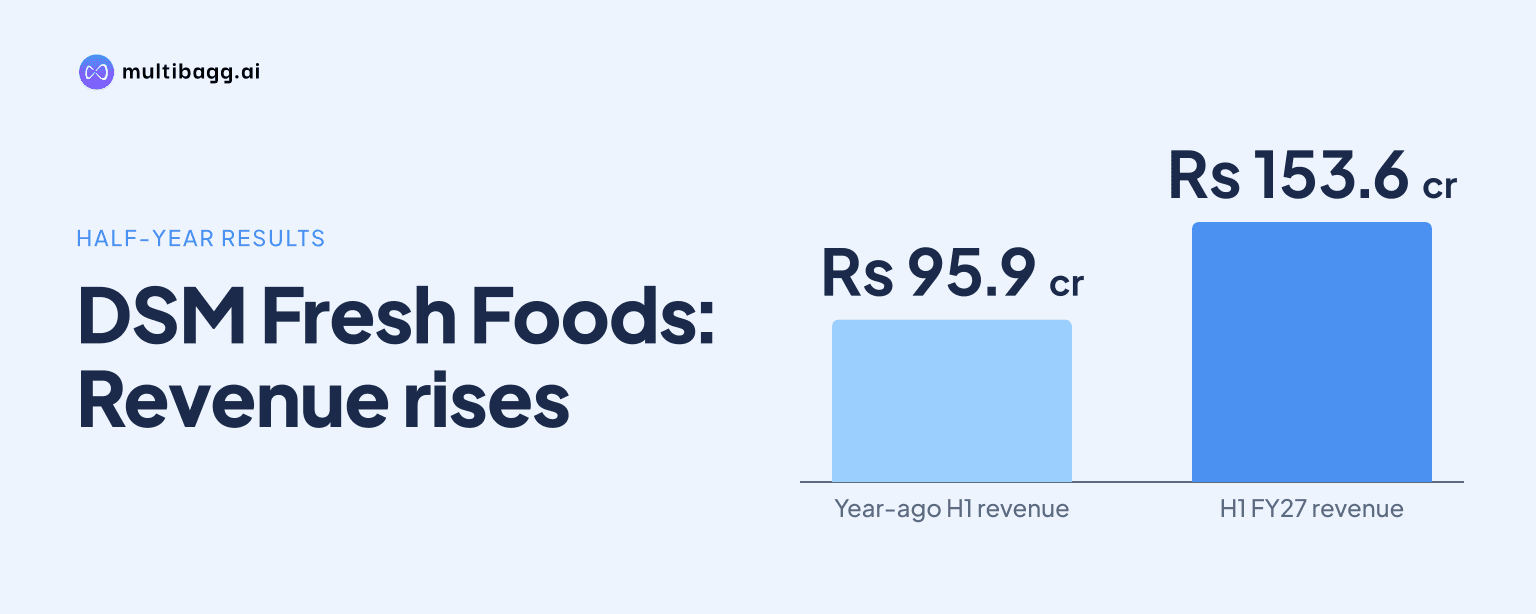
DSM Fresh Foods Ltd reported H1 FY27 standalone revenue of ₹153.6 crore, a 60.2% year-on-year increase, while net profit rose 25.7% to ₹8.8 crore for the half year ended September 30, 2026. The result shows strong sales growth, although profit expansion lagged revenue and operating margins narrowed.
Know DSM Fresh Foods inside out
Results, valuation, peers and who's buying, in one view.
What did DSM Fresh Foods report for H1 FY27?
DSM Fresh Foods reported standalone revenue from operations of ₹153.6 crore for H1 FY27, compared with ₹95.9 crore in H1 FY26. Total income reached ₹154.0 crore, including other income of ₹0.4 crore. The board approved the unaudited standalone and consolidated results on November 14, 2026.
Standalone profit before tax was ₹11.8 crore, almost unchanged from ₹11.7 crore a year earlier. Net profit increased to ₹8.8 crore from ₹7.0 crore. The company also reported consolidated revenue from operations of ₹165.5 crore and consolidated net profit of ₹7.3 crore, with earnings per share of ₹3.28.
Why did profit growth trail DSM Fresh Foods revenue growth?
DSM Fresh Foods' standalone revenue grew faster than profit because operating margin declined to 7.7% in H1 FY27 from 12.2% in H1 FY26. Profit before tax rose by only ₹0.1 crore year-on-year, even as revenue increased by ₹57.7 crore. This divergence is the central financial feature of the half-year result.
The company did not provide a detailed cost break-up in the supplied results summary. However, the reported margin movement establishes that a smaller portion of revenue translated into operating profit than in the prior-year period. Other income was ₹0.4 crore in H1 FY27, compared with ₹0.3 crore in H1 FY26, and was not large enough to materially alter the overall earnings picture.
Compared with H2 FY26, revenue was higher by ₹28.6 crore and net profit rose by ₹1.5 crore. But operating margin was also below the 9.1% reported in the immediately preceding half year. For investors, the results therefore combine substantial sales growth with lower profitability at the operating level.
What do borrowing and cash-flow figures show?
DSM Fresh Foods ended the period with short-term borrowings of ₹79.98 crore, up from ₹55.34 crore, while operating cash flow was negative ₹31.8 crore. The ₹24.64 crore increase in short-term borrowings is relevant because the company recorded revenue growth alongside a negative operating cash-flow position.
The supplied disclosure does not state the specific reasons for the cash outflow or the increase in borrowings. It nevertheless indicates that cash generation from operations did not match the reported accounting profit during the half year. Investors assessing the results may consequently focus on working-capital trends, short-term funding requirements and any management commentary provided during the scheduled earnings call.
The company operates under the Zappfresh brand and is described as a technology-enabled farm-to-fork fresh food business. In FY26, it disclosed initiatives including acquisition-led expansion in ready-to-eat foods, the launch of the Meevaa Foods brand, seafood sourcing partnerships and local meat-shop partnerships. These initiatives provide operating context, but the H1 FY27 filing does not quantify their individual contribution to revenue or profit.
Got a follow-up? Ask IRIS
How has DSM Fresh Foods used its IPO proceeds?
DSM Fresh Foods disclosed that it had utilised ₹58.25 crore, or 98.6%, of IPO proceeds of ₹59.06 crore as of the reporting date. The unutilised balance was ₹0.81 crore. The board approved the related IPO fund deviation statement along with the H1 FY27 results.
The company also said that the auditor's limited review opinion on the unaudited financial statements was unmodified. An unmodified review conclusion means the auditor did not report a modification to its conclusion based on the limited-review procedures performed. It does not change the underlying financial trends of margin compression, higher borrowings and negative operating cash flow.
The board meeting had initially been scheduled for November 13, 2026 and was moved to November 14, 2026. DSM Fresh Foods has also scheduled an earnings conference call for November 16, 2026 at 3:00 PM IST to discuss financial and operational performance for the half year.
What does the H1 FY27 result mean for investors?
DSM Fresh Foods' H1 FY27 result shows that demand translated into a 60.2% increase in standalone revenue, but the benefit to profit was more limited. Net profit increased 25.7%, while profit before tax was broadly flat and operating margin fell by 4.5 percentage points from the prior-year half. The difference between sales growth and profit growth is important for evaluating operating efficiency.
The balance-sheet and cash-flow data add another area for review. Short-term borrowings rose to ₹79.98 crore and operating cash flow was negative ₹31.8 crore. These figures do not establish the cause of the outflow, but they make cash conversion and funding needs relevant alongside reported revenue and profit.
Conclusion
DSM Fresh Foods delivered a sharp increase in H1 FY27 standalone revenue to ₹153.6 crore, while net profit rose to ₹8.8 crore. Yet the financial result also reflected a lower operating margin, nearly unchanged profit before tax, higher short-term borrowings and negative operating cash flow. The unmodified limited-review conclusion and near-complete IPO fund utilisation provide additional disclosure context.
The next scheduled event is DSM Fresh Foods' November 16, 2026 earnings call. Investors will look for management's discussion of the margin decline, the negative operating cash flow, short-term borrowings and the operational contribution of its expansion initiatives.