










eClerx says AI pilots make FY27 ACV goal harder to meet
Key highlights
- eClerx reported H1 FY27 deal wins of Rs 670.32 crore, down from Rs 726.18 crore in H1 FY26.
- Q2 FY27 new deal wins were Rs 288.61 crore, compared with Rs 381.71 crore in Q1 FY27.
- Analytics and automation revenue grew 27% year-on-year and had an annual run rate of about Rs 1,014.79 crore.
- Q2 FY27 utilisation fell to 74.9% from 75.5% in Q1 as eClerx added capacity ahead of shifted work.
powered by IRIS
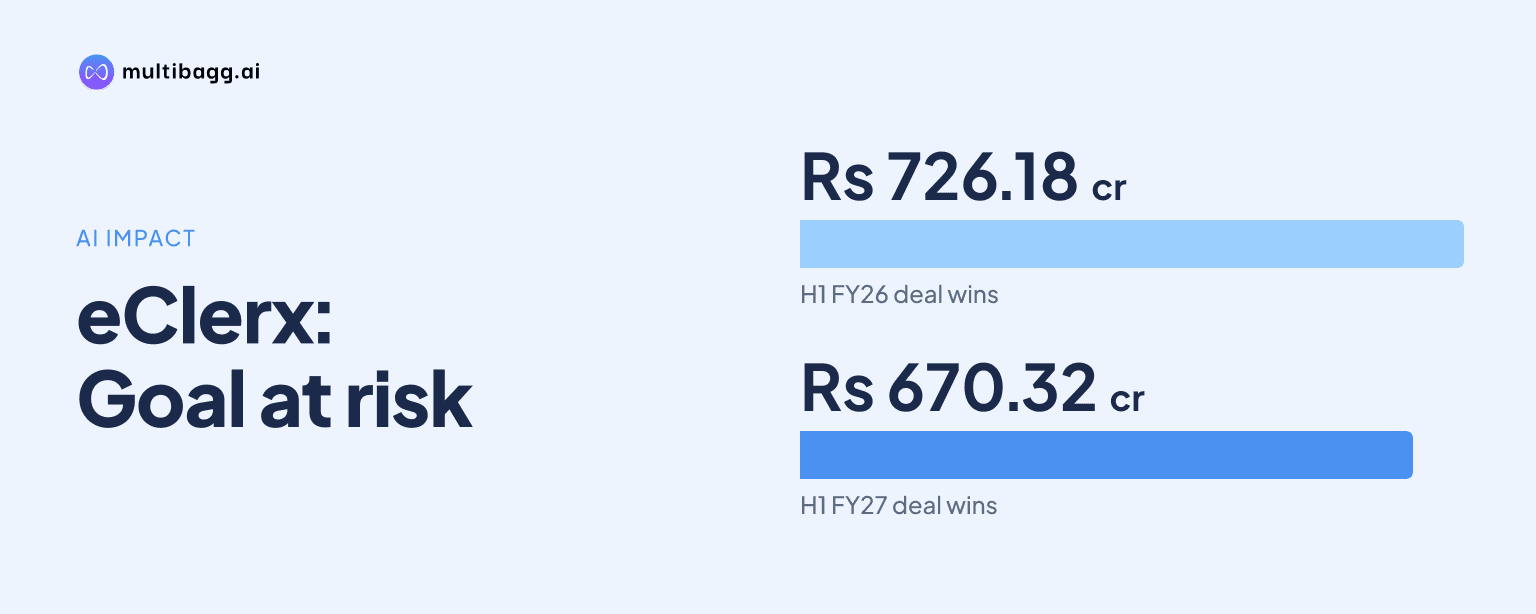
eClerx Services Limited said matching its FY26 annual contract value, or ACV, in FY27 will be difficult after first-half deal wins fell to Rs 670.32 crore from Rs 726.18 crore a year earlier, using the Q2 implied exchange rate of Rs 93.1 per US dollar. Management said clients are taking longer to decide and starting AI work through smaller pilots.
Know eClerx Services inside out
Results, valuation, peers and who's buying, in one view.
Why is eClerx’s FY27 ACV goal harder to meet?
eClerx’s FY27 ACV goal is harder to meet because H1 deal wins were about 8% below H1 FY26, while Q2 wins also declined from Q1. New deal wins were Rs 288.61 crore in Q2 FY27, compared with Rs 381.71 crore in Q1 FY27, taking H1 FY27 wins to Rs 670.32 crore against Rs 726.18 crore a year earlier. Management said it is still pursuing the FY26 result but accepted that the task will be difficult.
Management attributed the shortfall to a greater-than-expected right shift in client decisions rather than a material change in contract terms. An analyst estimated that eClerx would need about Rs 456.19 crore to Rs 465.50 crore of ACV in each of Q3 and Q4 merely to equal the prior year’s full-year level, based on the Q2 exchange rate. Management did not confirm that quarterly requirement, but said the pipeline remains healthy and conversions are taking longer.
How are AI pilots changing eClerx deal commitments?
eClerx said clients are committing smaller initial amounts because they are testing AI use cases before expanding into larger programmes. Management said customers are spending on AI tools, tokens, experimentation and deployment, while seeking evidence that the technology works in their specific operations. The company said contracts themselves are not materially different from earlier agreements.
The smaller initial deal is therefore a pilot or proof of concept, rather than management’s assertion that AI has permanently reduced the ultimate scope of outsourced work. eClerx said a successful pilot can lead to a subsequent programme, but gave no conversion rate or timetable. This sequencing can defer both ACV signing and revenue ramp-up even where the client relationship and service opportunity remain active.
Management also linked client caution to data readiness and the risks of incorrect implementation, especially in regulated sectors. It said a failed earlier automation project might have delivered less efficiency than expected, whereas an AI error can create a larger operational downside. Management said enterprise-wide returns on AI spending are still being established, although some smaller deployments have produced substantial productivity gains.
What is eClerx investing in to pursue AI demand?
eClerx is investing in AI and technology capability while analytics and automation grows faster than its overall business. Analytics and automation revenue increased 5% sequentially and 27% year-on-year in Q2 FY27, compared with 1.5% sequential operating-revenue growth company-wide. The business had an annual revenue run rate of about Rs 1,014.79 crore, using the Q2 implied exchange rate, and represented approximately 20% of revenue.
The company’s technology team had 2,300 people, and more than 280 employees had received Anthropic Claude AI certifications by the October 29, 2026 call. eClerx is expanding AI teams in continental Europe and the US, with an initial focus on placing engineers closer to clients. Management also said its former financial-services head now leads AI across the enterprise from the US.
Management identified Compliance Manager, Market360, QA360 and Fluiid4 as products being enhanced with generative AI. It also cited DocIntel and Loans Manager as tools supporting service delivery. However, eClerx does not separately report AI-enabled revenue, AI-related renewal values or AI-linked price reductions, and management said it would need to review the effect on top-10 client accounts.
Got a follow-up? Ask IRIS
Can other segments offset delayed AI decisions?
eClerx said emerging business, analytics and automation, Hi-tech and a seasonal fashion recovery could partly offset pressure in parts of banking, financial services and insurance, or BFSI. Emerging business rose to 12.6% of Q2 FY27 revenue from 11.7%, with finance and accounting as the principal service contributor. Communication, media and telecom revenue was broadly flat sequentially, while new voice programmes were ramping.
BFSI revenue grew about 3% sequentially in Q2 FY27 on short-term engagements, but eased US financial-crime-compliance regulation reduced refresh volumes at existing clients. eClerx has begun anti-money-laundering and know-your-customer work for a payments company and is pursuing adjacent services. Management moved its expected BFSI recovery from Q3 FY27 to Q4 FY27 and described that expectation as cautious optimism.
Hi-tech demand was supported by agentic AI and transformation services, according to management. Fashion, luxury and retail revenue was flat year-on-year, with Q2 affected by Italy’s August holiday period and weak demand in China and Europe; management expects a seasonal Q3 recovery. eClerx also reported 25 clients above Rs 27.93 crore of annual revenue each, up from 20 a year earlier.
What do delayed deals mean for capacity and margins?
eClerx added employees and delivery capacity ahead of anticipated work, causing utilisation to decline as deals shifted right. Total headcount rose 3.5% sequentially in Q2 FY27, including 724 offshore additions, while utilisation fell to 74.9% from 75.5% in Q1 FY27. Management said some hiring was made in advance of work that had not yet materialised.
India seat capacity increased by about 1,400 to 16,824 as Mohali and Chandigarh facilities became operational. Management expects another 800 to 1,000 seats over the next couple of quarters, including Mumbai and Pune facilities in Q3 and Q4 FY27. Capital expenditure was Rs 58.5 crore in Q2 FY27 and Rs 91.9 crore in H1 FY27, with H2 spending expected to be roughly similar to H1.
Operating earnings before interest, tax, depreciation and amortisation margin was 23.9% in Q2 FY27, up 90 basis points sequentially, with management attributing almost all of the improvement to foreign exchange. Management retained its FY27 margin range of 24% to 28%, while flagging a 20-basis-point effect from the revised provident-fund wage ceiling and about 20 basis points of additional depreciation and amortisation in H2.
Conclusion
eClerx is facing a slower deal-conversion environment rather than reporting an absence of client interest. The decline in H1 FY27 deal wins to Rs 670.32 crore reflects longer decisions and smaller initial AI pilots, while analytics and automation increased 27% year-on-year. Management’s approach is to maintain investment in AI capability, expand adjacent service areas and seek later expansions from pilot engagements.
The next indicators are Q3 and Q4 ACV closures, the expected seasonal recovery in fashion and luxury, and management’s cautiously optimistic expectation of a BFSI recovery in Q4 FY27. Investors can also watch whether planned additions of 800 to 1,000 seats are absorbed into revenue growth, and whether eClerx provides the unresolved quantification of AI-led renewal or pricing effects in large client accounts.